


Want to know who's next in line to join the tech billionaire club? Here's your guide:
Why This List Matters
- These founders are solving massive problems
- They're building the next generation of tech giants
- Many are focused on AI, fintech, and design tools
- Several have already hit unicorn status ($1B+ valuations)
Future Tech Billionaires
- Sam Altman - OpenAI (Estimated net worth: $1 billion)
- Yasser Elsaid - Chatbase
- Patrick Collison - Stripe
- John Collison - Stripe
- Evan Spiegel - Snap Inc.
- Bobby Murphy - Snap Inc.
- Dylan Field - Figma
- Vlad Tenev - Robinhood
- Baiju Bhatt - Robinhood
- Tobi Lütke - Shopify
- Daniel Ek - Spotify
- Ryan Breslow - Bolt
- Henrique Dubugras - Brex
- Pedro Franceschi - Brex
- Melanie Perkins - Canva
- Cliff Obrecht - Canva
- Cameron Winklevoss - Gemini
- Tyler Winklevoss - Gemini
- Alex Atallah - OpenSea
- Devin Finzer - OpenSea
- Alexis Ohanian - Reddit, Seven Seven Six
- Palmer Luckey - Oculus VR, Anduril Industries
- Emmett Shear - Twitch
- Drew Houston - Dropbox
- Stewart Butterfield - Slack
- Anne Wojcicki - 23andMe
- Katrina Lake - Stitch Fix
- Whitney Wolfe Herd - Bumble
- Tobias Lütke - Shopify
- Melanie Perkins - Canva
These individuals represent a diverse range of tech sectors, from artificial intelligence and fintech to social media and e-commerce.
While some, like Sam Altman, have already achieved billionaire status, others are well on their way to joining this exclusive club.
Lessons from Current and Future Tech Billionaires
Revenue First, Valuation Second
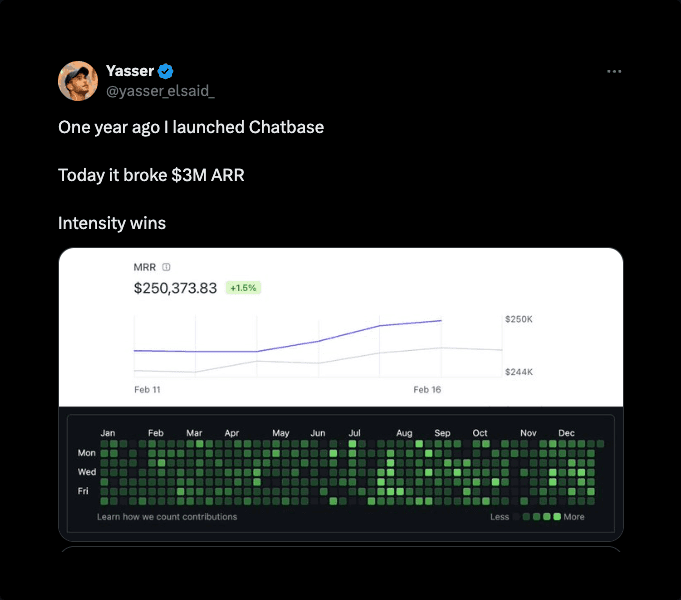
The next generation of tech billionaires isn't chasing vanity metrics.
Companies like Chatbase show what's possible with focus on revenue.
They reached $3 million ARR in just 1 year.
This proves lean teams can outperform heavily funded startups.
Focus on building products customers willingly pay for.
Aim for at least $1M ARR before significant fundraising.
AI Integration is Non-Negotiable
Every founder on this list is working directly with AI technology.
Some are building it.
Others are heavily integrating it.
Sam Altman's trajectory with OpenAI proves a key point: with the AI SEO market expected to reach $3.06 billion by 2033, artificial intelligence isn't just a feature.
It's the foundation of future tech empires.
Whether you're building:
- Developer tools
- Consumer apps
- Enterprise software
- AI Chatbots
AI should be core to your product strategy.
Not an afterthought.
Market Timing Determines Success
The difference between millions and billions often comes down to timing.
Look at the Collison brothers with Stripe:
- They launched when online payments were painful but possible.
- Not too early like failed 2000s payment startups.
- Not too late like countless Stripe competitors.
Today's key opportunities lie in:
- AI infrastructure (2024-2026) (Chatbase!)
- Climate tech (2025-2030)
- Biotech automation (2024-2027)
Growth Through Search Intent
Social media can drive initial traction. But sustainable growth comes from search traffic.
Companies need to invest in SEO early.
It's no coincidence that Canva, Figma, and Shopify rank for millions of keywords.
Working with specialized agencies can accelerate growth.
Consider partners like magicspace.agency for SaaS and AI companies.
Build for Acquisition or IPO from Day One
Most founders took one of two paths:
- Going public
- Positioning for strategic acquisition
This requires:
- Clean cap tables with professional investors
- Strong unit economics ($3K+ LTV for B2B SaaS)
- Clear market leadership in a growing category
- Audited financials from Series A onward
Conclusion
As we continue to "Google future tech billionaires," let's remember that the true measure of success in technology isn't just about amassing wealth, but about creating innovations that positively impact the world and shape our collective future.