
- Banks and the IRS enforce different rules: The IRS accepts a foreign address on Form 1040 and Form 8822. US banks and brokerages must collect a residential or business street address under FinCEN Customer Identification Program (CIP) rules (31 CFR § 1020.220), and Chase's deposit agreement lets it close accounts when you live outside the US.
- Most virtual mailboxes fail KYC checks: Anytime Mailbox, iPostal1, Traveling Mailbox, and The UPS Store register as USPS Commercial Mail Receiving Agencies (CMRAs). You must file notarized PS Form 1583 into the USPS CMRA Customer Registration Database, and USPS tags the address
DPVCMRA: Y. Capital One, Schwab, and other banks reject that flag in the Home/Legal address field. - State residency is separate from mail: Even South Dakota's full-time traveler driver's license (1-night hotel receipt plus a PMB) still carries a CMRA flag at banks, and South Dakota's updated SDCL § 12-1-4 sets a 30-day stay rule in a fixed dwelling for full state voter residency.
- Best residential solution: Cloud Residents gives you a real, non-CMRA US residential street address ($299/quarter) with optional residential lease documentation, no Form 1583 notary, AI mail summaries, and worldwide forwarding.
Keeping a US address while living abroad splits into two jobs: getting your paper envelopes scanned, and passing the residential street address check your bank runs against postal databases.
The IRS happily takes a foreign address on your 1040. Retail banks and brokerages like Chase, Capital One, and Fidelity do not: they want a physical US residential address, not a PO Box or a commercial mail drop. Miss that difference and a $10 virtual mailbox can get your accounts frozen during a routine KYC sweep.
Do you actually need a US address while living abroad?
For the IRS, no. For retail banks, credit cards, and most US brokerages, yes. Confusing federal tax rules with bank compliance is how expats file a clean tax return and still get a 30-day account closure notice from their bank.
1. US banks and credit cards (the PATRIOT Act mandate)
Try to open or keep a US bank account with a foreign address or a $10 UPS Store mailbox, and you hit the federal rule banks cannot waive: 31 CFR § 1020.220, written under USA PATRIOT Act Section 326. Before opening an account, a bank must collect your name, date of birth, identification number, and a residential or business street address (or an APO/FPO box or the street address of next of kin or another contact individual if you do not have one).
FinCEN's CIP FAQs even accept a rural-route mailbox because it points to a physical location, while flatly rejecting a post office box number because you cannot live inside a PO Box.
In practice, every US bank and brokerage splits your profile into two separate address fields, and mixing them up is how expats trigger compliance locks:
- Home / Legal (Residential CIP) address: Where you legally live. Banks verify this line against USPS and identity databases, block PO Boxes automatically, and reject CMRA virtual mailboxes the moment USPS data flags the building as a commercial mail drop.
- Mailing address: Where the bank sends paper statements, replacement debit or credit cards, and tax forms. Banks accept a PO Box or CMRA virtual mailbox in the mailing field only if a verified non-CMRA residential street address already sits in the Home/Legal field.
Major US financial institutions enforce those two fields differently in 2026:
- Chase: Chase's deposit account agreement gives the bank the right to close your account if you change your address to one outside the United States or if Chase determines you reside outside the United States.
- Capital One: Screens the Home/Physical address field directly against USPS CMRA flags (
DPVCMRA: Y). Paste a commercial virtual mailbox into your home address field and the form rejects it on the spot; it only works in the separate mailing field. - State Department Federal Credit Union (SDFCU): Built specifically for Americans living overseas. Eligible members (including anyone who joins an affiliated association like the American Consumer Council) can open and keep checking accounts with a non-US residential address, receive multi-factor authentication codes on WhatsApp without a US phone number, and send international transfers through a built-in Wise integration.
- Wise: Wise opens accounts for residents of many countries using a real home address (not a PO Box) and gives you USD routing details, though it is a money services business rather than an FDIC-insured US bank CIP profile.
Prop trading firms run the same residency checks before wiring payouts. Apex pays international traders only to a bank in their declared country of residence, and US traders only by ACH to a domestic bank account in their name (prop firm payout rules).
2. Brokerages, IRAs, and 401(k) accounts
Broker-dealers follow the same CIP mandate under 31 CFR § 1023.220, and then add a tougher hurdle: cross-border securities regulation.
US retail brokerages are licensed for US residents, not for every foreign country. The moment your brokerage reclassifies you as a resident of France, Germany, or the UK, it blocks new purchases to avoid selling unregistered securities or violating local laws like EU MiFID II (which bans retail sales of US-domiciled ETFs that lack a Key Information Document).
Here is what actually happens at the three largest US brokerages when you move abroad:
- Fidelity: Under Fidelity's public account FAQ, Fidelity will not open new accounts for customers residing outside the US. Existing customers who move abroad are blocked from buying new mutual fund shares (policy effective August 1, 2014), though dividend reinvestment continues and Fidelity does not force-sell existing holdings. Depending on the country you move to, Fidelity locks accounts to liquidate- and withdraw-only (no new deposits, equity buys, margin, or options).
- Vanguard: Vanguard's non-US notice restricts products on its US site to US residents and blocks existing accounts with a foreign address from buying new funds.
- Charles Schwab: Domestic Schwab accounts require a US physical residential address in the Home/Legal field and flag CMRA mail drops during compliance sweeps. If you want to declare your overseas residence openly, Charles Schwab International offers the Schwab One International account for US expats in eligible countries with a $0 account minimum, though US mutual funds and certain local ETF purchases remain restricted by country.
Keeping a verified US residential address on a retail Schwab, Fidelity, or Vanguard profile keeps your login in the domestic servicing bucket for full trading access, completely separate from how you file your IRS tax return.
401(k) and IRA custody is separate from retail trading. Moving abroad never forces you to cash out a retirement plan, and your balance stays invested. However, the recordkeeper still mails plan notices and Form 1099-R when you take distributions, and under IRS retirement plan withholding rules, the plan needs a valid Form W-9 and a usable address to treat you as a US person instead of withholding 30% as a foreign payee. Check your recordkeeper's address rules before you fly.
3. State tax residency, domicile, and the South Dakota rules
Renting a mailbox in Texas or Florida does not stop a high-tax state from taxing your worldwide income.
California FTB Publication 1031 defines domicile as the place where you keep your closest ties, and your old domicile sticks until you physically leave and establish a real home elsewhere with intent to remain. Franchise Tax Board auditors check your California day counts, home ownership or lease ties, family location, driver's license, vehicle registration, voter registration, and bank addresses. New York enforces a similarly strict domicile test alongside statutory residence rules based on maintaining a permanent place of abode and day counts.
To cut ties cleanly before moving abroad, expats usually establish domicile in one of the states that Tax Foundation's 2026 state income tax tables list with no individual wage income tax: Alaska, Florida, Nevada, New Hampshire, South Dakota, Tennessee, Texas, and Wyoming (Washington taxes certain capital gains).
South Dakota is the classic nomad shortcut because the South Dakota DPS Residency Affidavit lets full-time travelers get a driver's license in a single afternoon if you bring:
- A one-night stay receipt (no more than one year old) from a South Dakota hotel, campground, or RV park.
- A document (no more than one year old) proving a South Dakota personal mailbox (PMB) mail-forwarding address.
- An affidavit signed in person before a notary or South Dakota examiner (virtual notaries are rejected), under penalty of perjury (2 years imprisonment and a $4,000 fine), which also adds you to the South Dakota jury duty pool.
Here are the two catches that blindside nomads after they leave the South Dakota DMV in 2026:
- Your new driver's license will not save your PMB at the bank: South Dakota's DMV happily prints a PMB on your plastic license, but USPS still marks that exact street address as
DPVCMRA: Y. Type that PMB into the residential Home/Legal address field at Capital One or Schwab, and the bank's automated KYC check still rejects it as a commercial mail drop. - South Dakota closed the voter residency loophole: Under SDCL § 12-1-4 (updated July 1, 2025 and January 1, 2026) and 2025 HB 1208, state voter residency now requires living and sleeping in a fixed permanent dwelling for at least 30 consecutive days. Register with only a CMRA, mail-forwarding service, or PO Box, and county officials issue you a federal-only "national voter" ballot.
The CMRA trap: why most virtual mailboxes fail
Sign up for a $10 virtual mailbox, disguise the box number as Suite 400 or Apt 400 instead of PMB 400, and paste it into your bank profile. Ten seconds later, the bank rejects it anyway.
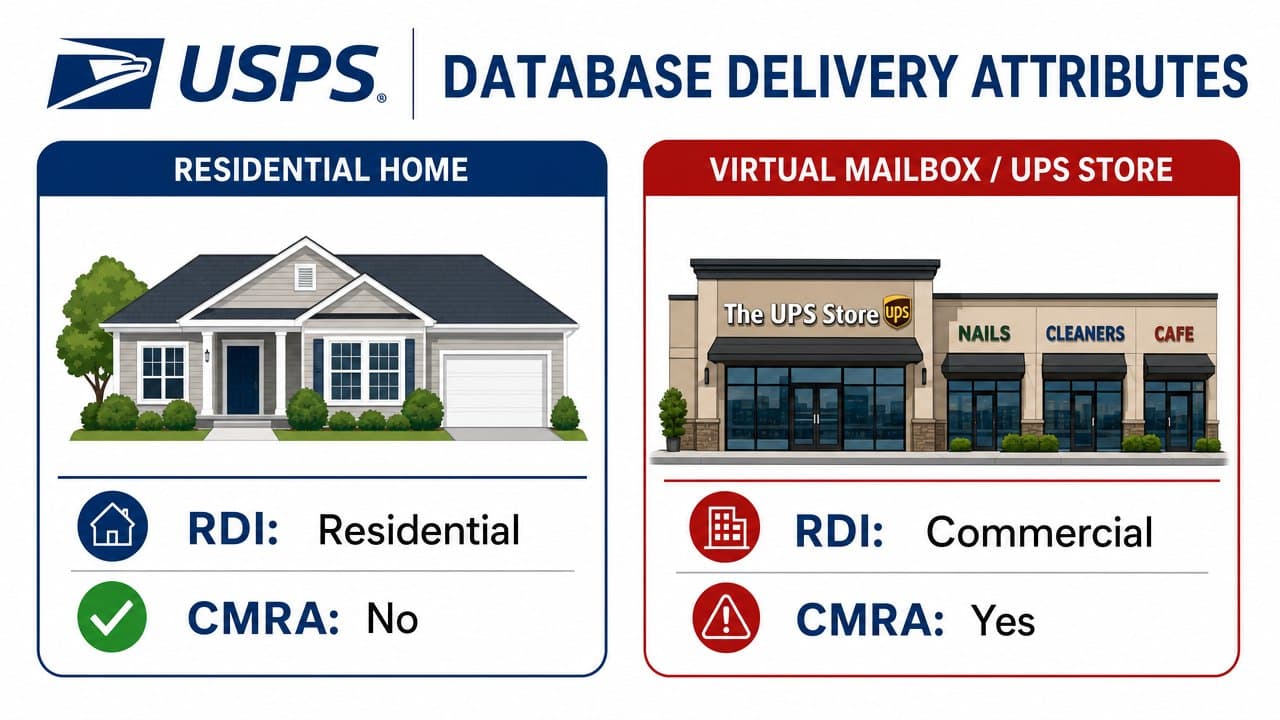
Banks do not read your apartment formatting to guess whether you sleep there. They query the building's street address in the USPS database, where every commercial virtual mailbox provider, UPS Store, and coworking mail room with single-point delivery is registered as a Commercial Mail Receiving Agency (CMRA) under USPS Domestic Mail Manual (DMM) 508.1.8.
Every storefront registers with its local Post Office on PS Form 1583-A. Before the store can scan or forward a single piece of your mail, you have to complete PS Form 1583 (June 2024 revision) (Application for Delivery of Mail Through Agent):
- Two mandatory IDs: One government-issued photo ID (such as a passport or driver's license) plus a second separate document proving your current physical residential address (a lease, mortgage, voter card, or vehicle registration).
- Live video or notary verification: You must sign or confirm your signature in front of the CMRA agent or pay $25 for a US-commissioned remote online notary on a live audio-video call.
- Mandatory upload to the USPS CMRA Customer Registration Database (CRD): Under USPS's CRD overhaul, the CMRA uploads your signed PS Form 1583 and both ID copies directly into the Postal Service's central database, and you have to file an updated Form 1583 whenever any address or ID detail changes.
That is why The UPS Store, Anytime Mailbox, iPostal1, Traveling Mailbox, and VirtualPostMail all force you through a notary check on day one.
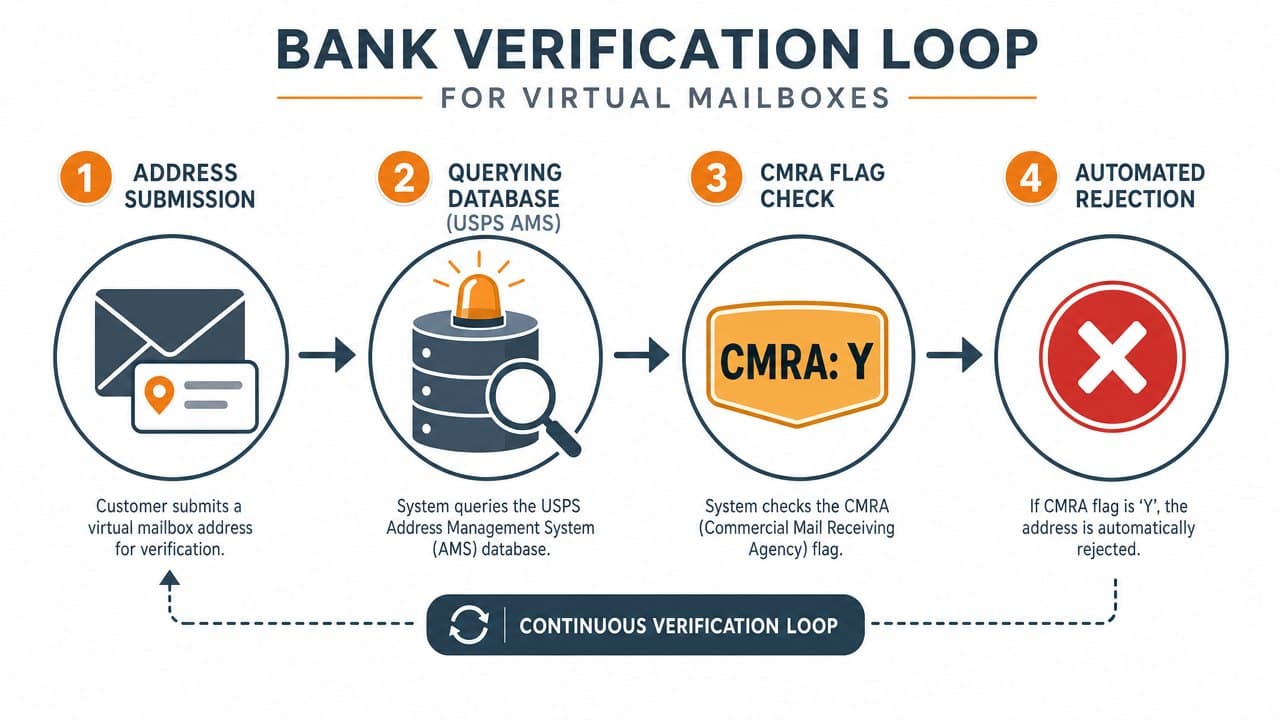
Once a building is in the CMRA registry, USPS exposes that status in its commercial data feeds. Query an address through the USPS Address Information API and it returns DPVCMRA (Y if the street address sits in the CMRA table, N if it does not), while the Residential Delivery Indicator (RDI) flags whether the building is Residential or Commercial. Both flags feed directly into the CASS and AMS databases that banks license through KYC vendors like LexisNexis, Experian, and Early Warning Services.
When you click "Save Address" on a bank or brokerage portal, four checks run in seconds:
- You enter the street address on an application or account profile update.
- The bank's KYC vendor standardizes the address against USPS AMS, CASS, and DPV tables, ignoring whether you typed
Suite,Unit, orApt. - USPS delivery flags return:
DPVCMRA(YorN) andRDI(ResidentialorCommercial). - Compliance rules fire: A
DPVCMRA: Yhit either blocks the form immediately in the Home/Legal field or triggers a compliance demand for a signed residential lease or utility bill in your name.
Worse, some banks let a CMRA address pass the web form without running a real-time lookup, making you think the trick worked. Months later, a background KYC sweep flags DPVCMRA: Y on your profile and freezes the account until you upload a utility bill or residential lease at that address, which a commercial mailbox receipt cannot pass.
The 5 ways expats maintain a US address (compared)
Expats and remote workers rely on five setups to handle paper mail, bank CIP checks, and Form 1583 rules:
| Method | Address Type | Bank CIP (Home Field) Accepted? | Form 1583 Notary? | Privacy & Discretion | Typical Cost |
|---|---|---|---|---|---|
| Friends & Family | Real Residential | Yes | No | Low (relatives open your mail) | Free |
| Commercial Virtual Mailbox (CMRA) | Commercial Mail Drop ( CMRA: Y) | Rejected by most banks in Home field; Mailing field only | Yes (2 IDs + live video/notary) | Moderate | $10 to $35 / month |
| Commercial Office Lease (TruLease) | Commercial Office | For business accounts | Yes | Moderate | $300 to $500 / month |
| Foreign Address / Expat Credit Union | International | Only at SDFCU, Schwab Int'l, Wise | No | High | Free |
| Cloud Residents | Real Residential Home ( CMRA: N) | Yes (true residential home) | No (non-CMRA home) | High (private scans + AI) | $299 / quarter |
1. The friends and family method
Using a parent's, sibling's, or close friend's house is how most expats start out. Better yet, 31 CFR § 1020.220 explicitly lets you list the residential street address of a next-of-kin or contact individual when you do not have a US home of your own.
Pros:
- True residential home address (
CMRA: N,RDI: Residential) that clears every bank database check. - Costs $0 upfront.
Cons:
- Zero financial privacy: Every IRS notice, replacement credit card, medical bill, and brokerage statement lands on your parents' kitchen table.
- Missed deadlines: Urgent tax or compliance letters with 30-day response windows sit unopened while your family is out of town.
- Fragile long-term: If your relatives sell the house or move, updating every bank, 401(k), and state record from abroad is a headache.
2. Traditional commercial virtual mailboxes
Services like Anytime Mailbox, iPostal1, Traveling Mailbox, and VirtualPostMail rent out commercial mail slots across hundreds of US cities.
Pros:
- Cheap ($10 to $35 per month).
- Works cleanly in the Mailing address field once you already have a separate, verified non-CMRA residential address sitting in the bank's Home/Legal field.
Cons:
- Flagged as
CMRA: Y: Fails residential checks in the Home/Legal field at Capital One, Schwab, and other strict banks. - USPS Form 1583 friction: Requires two IDs, a $25 online notary or live video witness, and registration in the central USPS CMRA Customer Registration Database.
3. Commercial office leases (TruLease / physical desks)
Programs like VirtualPostMail's TruLease partner with commercial building owners to bundle a signed office lease and utility bill with a business suite.
Pros:
- Gives you a signed commercial lease agreement and utility bill when a bank demands physical proof of address.
- Built for US LLCs and business checking accounts that need a verifiable corporate operating address.
Cons:
- Expensive: Costs $300 to $500 per month.
- Commercial RDI flag: Built for corporate banking, not personal retail checking, personal credit cards, or 401(k) accounts.
4. Switching to a foreign address (SDFCU, Schwab International, Wise)
If you would rather ditch US addresses altogether, three institutions let Americans bank or invest openly with a foreign home address:
- State Department Federal Credit Union (SDFCU): Accepts a foreign residential address for US checking and savings, sends MFA codes via WhatsApp instead of US SMS, and integrates Wise for foreign currency transfers.
- Charles Schwab International: Gives eligible expats a Schwab One International brokerage account with a foreign residential address and a $0 minimum balance.
- Wise: Opens multi-currency accounts and USD routing details verified against your overseas home address.
Pros:
- Matches where you actually live with zero US mailbox fees.
Cons:
- Major US retail banks (Chase, Capital One, Bank of America, Wells Fargo) and domestic credit card issuers close or restrict accounts when you switch to a foreign address.
- You give up most US travel rewards credit cards, Zelle on major retail banks, and domestic mutual fund purchases.
5. A residential virtual mailbox: Cloud Residents
Cloud Residents gives you a US residential street address at a real private home ($299/quarter) rather than a commercial mail storefront.
Because your mail goes to a private house under your name instead of a commercial PMB depot, USPS databases return a normal residential dwelling (CMRA: N, RDI: Residential):
- No CMRA flag: Clears the automated USPS AMS/DPV checks that block commercial mail drops in bank Home/Legal address fields.
- No Form 1583 notary: Because Cloud Residents is not a commercial mail storefront, USPS CMRA registration and Form 1583 notarization do not apply.
- Residential lease documentation: Provides a residential lease agreement in your legal name when a bank, brokerage, or state agency asks for formal proof of address.
- AI mail summaries: Staff photograph every incoming envelope the day it arrives. Request an open-and-scan and an AI summary pulls out key dates, dollar amounts, and deadlines from IRS or bank letters.
- Worldwide forwarding: Forwards replacement credit cards, hardware keys, and documents anywhere in the world via DHL Express, FedEx, UPS, and USPS.
Step-by-step checklist: preparing your US address before leaving
Run through these five steps two to four weeks before your flight. Changing your address on a bank or brokerage account from a foreign IP after you land is the fastest way to trigger a fraud lock and a demand to walk into a US branch with two IDs.
1. Audit every financial account and separate home vs. mailing fields
Log into every financial and government portal while you are still on a US connection with a working US phone number:
- Checking and savings accounts
- Credit cards (order early replacement cards for any plastic expiring within the next 12 months)
- Retail brokerages, IRAs, and 401(k) / 403(b) / 457 recordkeepers
- Student loan servicers, insurance policies, and the Social Security Administration
- State driver's license and voter registration
On every bank and brokerage profile, inspect both the Home / Legal (CIP) address and the Mailing address. Call or message your 401(k) administrator to confirm how they deliver Form 1099-R and make sure a signed Form W-9 is on file.
Leaving a high-tax state like California or New York? Cut your physical domicile ties before you fly, and check the audit checklists in California FTB Publication 1031 and New York's nonresident FAQs.
2. Lock down your US phone number for 2FA
Keep a real US cellular number that receives SMS over Wi-Fi calling abroad. Banks block VoIP numbers like Google Voice and Skype from receiving one-time passcodes.
Port your number to a cheap US eSIM carrier with native Wi-Fi calling (like Tello, starting around $5/month) so real carrier texts keep arriving over Wi-Fi anywhere in the world. Test bank SMS codes before you leave the US, and add an authenticator app or hardware security key (YubiKey) on every login that supports it.
3. Claim and standardize your residential address
Set up your US residential address two to four weeks before departure so replacement cards and verification letters arrive before you board the plane.
With Cloud Residents, identity verification and address assignment take about three business days. Save the exact USPS-standardized street line in your password manager and paste that identical spelling across every bank, brokerage, and tax portal.
One critical rule when switching mail providers: never file a USPS Change of Address (COA) order out of a commercial virtual mailbox. Under USPS CMRA guidelines and PS Form 1583 item 15, USPS blocks COA forwarding from any CMRA, so the old operator has to re-mail your envelopes with fresh postage.
4. Turn on paperless delivery and file IRS Form 8822 if needed
Switch on paperless statements, electronic tax forms (1099s), and email alerts across every account so only replacement cards, IRS notices, and legal letters ever hit your physical mailbox.
Under IRS Topic 157, you can update your IRS address mid-year by filing Form 8822 or simply put your new address on your next Form 1040. You can list your foreign address directly on Form 1040, or route IRS mail to your US residential address for same-day digital scanning.
5. Pair account logins with a dedicated US VPN
Bank fraud engines score foreign IP addresses aggressively. Log into a domestic brokerage or checking account from an unfamiliar hotel Wi-Fi abroad and you risk an automated security freeze.
Run a reliable VPN connected to a US server (or a dedicated US residential IP) whenever you open US banking portals, and stick to a laptop or phone whose browser cookies and device fingerprint your bank already trusts.
Frequently asked questions
Can I use a P.O. Box for a US bank account?
Not as your residential or legal CIP address. Under 31 CFR § 1020.220, banks must collect a residential or business street address (or an APO/FPO or next-of-kin street address if you have none). Banks allow a PO Box in the separate Mailing address field, while FinCEN's CIP guidance excludes post office boxes from satisfying the physical location rule.
Why do banks reject virtual mailbox addresses?
USPS flags Commercial Mail Receiving Agencies with DPVCMRA: Y in its Address Information database and marks commercial storefronts under its Residential Delivery Indicator (RDI). Banks and KYC vendors query those flags automatically. Even when a virtual mailbox uses "Suite" or "Apt" instead of "PMB", the underlying street number still returns CMRA: Y and fails the residential address check.
Can I keep my Chase or Capital One account if I move abroad?
Chase's deposit account agreement lets the bank close your account if you change your address to one outside the US or if Chase determines you live outside the US. Capital One rejects CMRA addresses in the Home/Physical address field and only accepts them as a mailing address. Expats who keep domestic retail accounts maintain a verified non-CMRA US residential address (such as Cloud Residents or a family home) and a working US cellular number for 2FA, or open an expat-friendly account at SDFCU.
Does a South Dakota PMB work for banking while living abroad?
A South Dakota PMB paired with a one-night hotel receipt satisfies the South Dakota DPS Residency Affidavit for a driver's license, but USPS still classifies that PMB as a commercial mail drop (DPVCMRA: Y). Banks that screen against USPS CMRA flags reject a South Dakota PMB as your Home/Legal CIP address unless you also put a non-CMRA residential street address on file. South Dakota's updated voter residency law (SDCL § 12-1-4) also sets a 30-day stay rule in a fixed permanent dwelling for full state voter registration.
What happens to my 401(k) or IRA when I move overseas?
Moving abroad does not force a 401(k) or IRA withdrawal. Your investments stay in the plan as long as you keep a valid Form W-9 and an accepted address on file for Form 1099-R delivery, which avoids mandatory 30% nonresident withholding. At retail brokerages like Fidelity and Vanguard, switching to a foreign address blocks new mutual fund purchases while leaving existing holdings intact.
Do I need a notarized USPS Form 1583 for Cloud Residents?
No. PS Form 1583 only applies to commercial mail drops regulated as CMRAs under USPS DMM 508.1.8. Because Cloud Residents receives mail at a private residential home under your name rather than a commercial PMB facility, CMRA database registration and Form 1583 notarization do not apply.
Can I use a foreign address on my US tax return?
Yes. The IRS accepts foreign addresses on Form 1040 and Form 8822. You do not need a US address solely to file federal income taxes, though expats route IRS correspondence to a US residential scanning address so time-sensitive audit or refund letters do not get delayed in international post.
The bottom line
The IRS lets you file from anywhere in the world, but US retail banks, credit card issuers, and domestic brokerages enforce strict physical street address checks.
A $10 commercial virtual mailbox works in a bank's secondary Mailing field, but its DPVCMRA: Y flag fails the primary Home / Legal (CIP) check at institutions like Capital One and Schwab. Borrowing a relative's house passes the database check at the cost of your financial privacy.
If you want a standalone, non-CMRA US home address with optional residential lease documentation, AI mail summaries, and worldwide forwarding, set up Cloud Residents before you leave the country.