

Most "best marketing books" lists feel like someone asked LinkedIn to make a bookshelf.
Same blurbs. Same fake urgency. Same "in today's rapidly changing digital landscape" sentence that should be illegal in at least 11 countries.
This list is different.
These are the marketing books that actually change how you write, position, price, launch, sell, and think about customers. Some are old. Good. Old books had to survive without TikTok carousels and founder podcasts doing free PR.
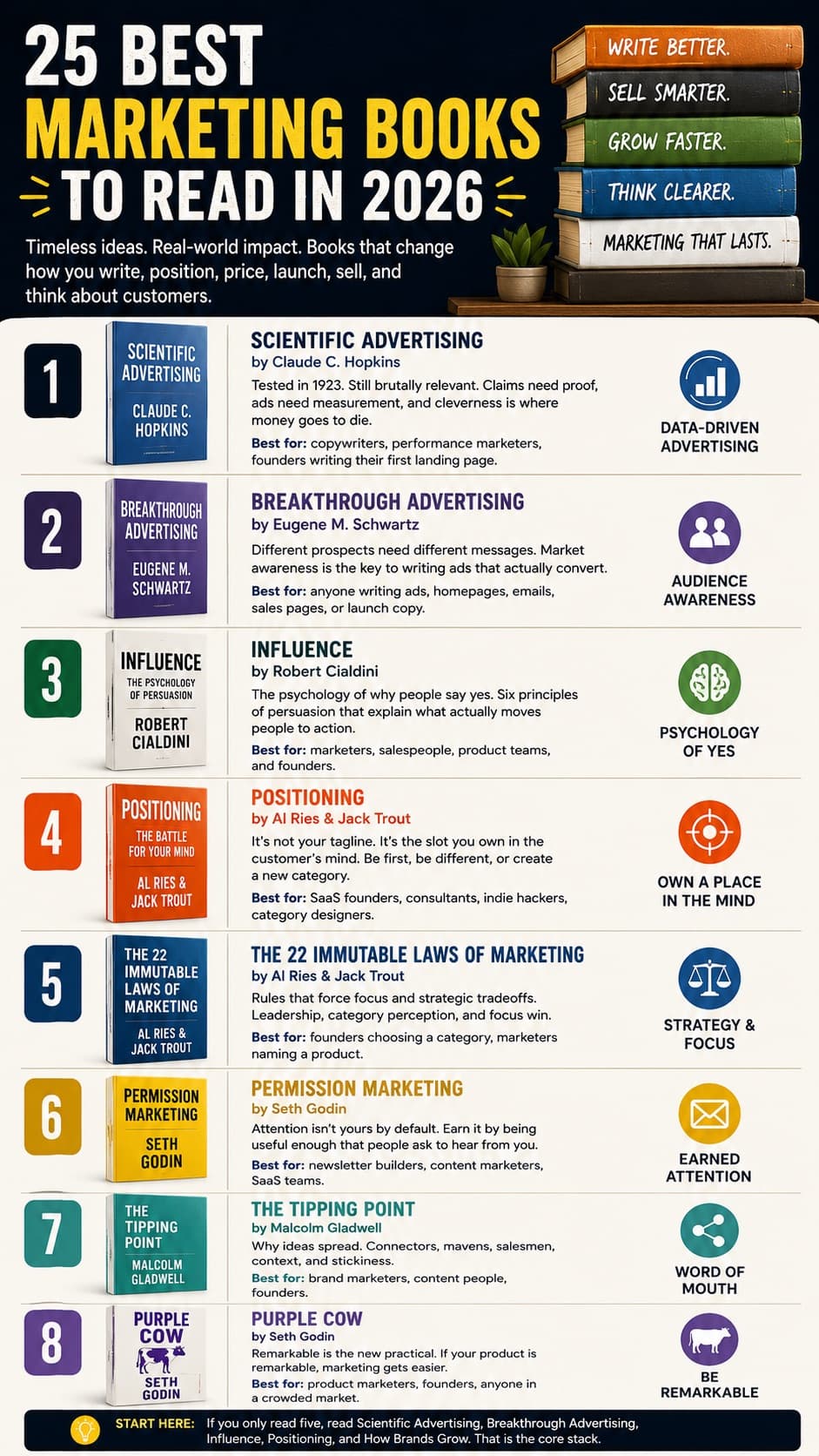
If you only read five, read Scientific Advertising, Breakthrough Advertising, Influence, Positioning, and How Brands Grow. That is the core stack.
Disclosure: some links below are Amazon affiliate links.
1. Scientific Advertising by Claude C. Hopkins
Read this before you spend another dollar on ads.
Hopkins was writing about tested advertising in 1923, which is funny because half of Twitter discovered "iterate based on data" last Tuesday. The book is short, blunt, and still annoyingly correct: claims need proof, ads need measurement, and cleverness is usually where money goes to die.
Best for: copywriters, performance marketers, founders writing their first landing page.
Get Scientific Advertising on Amazon2. Breakthrough Advertising by Eugene M. Schwartz
This is the one people quote when they want to sound like a serious direct response gremlin.
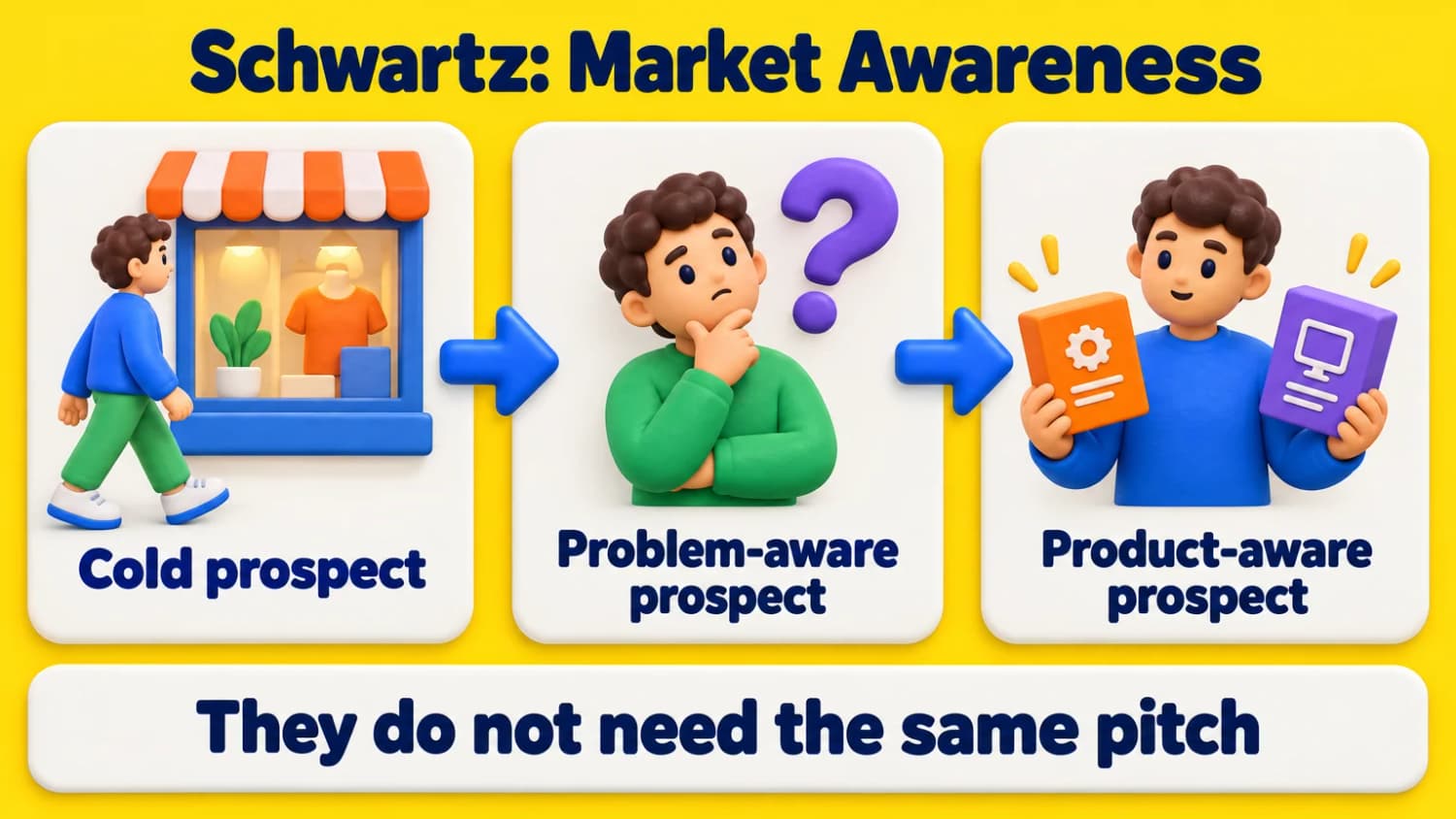
The useful part is not "write better headlines." It is Schwartz's idea of market awareness. A cold prospect, a problem-aware prospect, and a product-aware prospect do not need the same pitch. Obvious once you see it. Expensive until you do.
Best for: anyone writing ads, homepages, emails, sales pages, or launch copy.
Get Breakthrough Advertising on Amazon3. Influence by Robert Cialdini
Cialdini explains why people say yes: social proof, scarcity, authority, reciprocity, liking, commitment, consistency.
The scammy read is "how do I manipulate people?" The useful read is "why did this page convert when the prettier one did not?" If you sell anything online, this book gives you names for patterns you already feel in your gut.
Best for: marketers, salespeople, product teams, and founders who want persuasion without sounding like a webinar funnel.
Get Influence on Amazon4. Positioning by Al Ries and Jack Trout
Positioning is not your tagline. It is the slot you own in the customer's head.
This book is old enough to mention brands your intern has never heard of, but the lesson is evergreen: if customers cannot quickly place you, they forget you. You can win by being first, being different, or creating a new category. You usually do not win by being "the AI-powered platform for modern teams." Please stop.
Best for: SaaS founders, consultants, indie hackers, category designers, and anyone whose homepage says too much.
Get Positioning on Amazon5. The 22 Immutable Laws of Marketing by Al Ries and Jack Trout
This is basically Positioning with more punch and more rules.
Some "laws" are debatable. That is fine. The point is to force strategic tradeoffs. Leadership matters. Focus matters. Category perception matters. Once a buyer has decided what you are, changing their mind is brutally expensive.
Best for: founders choosing a category, marketers naming a product, and anyone tempted to chase every segment at once.
Get The 22 Immutable Laws of Marketing on Amazon6. Permission Marketing by Seth Godin
This book predicted the inbox war before every brand decided it deserved to text you about socks.
Godin's core point is simple: attention is not yours by default. You earn it by being useful enough that people ask to hear from you again. That is still the whole game in email, content, community, and social.
Best for: newsletter builders, content marketers, SaaS teams, and anyone treating subscribers like a rented list.
Get Permission Marketing on Amazon7. The Tipping Point by Malcolm Gladwell
Gladwell gets dunked on because he writes ideas too well. Marketers should probably study that instead of sneering at it.
The Tipping Point is about why some ideas spread through networks and others sit there like a Notion launch page with 14 upvotes. You get connectors, mavens, salesmen, context, and stickiness. Not a growth playbook, but useful for thinking about distribution.
Best for: brand marketers, content people, and founders trying to understand word of mouth.
Get The Tipping Point on Amazon8. Purple Cow by Seth Godin
"Be remarkable" sounds obvious until you look at most product categories.
Purple Cow is a short slap. If your product is interchangeable, marketing has to do all the heavy lifting. If the product itself is worth talking about, marketing gets much easier. This is especially relevant now that AI can generate infinite average content in seven seconds.
Best for: founders building in crowded markets, creators, product marketers, and anyone competing on "features plus vibes."
Get Purple Cow on Amazon9. Contagious by Jonah Berger
Berger gives you the STEPPS framework: social currency, triggers, emotion, public, practical value, stories.
The best part is that it makes "viral" feel less mystical. People share things because the thing does something for them. It makes them look smart, feel something, remember a cue, help a friend, or tell a clean story. "Please share" is not one of the steps.
Best for: social marketers, startup launchers, content strategists, and anyone trying to make ideas travel.
Get Contagious on Amazon10. Hooked by Nir Eyal
Hooked is about the loop behind habit-forming products: trigger, action, variable reward, investment.
Use it carefully. There is a thin line between building something people return to because it helps them and building a tiny slot machine with onboarding screens. Still, if you work in product-led growth, lifecycle marketing, or consumer apps, you should understand the loop.
Best for: product marketers, app founders, growth teams, and retention people.
Get Hooked on Amazon11. This Is Marketing by Seth Godin
This is Godin's grown-up marketing book.
The headline idea: marketing is helping a specific group of people get where they already want to go. That sounds soft until you realize most bad marketing comes from ignoring it. Wrong audience, wrong promise, wrong story, wrong status signal.
Best for: marketers who want the job to feel less gross, founders defining an audience, and creators selling without turning into a human popup.
Get This Is Marketing on Amazon12. Building a StoryBrand by Donald Miller
StoryBrand is popular because it solves a very common problem: websites that make the company the hero.
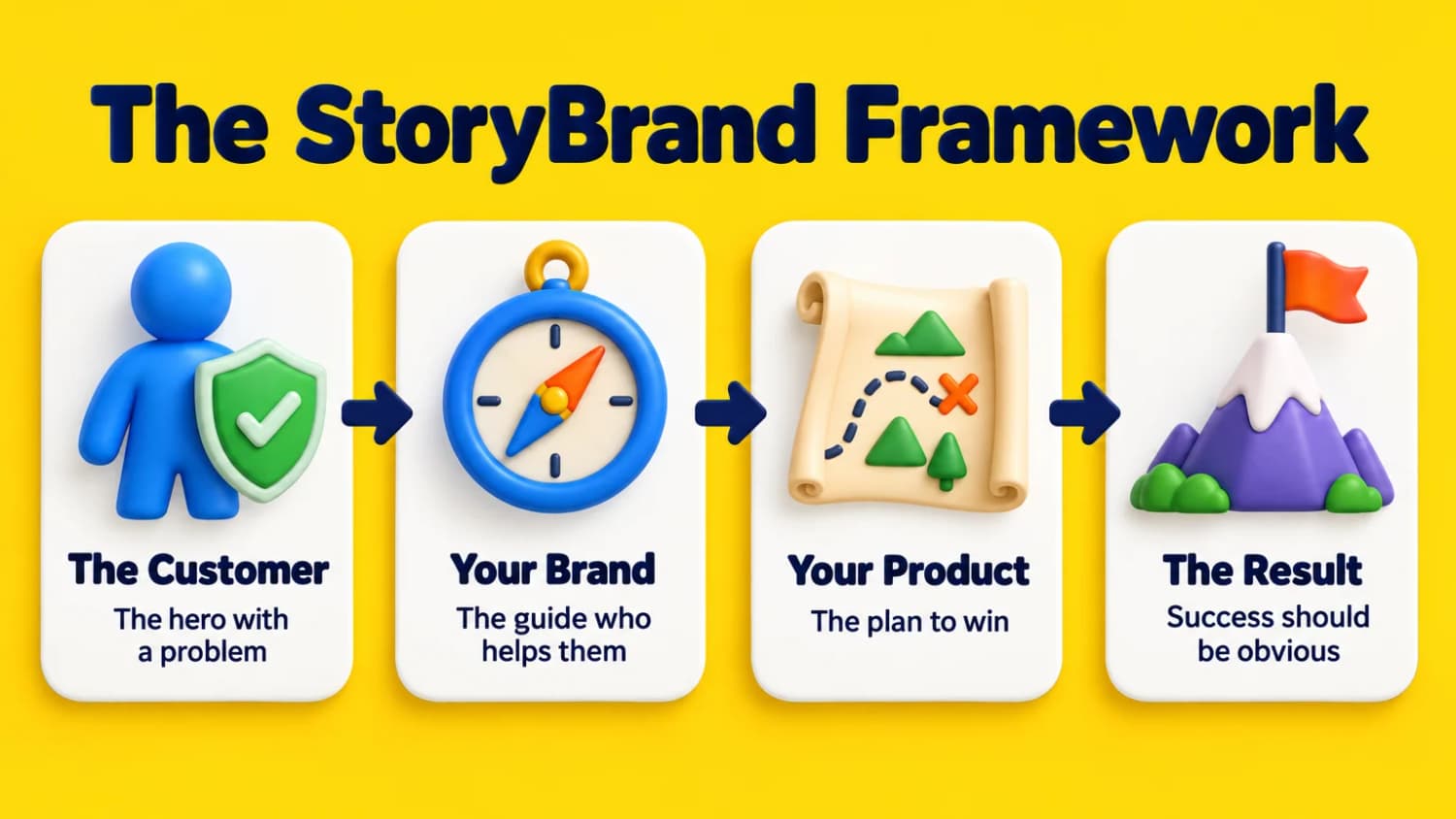
Miller's framework is simple. The customer has a problem. Your brand is the guide. Your product is the plan. The result should be obvious. It can get formulaic if you copy it too literally, but the clarity lesson is worth it.
Best for: homepage rewrites, service businesses, consultants, agencies, and founders who explain too much.
Get Building a StoryBrand on Amazon13. Dotcom Secrets by Russell Brunson
Yes, the funnel bro energy is real. Read it anyway.
Dotcom Secrets is useful because Brunson understands offer flow, lead magnets, upsells, email sequences, and why people need different messages at different stages. You do not have to copy the internet marketing aesthetic. In fact, please do not. Steal the mechanics, leave the rented Lamborghini.
Best for: creators, course sellers, agencies, ecommerce teams, and founders building sales funnels.
Get Dotcom Secrets on Amazon14. $100M Offers by Alex Hormozi
Hormozi is loud, but the offer work is useful.
The book forces you to stop hiding behind "better marketing" when the actual problem is a weak offer. More value, clearer promise, lower perceived risk, better guarantee, sharper niche. If your product is hard to say yes to, no amount of copy glitter fixes it.
Best for: founders, consultants, agencies, coaches, and anyone packaging a service.
Get $100M Offers on Amazon15. The Choice Factory by Richard Shotton
Shotton turns behavioral science into practical marketing examples without making you feel like you accidentally enrolled in a psych PhD.
You get 25 biases and how they show up in pricing, ads, packaging, social proof, and buying decisions. Very skimmable. Very easy to apply. Also a good reminder that customers are not spreadsheets with wallets.
Best for: conversion copywriters, CRO teams, brand strategists, and paid media people.
Get The Choice Factory on Amazon16. How Brands Grow by Byron Sharp
This book is where performance marketers go to get humbled.
Sharp argues that brands grow by increasing mental and physical availability, not by obsessing over tiny loyalty segments. Distinctive assets matter. Reach matters. Being easy to notice and easy to buy matters. It is less romantic than "brand love," which is why it is useful.
Best for: brand marketers, CPG people, B2B teams with long sales cycles, and founders who think positioning ends at the website.
Get How Brands Grow on Amazon17. Crossing the Chasm by Geoffrey Moore
If you sell a new thing to a conservative market, read this before blaming sales.
Moore explains the gap between early adopters and the mainstream. Early users tolerate weirdness because they want the edge. Mainstream buyers want proof, safety, references, and a complete solution. Same product, different buyer psychology.
Best for: B2B SaaS, devtools, enterprise startups, and technical founders selling beyond early adopters.
Get Crossing the Chasm on Amazon18. Blue Ocean Strategy by W. Chan Kim and Renee Mauborgne
Blue Ocean Strategy is about escaping direct comparison.
Instead of fighting everyone on the same features, price points, and channels, you redraw the market around a different value curve. The framework can feel a little business-school, but the strategic question is excellent: what can you remove, reduce, raise, or create?
Best for: founders entering crowded markets, product marketers, and teams stuck in comparison-page hell.
Get Blue Ocean Strategy on Amazon19. Hacking Growth by Sean Ellis and Morgan Brown
This is the grown-up version of "growth hacking."
The useful bit is the operating system: pick a growth lever, form hypotheses, run experiments, measure honestly, scale what works. Boring? Yes. That is why it works better than changing your button color because a thread said orange converts.
Best for: startup marketers, growth teams, product managers, and founders who need a testing cadence.
Get Hacking Growth on Amazon20. The 1-Page Marketing Plan by Allan Dib
This is not the fanciest book here. That is the point.
Dib gives you a simple way to map your market, message, channels, conversion path, and follow-up. It is useful when your "strategy" is a pile of ideas in Slack and three half-finished campaigns in Notion.
Best for: small businesses, solo founders, consultants, and marketers who need a practical plan fast.
Get The 1-Page Marketing Plan on Amazon21. Everybody Writes by Ann Handley
Every marketer writes now. Emails, landing pages, docs, posts, ads, onboarding, internal pitches. The job is half distribution and half sentences.
Handley makes writing feel less mystical and more like a craft you can improve. The advice is practical, warm, and mercifully free of "10x your content machine" nonsense.
Best for: content marketers, founders, social leads, newsletter writers, and anyone whose first drafts sound like a vendor booth.
Get Everybody Writes on Amazon22. Epic Content Marketing by Joe Pulizzi
Pulizzi is strongest on the idea that content needs a mission, not just a publishing schedule.
If you are writing blog posts because "SEO said so," this book helps you zoom out. Who is the audience? What do they get from you that they cannot get anywhere else? Why would they come back? Painfully basic questions. Usually skipped.
Best for: content teams, B2B marketers, SEO leads, and founders using content as a growth channel.
Get Epic Content Marketing on Amazon23. Invisible Influence by Jonah Berger
This is a quieter cousin to Contagious.
Berger looks at how other people shape our choices, often without us noticing. Sometimes we imitate. Sometimes we differentiate. Sometimes the room decides before the buyer does. Useful if your market has status games, peer pressure, category norms, or "everyone uses X" dynamics. So, all markets.
Best for: brand strategists, social marketers, community builders, and product marketers.
Get Invisible Influence on Amazon24. Made to Stick by Chip Heath and Dan Heath
The Heath brothers explain why some ideas survive and others evaporate.
Their SUCCESS framework is simple: simple, unexpected, concrete, credible, emotional, stories. The real value is the reminder to make the idea easy to repeat. If a customer cannot retell your pitch to a friend, your positioning probably needs a shower and a haircut.
Best for: messaging work, content, sales enablement, launches, and founder storytelling.
Get Made to Stick on Amazon25. Thinking, Fast and Slow by Daniel Kahneman
Not technically a marketing book. Still belongs here.
Kahneman explains the messy machinery behind human judgment: fast intuition, slow reasoning, bias, framing, loss aversion, confidence, memory. It will make you more skeptical of surveys, customer interviews, attribution dashboards, and your own brilliant opinions. Annoying but healthy.
Best for: anyone who wants to understand why buyers say one thing, do another, and then explain it confidently afterward.
Get Thinking, Fast and Slow on AmazonThe best reading order
Do not read all 25 in order unless you are procrastinating on something expensive.
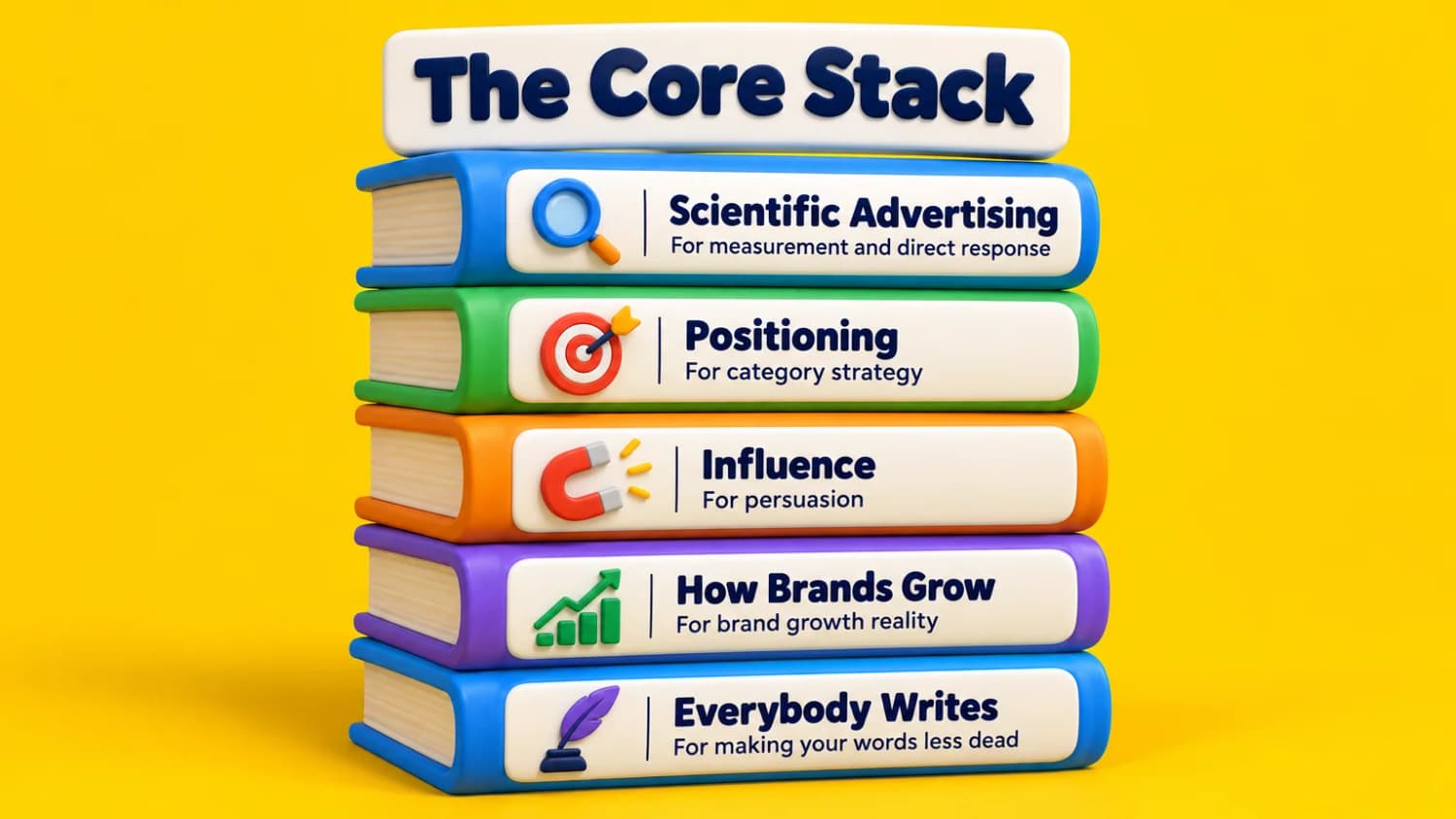
Start here:
- Scientific Advertising for measurement and direct response.
- Positioning for category strategy.
- Influence for persuasion.
- How Brands Grow for brand growth reality.
- Everybody Writes for making your words less dead.
Then branch based on the problem:
- Need better copy? Read Breakthrough Advertising, Made to Stick, and Building a StoryBrand.
- Need more word of mouth? Read Contagious, Purple Cow, and The Tipping Point.
- Need a stronger offer? Read $100M Offers and Dotcom Secrets.
- Need startup growth? Read Hacking Growth and Crossing the Chasm.
- Need brand strategy? Read How Brands Grow, Positioning, and Blue Ocean Strategy.
A few honorable mentions
If you want to keep going, add Ogilvy on Advertising by David Ogilvy, Alchemy by Rory Sutherland, and Audacious by Mark Schaefer.
But honestly, the goal is not to become a person who has read every marketing book. The goal is to become dangerous with three ideas and actually use them.