

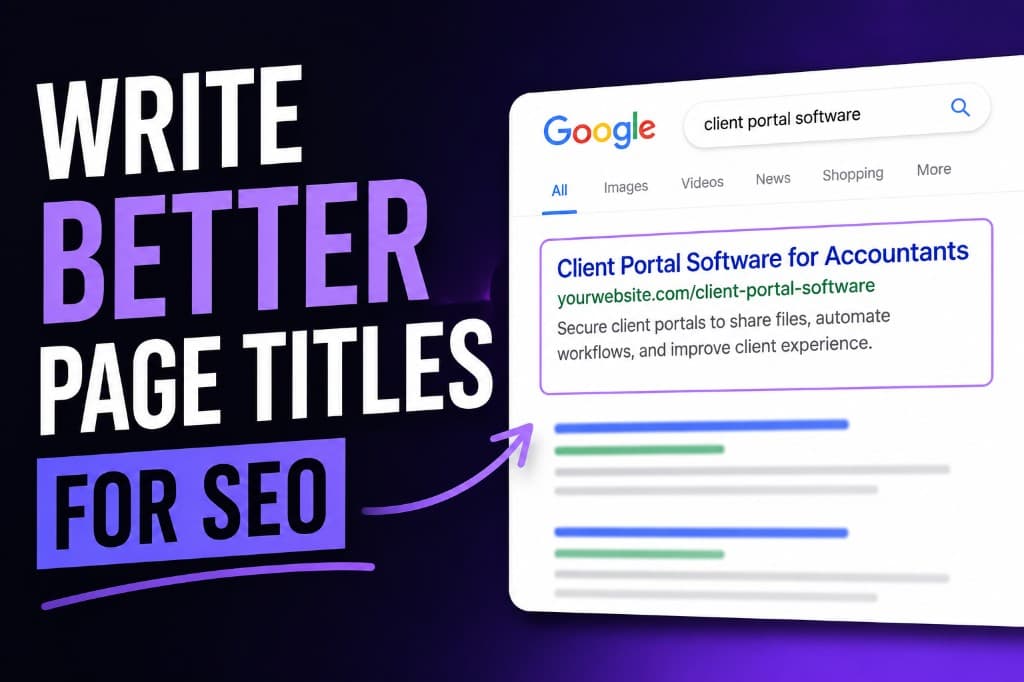
Most SEO title advice is technically correct and practically useless.
"Keep it under 60 characters."
"Use your keyword."
"Make it compelling."
Cool. Also drink water and sleep eight hours.
The better way to write page titles is to treat the SERP like the brief. Look at what already ranks, identify the pattern, then write the clearest version for your page.
That is the pattern I keep seeing in my SEO Roasts: bad titles usually do not fail because they are missing a magic word. They fail because they are vague, bloated, mismatched, or trying to be clever when Google wants obvious.
What Is a Page Title?
A page title, or title tag, is the HTML <title> shown in Google as the blue clickable headline.
It does two jobs:
- It tells Google what the page is about.
- It tells humans why they should click.
If the title is weak, Google may rewrite it. If it is too long, Google may cut it off. If it does not match the page, people bounce or ignore it.
Small tag. Big leverage.
The Simple Formula
Use this as the starting point:
Primary keyword + useful modifier / benefit + brand
Examples:
| Weak title | Better title |
|---|---|
| Home | Client Portal Software for Accountants |
| SEO Tips | How to Create Better Page Titles for SEO |
| Products | Best AI Presentation Makers in 2026 |
| Pricing | Client Portal Pricing |
| Running Shoes | Best Running Shoes for Beginners |
Do not worship the formula. Use it to stop writing titles like "Home."
1. Put the Main Query First
The strongest pattern from the roasts is boring but powerful:
SEO title -> meta description -> H1 -> URL slug
They should all point at the same primary phrase.
If the page is about "client portal software," do not title it:
Secure Collaboration Platform for Modern Firms
That sounds like a B2B SaaS homepage generated during a mild fever.
Use the query people actually search:
Client Portal Software for Accountants
Front-load the main phrase when possible. Google and humans should understand the page in the first few words.
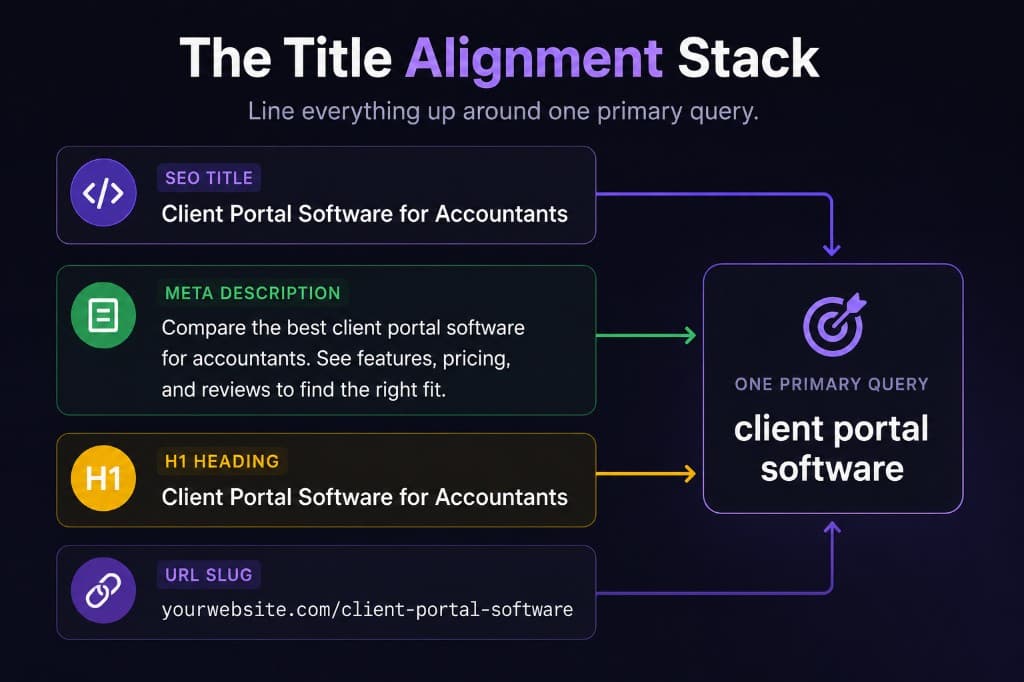
Line up the title, description, H1, and slug around one primary query. Boring? Yes. Effective? Also yes.
2. Aim for 40-55 Characters
The practical sweet spot is usually 40-55 characters.
That is not a law. Google uses pixel width, not just character count. But 40-55 characters is a good range if you want the title to stay readable and avoid truncation.
In the roasts, overlong titles kept showing up:
- A digital signage page had a 94-character title while competitors were closer to 60.
- A client portal title was getting cut off in Google.
- A homepage title needed to stay under roughly 60 characters so the important words stayed visible.
The rule:
Shorten until the words that matter appear before the ellipsis.
If Google cuts off your benefit, your number, or your query, the title is too loose.
Here is the same idea using the best AI presentation maker SERP. The long title loses the useful part. The tighter one keeps the keyword and benefit visible.
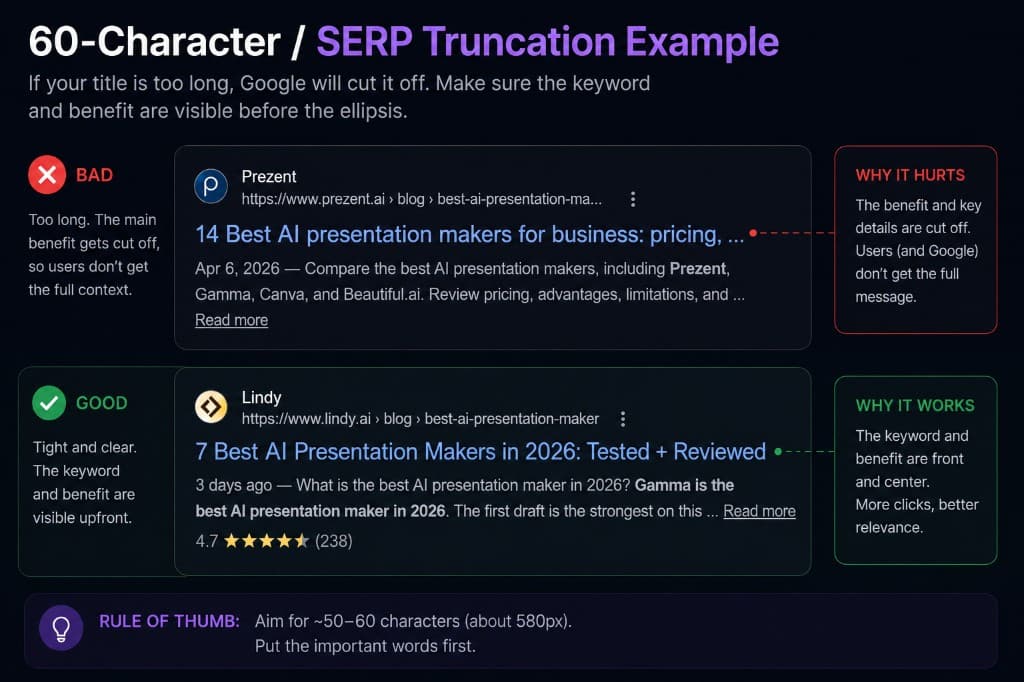
The goal is not exactly 60 characters. The goal is to keep the important words visible before Google starts doing surgery.
3. Mirror What Already Wins
Before writing the title, search the keyword.
Then look at the top 10 titles side by side.
You are looking for patterns:
- Are they using "best"?
- Are they using "top"?
- Are they using a year?
- Are they using numbers?
- Are they using "software", "tools", "platform", or "service"?
- Are they comparing multiple phrases, like "client portal" and "customer portal"?
This is not copying.
This is matching the market.
If every top result says "best AI presentation makers" and your title says "AI slide creation solution," congratulations, you have invented a worse phrase.
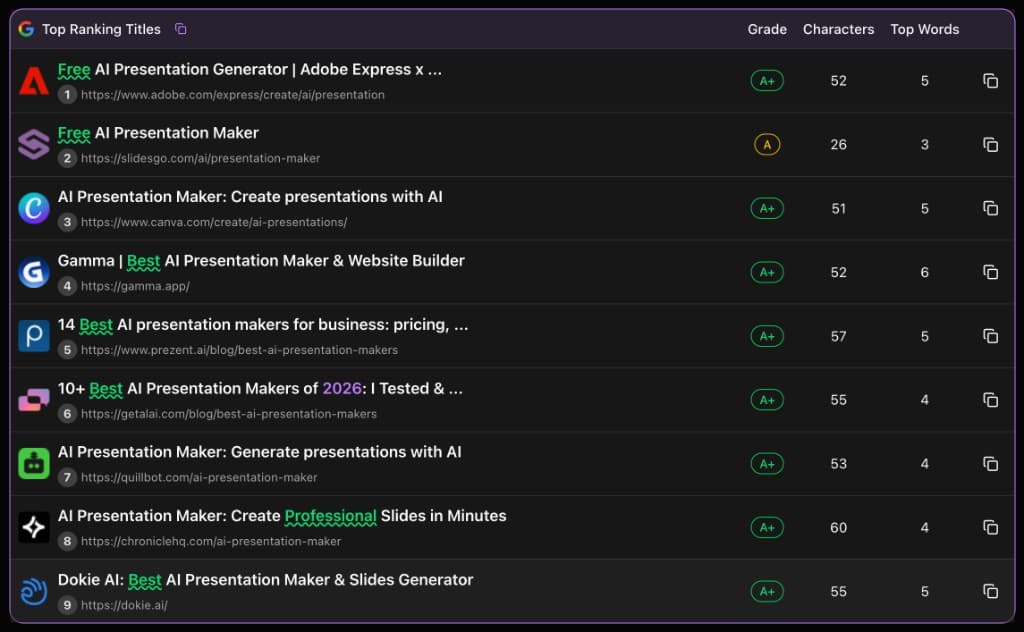
The SERP tells you the format Google already likes. Your job is to write the cleanest version that fits your page.
4. Use Proven Title Patterns
After reviewing a lot of Semrush-style winners, the patterns are obvious.
The best titles are not weird. They are clear, specific, and shaped around intent.
Use these patterns as starting points:
| Intent | Pattern | Example |
|---|---|---|
| How-to | How to [Task] | How to Do Keyword Research for SEO |
| Definition | What Is [Term]? | What Is Technical SEO? |
| Guide | [Topic]: A Beginner's Guide | Keyword Search Volume: A Beginner's Guide |
| Listicle | [Number] Best [Tools] | 15 Best Keyword Research Tools |
| Checklist | [Topic] Checklist: [Number] Tips | SEO Checklist: 41 Tips to Optimize Your Website |
| Comparison | [A] vs [B] | SEO vs. SMM: Why You Need Both |
| Error/problem | What Does [Error] Mean? | What Does Error 404 Not Found Mean? |
Some modifiers keep showing up because they work:
BestTopCompleteBeginner's GuideExamplesTemplateFree2026
Use power words carefully. Best, Top, Free, Complete, and Essential can help. Jaw-dropping, Unbelievable, and Shocking usually make you sound like you sell miracle protein powder.
5. Match the Page Type
The title should match the job of the URL.
Pricing page? Put pricing in the title.
Support page? Put support in the title.
Docs page? Put docs or documentation in the title.
Login page? Put login in the title.
Do not make every page sound like a homepage.
In one roast, a pricing URL was weaker because the title did not clearly match pricing intent. That is such an easy fix it almost feels rude.
Google likes clarity. Users like clarity. Your title should say what the page is.
6. Avoid "Home" and Other Nothing Titles
Ultra-short titles can be just as bad as long ones.
"Home" is not a title. It is a shrug.
"About" is not much better.
If your homepage title does not say what the product does, you are wasting the most important title on the site.
Bad:
Home
Better:
AI Customer Support Chatbot for SaaS Teams
Bad:
Products
Better:
Best Client Portal Software for Accountants
You do not need poetry. You need specificity.
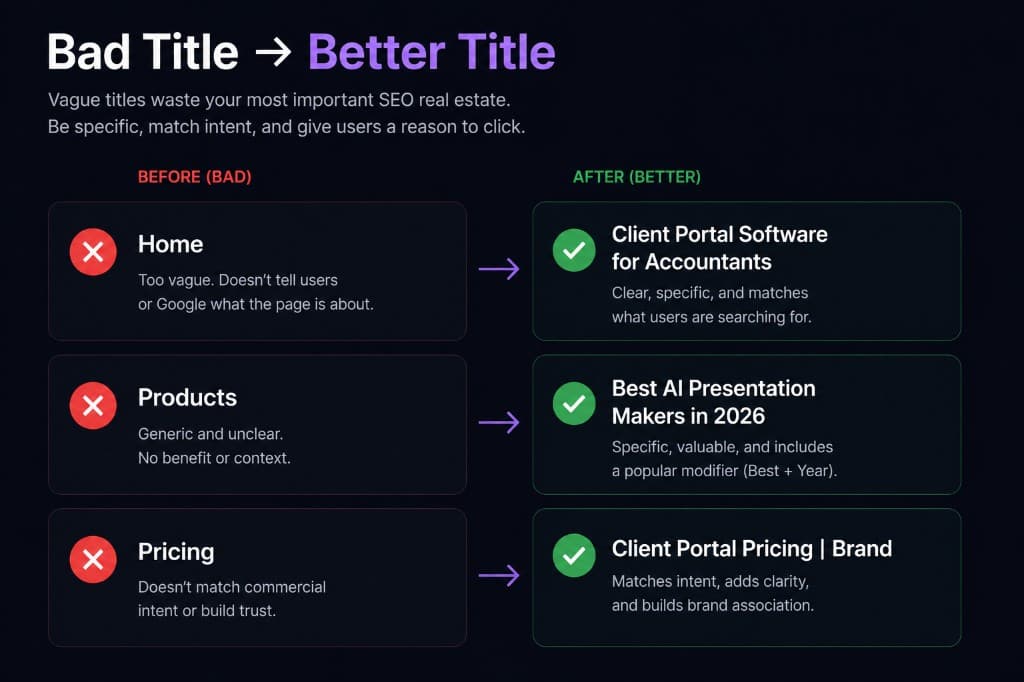
Vague titles waste the most important SEO real estate on the page. Say what the page is.
7. Use Numbers and Years Carefully
Numbers and years work because they set expectations.
Examples:
- 8 Benefits of Digital Signage
- 10 Best AI Presentation Makers in 2026
- Top 6 Client Portal Software Tools
But the title must match the page.
If the title says "8 benefits," the page should clearly have 8 benefits.
If your URL slug says /five-options and your title later becomes "10 options," you have created a tiny SEO goblin. Avoid that.
Use stable slugs for the head term:
/best-ai-presentation-makers
Then update the title as needed:
10 Best AI Presentation Makers in 2026
Much cleaner.
8. Do Not Keyword-Stuff
Google's title guidance is not complicated:
- Make titles unique.
- Make them descriptive.
- Keep them concise.
- Avoid boilerplate.
- Avoid keyword stuffing.
- Match the language of the page.
Bad:
SEO Title Generator | SEO Title Tool | Best SEO Title Tags SEO
Good:
SEO Title Generator: Write Better Titles in 2026
If the title sounds like it was written by someone trying to trick a robot, rewrite it.
How to Use the SEO Roast Title Generator
I built the SEO Title Generator inside SEO Roast because this workflow kept coming up in audits.
The idea is simple:
- Enter your target keyword.
- Pull the top-ranking titles.
- See common words, modifiers, length, and structure.
- Generate better title options.
- Grade the final title before you ship it.
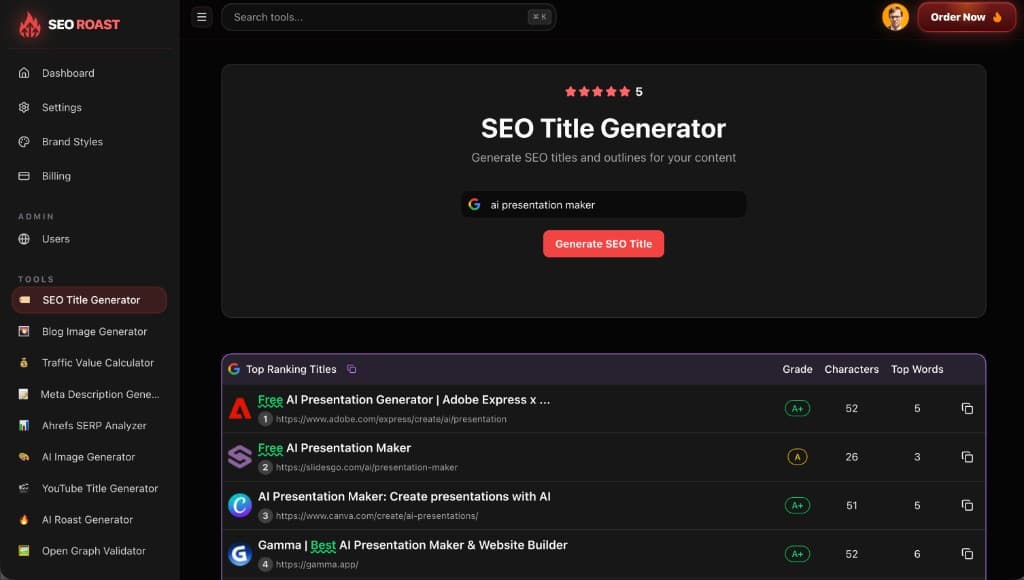
Start with the keyword. The tool pulls the SERP so you are not writing in a vacuum.
The best part is seeing the top results together.
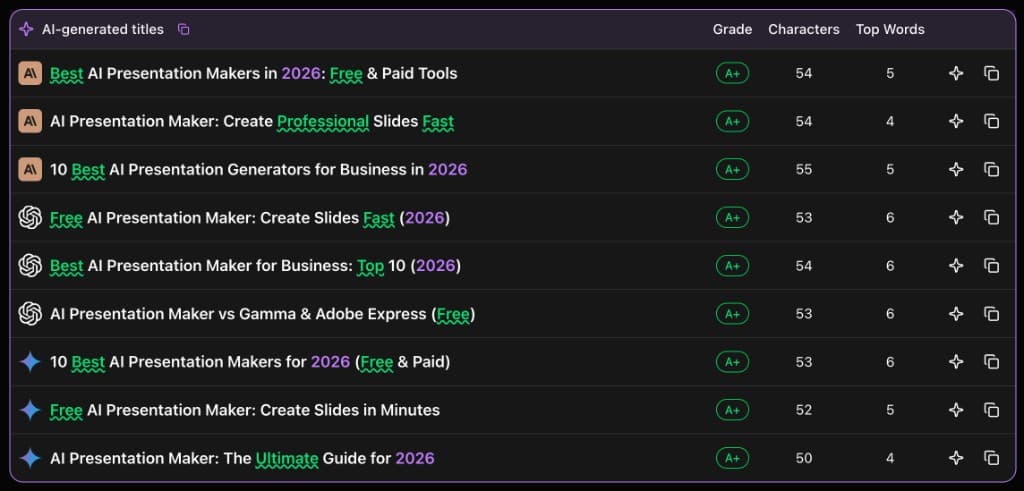
Generate options, but do not blindly pick the first one. Look for the title that matches intent, length, and the SERP pattern.
Then use the analysis view to check word patterns, character length, and how the title looks in Google.
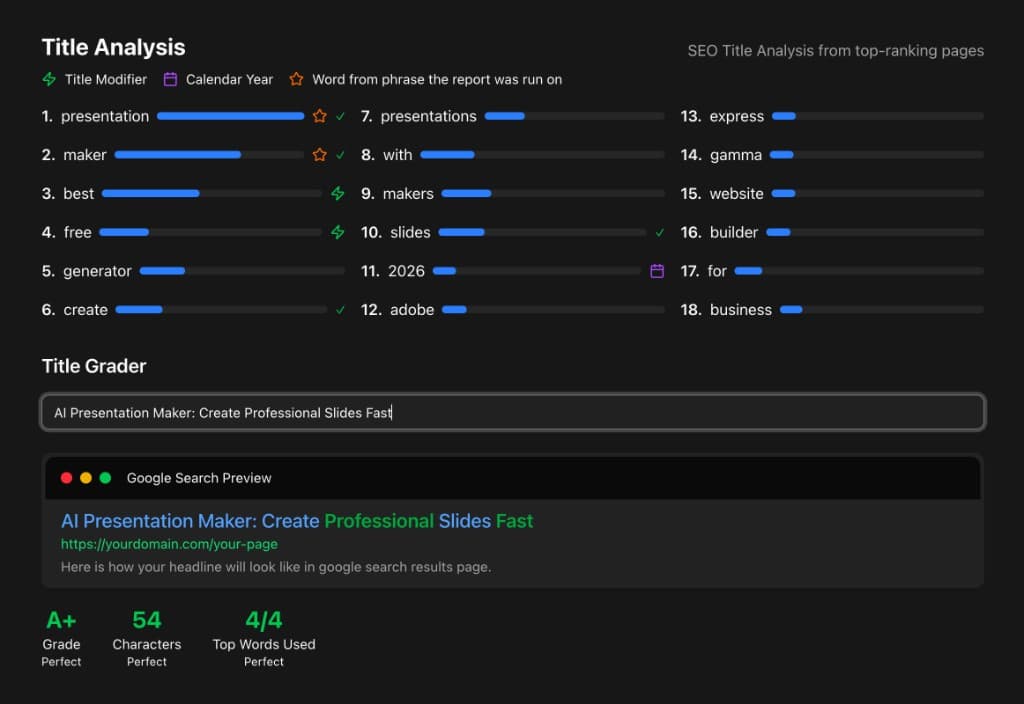
This is the workflow: SERP pattern -> candidate title -> preview -> tighten.
A Practical Title Audit Loop
Here is the loop I use:
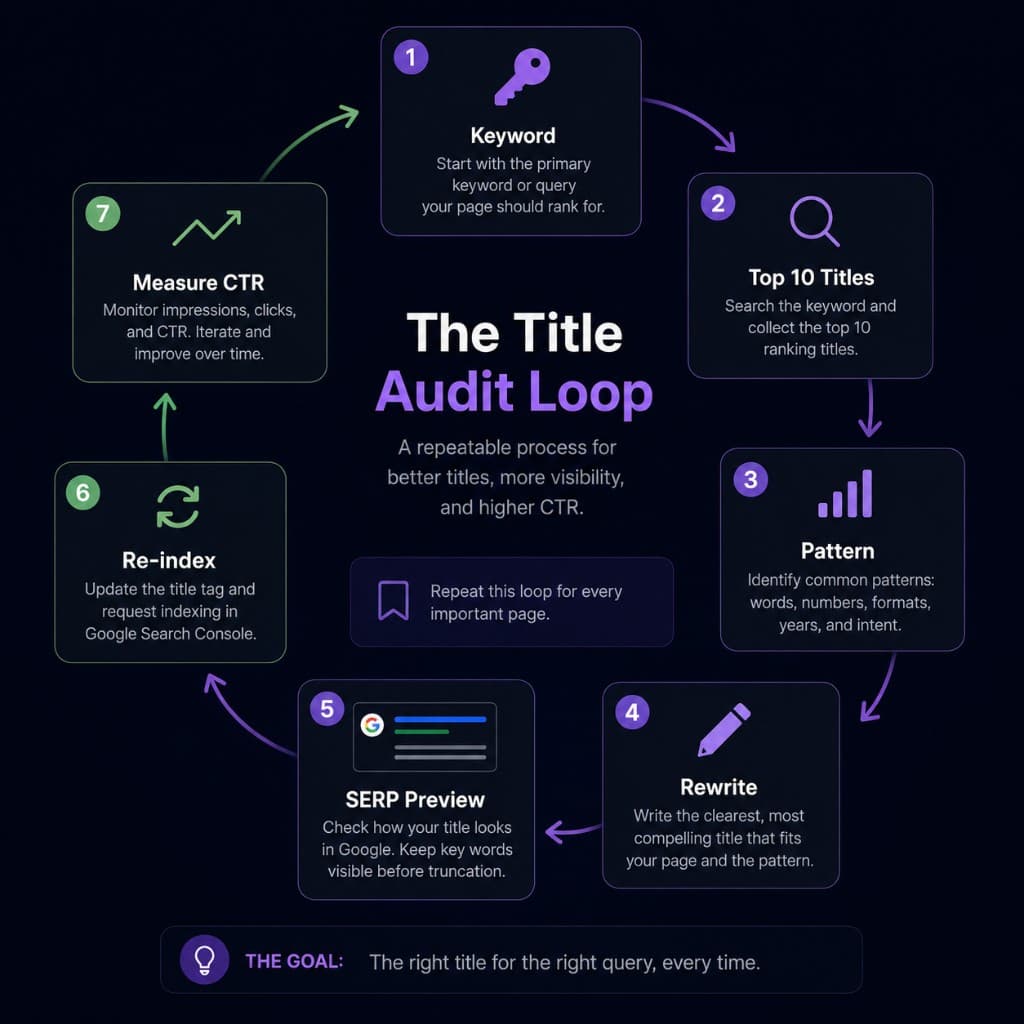
This is the loop: find the pattern, rewrite the title, preview it, re-index, then measure CTR.
- Pick the target keyword.
- Search it in Google.
- Pull the top 10 titles.
- Note repeated words, numbers, years, and modifiers.
- Check the page type and search intent.
- Write 5-10 title options.
- Keep the important words under the cutoff.
- Align title, meta description, H1, and slug.
- Re-index the page.
- Measure CTR in Google Search Console.
If a page has high impressions and low CTR, the title is often the fastest win.
Not always. But often enough that you should check it before launching a 4-month content strategy.
Bulk Fix Titles in Cursor
If you have dozens of weak titles, you can turn this into a repeatable Cursor workflow.
Use an Agent Skill for title rewrites: Cursor Skills are reusable instruction files that teach the agent a specific workflow, and Cursor automatically discovers them from skill directories like .cursor/skills/ or .agents/skills/ (Cursor Skills docs).
Create this file in your project:
.cursor/skills/seo-title-optimization/SKILL.mdThen add:
---
name: seo-title-optimization
description: Rewrite and audit SEO page titles, title tags, MDX frontmatter titles, H1 alignment, and bulk title improvements. Use when the user mentions titles, title tags, SERP titles, metadata titles, SEO titles, CTR, truncation, or asks to improve titles across pages.
---

# SEO Title Optimization

Treat the SERP as the brief.

For each title:

- Put the primary query near the front.
- Align title, meta description, H1, and URL slug around the same topic.
- Match the page type: pricing, support, docs, login, product, comparison, review, guide, pillar, definition, how-to, or listicle.
- Keep important words visible before truncation.
- Use 40-55 characters as the ideal range when possible.
- Prefer human clarity over keyword stuffing.
- Make every title unique.
- Mirror SERP patterns when useful: best, top, numbers, year, comparison terms.
- Avoid changing slugs just to match temporary numbers or years.

Workflow:

1. Identify the primary keyword.
2. Determine search intent.
3. Compare top-ranking titles when SERP data is available.
4. Choose the right title pattern.
5. Draft 3-5 title options.
6. Pick the title that is accurate, concise, and most likely to earn the click.
7. For bulk work, return a before/after table.
Then ask Cursor something like:
Use the seo-title-optimization skill to audit all MDX blog post titles in content/blog.
Return a before/after table with suggested titles around 40-55 characters when possible.
Do not edit slugs.
The skill can tell the agent to:
- Read the current title, H1, description, and slug.
- Identify the primary query.
- Compare against top-ranking patterns if research is available.
- Rewrite the title around 40-55 characters when possible.
- Keep titles unique.
- Avoid changing slugs with numbers unless you mean to.
- Return a before/after table.
That gives you a bulk title improvement workflow without re-explaining the rules every time.
Title Tag Checklist
Before publishing, ask:
- Is the primary keyword near the front?
- Does the title match the page type?
- Is it unique?
- Is it around 40-55 characters when possible?
- Would the important part survive truncation?
- Does it match the H1, description, and slug?
- Does it mirror the SERP without copying it?
- Does it sound human?
If yes, ship it.
If no, tighten.
Final Take
Better page titles are one of the highest-ROI SEO fixes because they sit at the intersection of ranking and CTR.
A title should not be clever first.
It should be clear first.
Put the query up front. Match the page. Mirror what already wins. Keep the title tight enough to survive Google. Then watch Search Console and iterate.
That is not glamorous SEO.
It is the kind that works.