

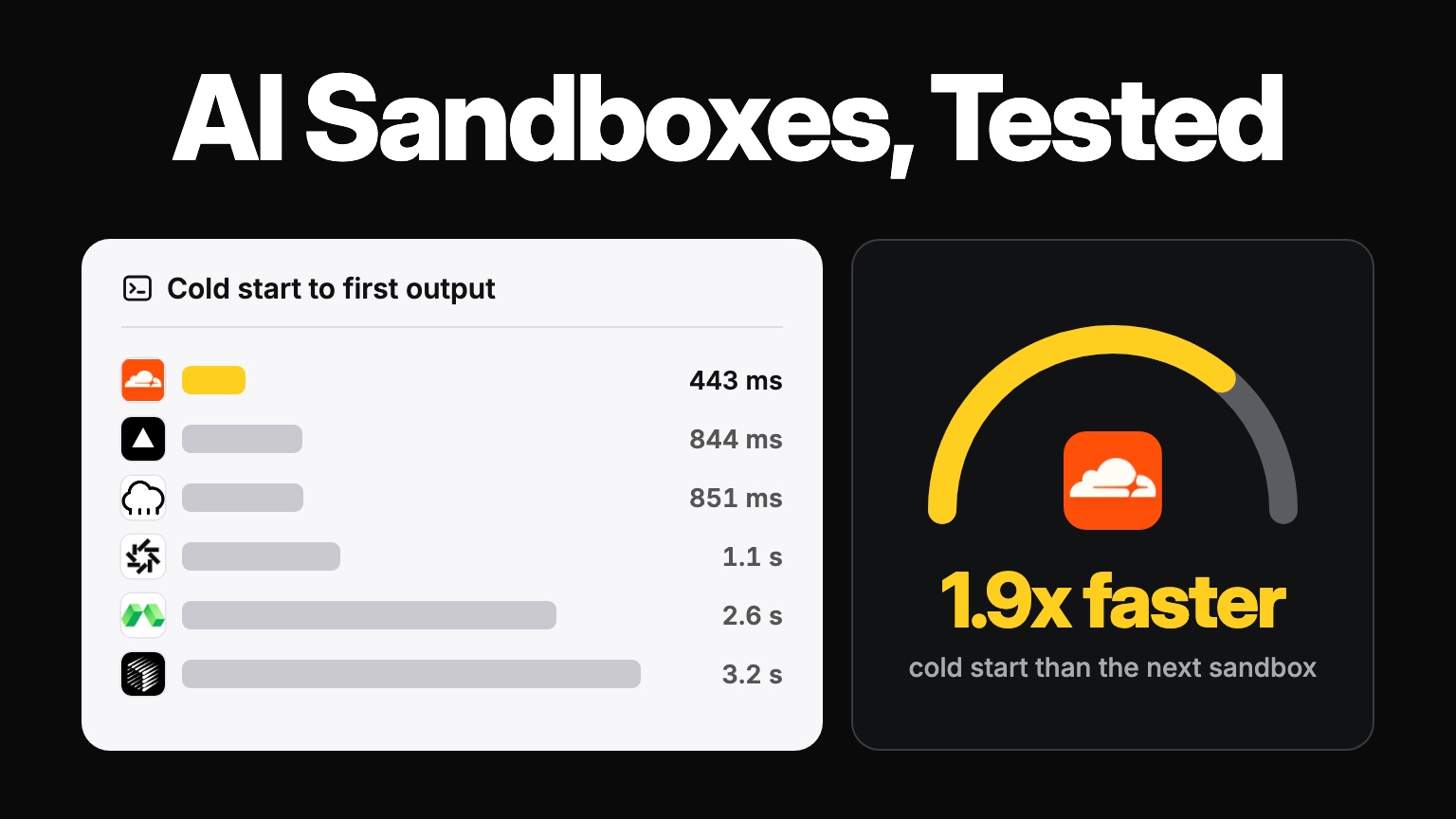
The cheapest sandbox had the fastest CPU. InstaBox costs $0.004 per vCPU-hour and beat every bigger name on raw compute. Cloudflare Sandbox had the fastest cold start (443 ms) and warm exec (117 ms). Freestyle kept a live process in RAM across a 1.10s pause and resume. Vercel's "2 vCPU" is one physical core with two HyperThreads. Daytona caps self-serve at 500 vCPUs and blocks open internet until a $500 top-up. Pick by workload, not by logo.
The cheapest sandbox I tested, InstaBox at $0.004 per vCPU-hour, posted the fastest single-core score of all six (187 ms on 500k SHA-256 hashes) and scaled cleanly to 4 cores (164 to 186 ms wall time). Cloudflare Sandbox booted about 2x faster than everyone else (443 ms client, 57 ms on the server) with a 117 ms warm exec, while Vercel Sandbox's "2 vCPU" machine choked when I ran 2 workers in parallel (745 ms median, a HyperThread penalty). Freestyle paused and resumed a VM with a live process still in RAM in 1.10s, Modal's billing API showed a 62-second idle wait costing $0.000359, and all 3 providers whose free credits I checked live (Daytona, Modal, Freestyle) held part of them back until I added a card.
I ran all of this between November 23 and 25, 2026, with my own accounts, real SDKs, and no review keys. None of these providers has an affiliate program (I checked 10 of them, 0 had one), so nobody paid for placement here.
Why I ran this
On November 24 a founder posted on X that they urgently needed alternatives to Daytona "without rate limits" and with access to 2,000+ vCPUs. That is 4x the highest self-serve tier Daytona documents.
The replies were the usual mix of logos and vibes. Nobody posted a number. I build agent products, I pay for these boxes, and I wanted to know which ones actually hold up when you go from 1 sandbox to a fleet.
So I signed up for 13 providers, got 6 of them running end to end, and ran the same test suite on each one.
How I tested
Every live-tested provider got the same five tests, through its official SDK or REST API:
- Cold start: create a sandbox and time it until the first
echocomes back. 5 fresh runs, p50 and p95. - Warm exec: run a short Python command in an already-running sandbox, 5 times.
- Persistence: write a file (and where possible start a background process), pause or snapshot, resume, check what survived.
- Idle billing: sit idle for about 60 seconds, the way an agent waits on LLM tokens, then read the provider's own usage meter.
- The vCPU test: read
/proc/cpuinfo, then hash 500,000 SHA-256 values in Python on 1, 2 and 4 parallel workers.
I also hit example.com from inside each box to see if outbound internet works by default. Every sandbox, snapshot and container was deleted after the run.
One honest caveat: client-side times were measured from Southeast Asia over the public internet. Cloudflare gets a real advantage from having an edge location near me, which is why I also report its server-side numbers.
Cold start and warm exec
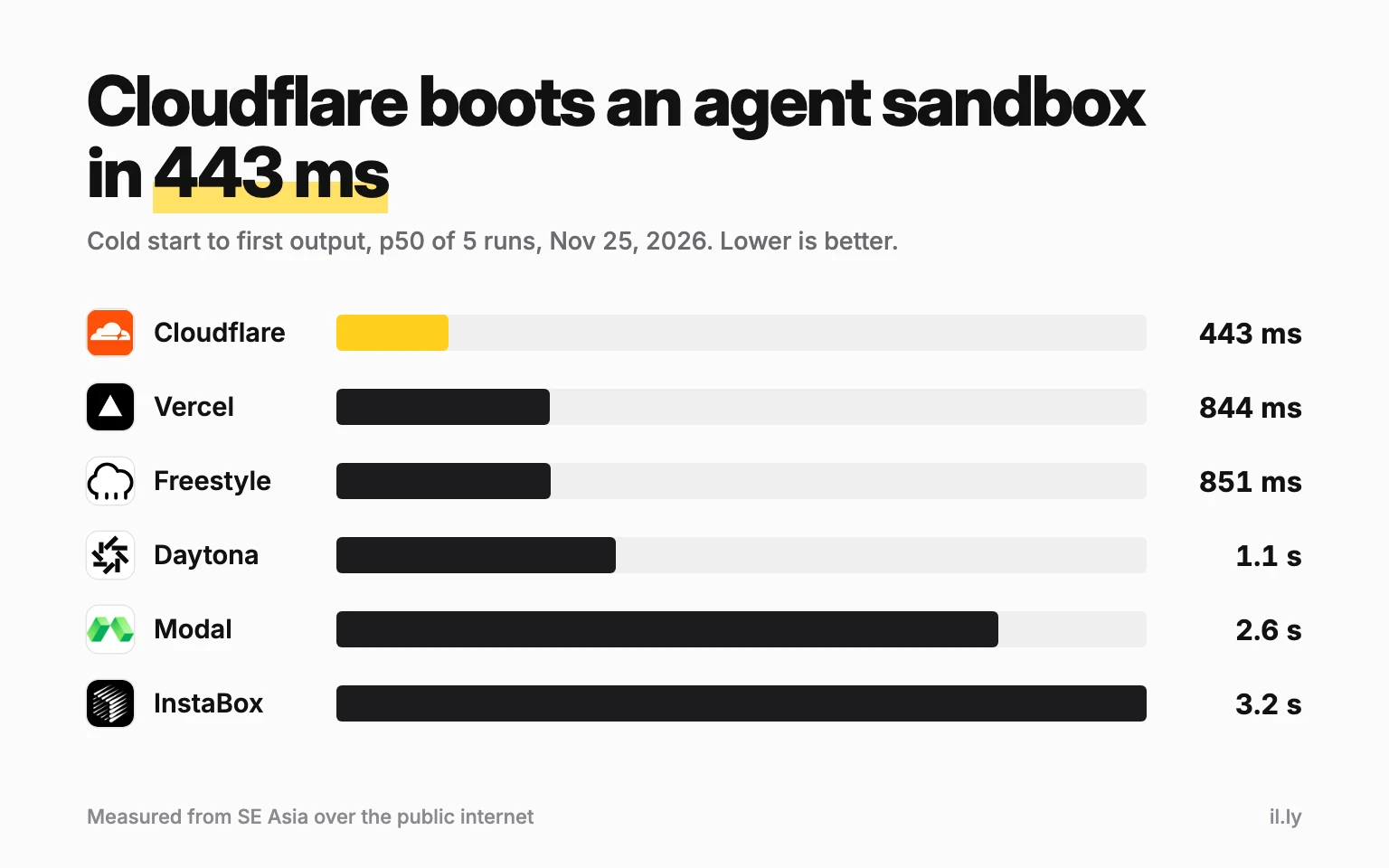
Here is how long each sandbox took to boot. The table adds warm exec and pause/resume.
| Provider | Cold to stdout (p50) | Warm Python exec (p50) | Pause to resume | Keeps RAM? |
|---|---|---|---|---|
| Cloudflare Sandbox | 443 ms (57 ms server) | 117 ms (18 ms server) | 11.28s (10.8s snapshot) | No |
| Vercel Sandbox | 844 ms (33 ms server) | 390 ms | 3.12s | No |
| Freestyle | 851 ms | 291 ms | 1.10s to 1.72s | Yes, live PID |
| Daytona | 1,107 ms | 237 ms | 2.89s | No |
| Modal | 2,621 ms | 939 ms | 2.53s | No |
| InstaBox | 3,208 ms | 791 ms | 2.92s | Yes, live PID |
Three things stood out.
Cloudflare is in its own league for latency. The container starts in 57 ms on the server side and a warm Python call takes 18 ms server-side. If your agent runs lots of tiny tool calls, that adds up fast.
Vercel and Freestyle are tied for second at about 850 ms. Vercel's Firecracker boot is only 33 ms on the server, so most of what you wait for is network and setup.
Only two providers kept a running process alive across a pause: Freestyle and InstaBox. Everyone else restores the disk, and your agent has to restart its dev server, REPL or browser. Freestyle did it in 1.10s at best, more than 2x faster than anyone else's round trip.
The vCPU lie
Same Python script, same 500,000 hashes, six very different results.
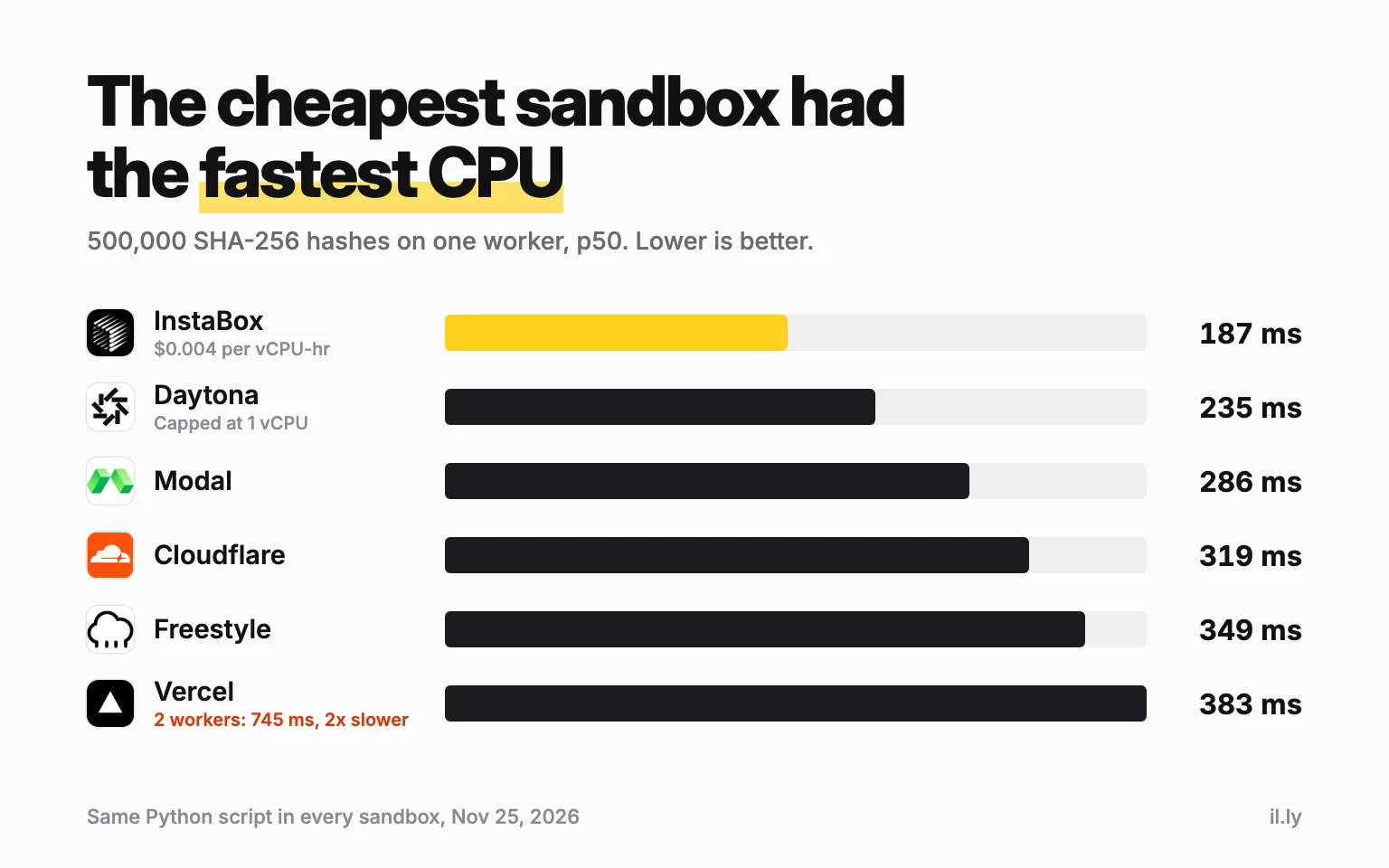
A vCPU on a pricing page tells you almost nothing. It can be a full Zen 5 core, a slice of a cgroup, or half of a HyperThreaded Intel core. So I hashed.
| Provider | CPU seen inside the box | 1 worker (p50) | 2 or 4 workers (wall) |
|---|---|---|---|
| InstaBox | AMD EPYC, 4 cores, 1 thread each | 187 ms | 164 to 186 ms on 4 workers |
| Daytona | AMD EPYC 9J45 (Zen 5) | 235 ms | Capped at 1.0 vCPU by cgroup |
Modal (cpu=1.0) | Masked by gVisor | 286 ms | 296 to 302 ms on 2 workers |
| Cloudflare | AMD EPYC 9684X (Genoa-X) | 319 ms | 316 to 354 ms on 4 workers |
| Freestyle | AMD EPYC 7003 (Milan) | 349 ms | 385 to 396 ms on 4 workers |
| Vercel | Intel Xeon @ 2.90GHz, 1 core x 2 threads | 383 ms | 676 to 770 ms on 2 workers |
The cheapest box was the fastest. InstaBox's single core was 2.05x faster than Vercel's and 26% faster than Daytona's Zen 5. On 4 workers it barely slowed down, which is what real physical cores look like.
Vercel is the opposite case. Its "2 vCPU" sandbox is 1 physical core with 2 HyperThreads. One worker runs at 383 ms. Two workers in parallel take 745 ms (median of 3 runs), almost exactly double. If you run tests, builds or anything parallel inside a Vercel sandbox, you are paying for 2 vCPUs and getting about 1.
Daytona has fast silicon but two quirks. The cgroup holds you to 1.0 vCPU, while nproc reports the host's 48 CPUs and free -m shows 193,204 MiB of host RAM. Tools that size thread pools from nproc will oversubscribe badly.
Cloudflare, Modal and Freestyle all scaled linearly. No surprises there, just slower cores than InstaBox.
The idle tax
This is the chart that matters for your monthly bill.
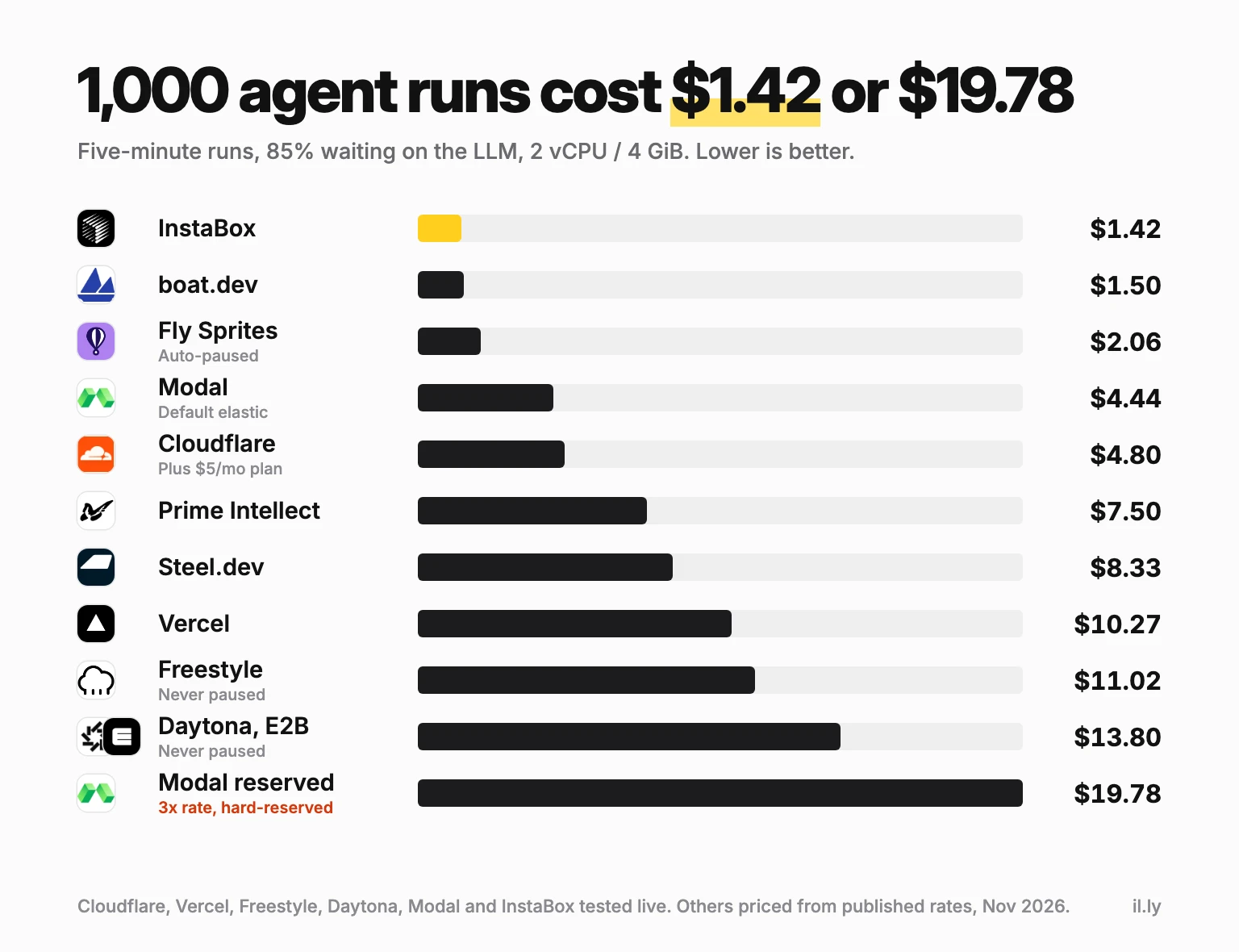
Agents mostly wait. In a typical 5-minute run, the model thinks for most of it and the sandbox sits idle. I priced 1,000 such runs at 2 vCPU / 4 GiB: 12.5 hours of active CPU plus 70.8 hours of waiting.
The spread is huge: $1.42 on InstaBox, $4.44 on Modal's default elastic setting, $13.80 on Daytona or E2B if you never pause, and $19.78 on Modal if you hard-reserve a core.
The billing model matters more than the list price:
- Active-CPU billing (Cloudflare, Vercel, Fly Sprites): CPU stops billing while you wait. On Vercel, a 62-second idle wait billed only 6.74% of the time as active CPU. Memory still bills by the clock.
- Elastic floor (Modal): Modal's own billing API showed a 62-second idle wait costing $0.00035882, within 0.6% of the math from its docs. Lowest idle burn I measured.
- Wall clock (Daytona, E2B, Freestyle, InstaBox): you pay while it runs, idle or not. Pausing or stopping is how you stop the meter. InstaBox gets away with it because the base rate is so low.
Scaling to 2,000 vCPUs
This was the question that started it all. Here is what each provider allows self-serve, without talking to sales:
| Provider | Self-serve ceiling | Entry plan | Catch |
|---|---|---|---|
| Cloudflare Sandbox | 15,000 vCPUs | $5/mo Workers Paid | Deploy a Worker, not just an API key |
| Vercel Sandbox | 10,000 concurrent, 5,000 vCPUs/min | $20/mo Pro | Ramp starts at 150 vCPUs/min, adds 500/min |
| Modal | 5,000 containers | $250/mo Team | 3x rate on sandbox CPU |
| InstaBox | 3,200 vCPUs (Builder), 16,000 (Team) | $100/mo Builder | 32 concurrent exec calls (docs conflict) |
| Freestyle | 16,000 vCPUs | $500/mo Pro | 400 VMs max, so 1,600 vCPUs at default size |
| Prime Intellect | 4,096 vCPUs, 102,400 creates/hr | Prepaid wallet | Launch rates end Dec 22, 2026 |
| Daytona | 500 vCPUs | Tier 4 ($2k top-up) | Hard cap, 4x below the ask |
At list rates, a 2,000 vCPU / 4 TB fleet costs about $17/hr on InstaBox and $18/hr on boat.dev, versus $90/hr on Prime Intellect, $132/hr on Freestyle and $165.60/hr on Daytona or E2B. That is a 9.7x spread for the same core count.
Provider by provider
Cloudflare Sandbox
The case for it: fastest cold start (443 ms) and warm exec (117 ms) I measured, clean VM isolation, linear 2 and 4-core scaling on AMD EPYC 9684X, active-CPU billing, and a 15,000 vCPU default ceiling on a $5/mo plan. For a 2,000-vCPU fleet it is the easiest self-serve answer.
The catches: snapshots are beta. Saving one took 10.8 seconds (restore was only 101 ms server-side) and they keep the disk, not RAM. You deploy a Worker and a Durable Object, not just call an API. And when I ran wrangler delete, the underlying Container application kept running and billing until I removed it with wrangler containers delete <id>. Check for orphans after every teardown.
Vercel Sandbox
The case for it: 33 ms server boot, 844 ms to first output, open egress by default, active-CPU billing that proved itself live (6.74% billed during idle), and the biggest self-serve concurrency I found: 10,000 sandboxes on the $20 Pro plan.
The catches: the CPU, covered above. Then the SDK. In @vercel/sandbox@4.1.0 the default is persistent: true, which wrote an 806.5 MiB snapshot when I called stop(). That costs $0.08/GB-month for 30 days and adds 2.4s to every stop. Ephemeral agents should pass persistent: false. The SDK also crashed on import in Bun 1.4.5 (@vercel/drives); it works fine in Node.js.
Freestyle
The case for it: full 4 vCPU / 8 GiB Linux VMs, 851 ms cold start, 291 ms warm exec, and the best persistence story here: pause and resume in 1.10 to 1.72s with a live background process still alive in RAM. Default-deny firewall, which I like for untrusted code. Runloop even sends its migrating customers here.
The catches: the no-card free tier is half the advertised one (5 VMs and 100 vCPU-hours, doubling only after a $1 card check). Pro allows 16,000 vCPUs but only 400 VMs, so at the default 4 vCPU size you top out at 1,600. Background jobs need setsid to survive the exec shell, and create/exec rate limits are not published.
InstaBox
The case for it: the cheapest rate ($0.017/hr for 2 vCPU / 4 GiB) and the fastest CPU in the test, with true 4-core scaling. Suspend and resume kept RAM and a live process (2.92s round trip). Open egress, clean isolation.
The catches: slowest cold start of the six (3.21s p50, worst run 5.1s) and a 791 ms warm exec. The Free tier allows 3 starts per minute and I hit 429 rate_limited twice. The docs contradict themselves on exec concurrency: one page says 32 concurrent exec calls on every plan, another says 32 / 64 / 256 by plan. At fleet scale that cap is the real limit, so long jobs should run in the background or over SSH.
Daytona
The case for it: fast Zen 5 silicon (235 ms single-core), quick 237 ms warm exec, $100 in credits without a card, and no CAPTCHA at signup. It is a solid sandbox for one agent or a few hundred.
The catches: this is the one the X post was about, and the walls are real. Outbound internet is blocked on the starter tier: example.com got a connection reset, only allow-listed hosts like GitHub worked. Unrestricted egress needs a $500 top-up to Tier 3. The top self-serve tier caps at 500 vCPUs. The container leaks host CPU and RAM counts. RAM-preserving pause is VM-only. And the "$200 free" is $100 without a card, $100 more with one.
Modal
The case for it: the cheapest idle behavior I measured ($0.000359 for a 62-second wait, read straight from App.sandboxes.stats()), linear scaling at cpu=1.0, open egress, GPUs on the same platform, and a 2.53s snapshot round trip.
The catches: slowest warm exec (939 ms) and second-slowest cold start (2.62s), mostly because the first exec() absorbs the container boot. Sandbox CPU bills at 3x the normal Modal Function rate. If you reserve a full core instead of using the elastic default, 1,000 runs cost $19.78 instead of $4.44. gVisor hides the CPU model and shows nproc=17. The "$30/mo free" is $1 until you add a card.
The ones I could not test
I stop at every gate instead of working around it. Here is what blocked me, which is useful data on its own.
- Fly.io Sprites:
fly.io/pricingsays you start with $1 of credit and no card.sprite loginworked, then refused to create a token: "Add a credit card to start using Sprites." The rate looks great on paper ($0.0385 per active CPU-hour, $2.06 per 1,000 runs with auto-pause), but I could not verify it live. - E2B: rejected a disposable email, then a real custom domain using Cloudflare Email Routing, then both GitHub and Google OAuth on November 25. Modal, InstaBox and Freestyle all accepted the same OAuth accounts that day. On paper E2B matches Daytona's rates exactly ($0.1656/hr) with open egress and free pause storage, but the Hobby plan caps at 1 hour and 10 sandboxes before a $150/mo jump.
- Runloop: gone. The team joined OpenAI and support ended November 13, 2026. The platform returns
503 DEPLOYMENT_PAUSEDand the API domain does not resolve. If a "best sandboxes" list still recommends it, that list is stale. - boat.dev: bare-metal EU VMs at $0.009/vCPU-hour, but the trial needs a card, extra starts cost a fee, and anything over the start limit fails with a hard
429instead of queuing. - Prime Intellect: the cleanest high-burst ceiling on paper (4,096 vCPUs, 102,400 creates per hour), but signup needs a reCAPTCHA and a prepaid wallet, with no free credits.
The full 14-provider breakdown, including browser sandboxes like Browserbase and Steel, lives on the awesome.tools sandbox matrix.
Which one should you actually pick?
- Lots of short tool calls, latency matters most: Cloudflare Sandbox. Nothing else came close on cold start or warm exec.
- A 2,000+ vCPU fleet today, self-serve: Cloudflare (15,000 vCPUs for $5/mo) or Vercel Pro (10,000 concurrent). Avoid Daytona at this size.
- Cheapest raw compute for CPU-heavy jobs: InstaBox. Fastest cores at the lowest rate, if you can live with 3-second cold starts and the exec cap.
- Long-lived agents that pause between turns: Freestyle. It is the only fast option that keeps your processes in RAM.
- Mostly idle agents waiting on LLM tokens: Modal on the elastic default. Never hard-reserve cores there.
- Parallel builds or tests inside the sandbox: anything but Vercel's 2 vCPU tier.
- One agent, a few hundred sandboxes, allow-listed hosts only: Daytona is fine and fast.
My own default after this: Cloudflare for interactive agents, InstaBox for cheap heavy compute, Freestyle when the agent needs to sleep and wake up with its state intact. Prices and limits move fast in this market, so I will rerun these tests when the providers ship changes.