
Prop firm trailing drawdown and fee calculator
Pick a plan, enter your trading days, and see where the max loss floor sits and how much room is left. Then count what the account costs once failed attempts and activation are added. The presets use rules and list prices I read on each firm's own pages on 8 October 2026. Every rule field is editable.
1. Account rules
The Maximum Loss Limit trails the end-of-day balance and locks at the starting balance. Topstep checks it in real time, open trades included. The daily loss limit is optional.
The highest level the floor can reach, such as 50,000 on a Topstep 50K Combine or 50,100 on an Apex 50K funded account. Leave empty if it never locks.
Hitting it pauses the day at the limit on this plan. Leave empty for no daily limit.
2. Your trading days
Enter each day's best open P&L, worst open P&L and closing P&L. A day runs from one reset of the firm's clock to the next. The sample week is made up. Replace it with your own.
3. Where your floor is now
No day touched the floor. Reaching the $53,000 target needs $1,700 more.
White line: closing balance. Grey bars: each day's high and low. Amber line: the floor after each close. Within a day the calculator assumes the high came before the low, the worst case for an intraday trailing floor. It doesn't model consistency rules, minimum days, contract limits or time limits.
4. What it costs to get funded
Topstep 50K Combine: $296 to reach a funded account. The Combine is a monthly subscription. A reset costs the monthly price again.
List prices. Monthly plans are counted inside their first billing month, so a slower pass costs more. Euro and dollar prices are not converted.
The trailing drawdown formula
Floor = highest balance so far, minus the max loss, and never above the lock level. On an intraday account the highest balance includes open profit. On an end-of-day account it is the highest closing balance.
Take the sample week on a Topstep 50K Combine, with a $2,000 max loss that locks at $50,000. The closes are $50,400, $50,700, $50,300, $50,500 and $51,300, so the highest close is $51,300 and the floor is $49,300. Day 3 dipped to $50,000 during the session, which stayed above that day's $48,700 floor.
Run the same week on Apex's 50K Intraday Trail and it fails. On day 3 the open profit reached $52,000, which pulled the threshold to $50,000, and the pullback touched it.
How the three floors move
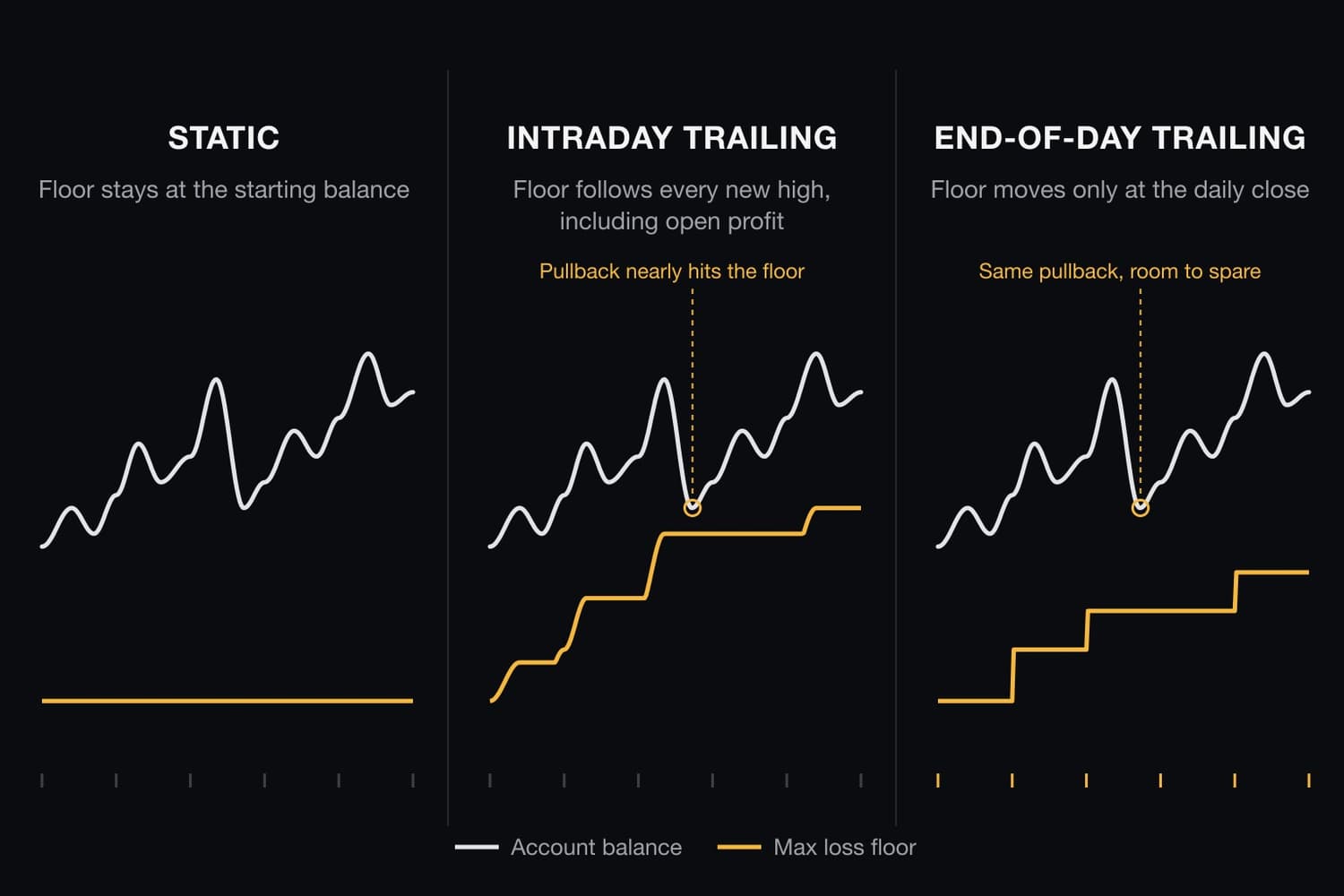
Static. The floor is the starting balance minus the max loss, for the life of the account. A winning week gives you more room.
Intraday trailing. The floor follows every new high, open profit included. A trade that runs up $1,300 and comes back has still moved the floor up $1,300.
End-of-day trailing. The floor moves once a day, from the closing balance. The same trade moves it by whatever the day closed at.
I compared the firms behind these presets on payouts, rules and fees in best prop trading firms.
Where the preset numbers come from
Read on 8 October 2026. Percent rules are shown in dollars for a $50,000 account, which is my arithmetic. Prices are list prices. I didn't buy a challenge, so none of this is a measured result.
| Plan | Max loss | Type | Daily limit | Target | First attempt | Activation | Sources |
|---|---|---|---|---|---|---|---|
| FTMO 2-Step $50K | $5,000 | Static | $2,500 | $5,000 | €345 | €0 | Trading objectives, Price list, Fee refund |
| FundedNext Stellar 2-Step $50K | $5,000 | Static | $2,500 | $4,000 | $299.99 | $0 | Stellar 2-Step, Reset price, Fee refund |
| Topstep 50K Combine | $2,000 | End-of-day trailing | None | $3,000 | $49 | $149 | Maximum Loss Limit, Pricing |
| Apex 50K Intraday Trail | $2,000 | Intraday trailing | None | $3,000 | $249 | $99 | Intraday trailing drawdown, Price list |
| Apex 50K EOD Trail | $2,000 | End-of-day trailing | $1,000 | $3,000 | $590 | $129 | EOD evaluations, EOD drawdown, Price list |
| Topstep 50K Combine, no activation fee | $2,000 | End-of-day trailing | None | $3,000 | $95 | $0 | Pricing |
| FTMO Futures Growth 50K | $2,000 | End-of-day trailing | None | $3,000 | $119 | $0 | Futures comparison table, Futures rules |
| FTMO Futures Pro 50K | $3,000 | End-of-day trailing | $1,000 | $3,000 | $139 | $0 | Futures comparison table, Futures rules |
| Topstep 50K Express, funded | $2,000 | End-of-day trailing | None | None | Funded | Funded | Maximum Loss Limit |
| Apex 50K Intraday, funded | $2,000 | Intraday trailing | None | None | Funded | Funded | Lock at start plus $100 |
| Apex 50K EOD, funded | $2,000 | End-of-day trailing | None | None | Funded | Funded | Lock at start plus $100 |
Drawdown questions
What is the difference between a static and a trailing drawdown?
A static floor stays at the starting balance minus the max loss. A trailing floor rises as the account makes new highs and never comes back down. Touch either one and the account is closed.
Does open profit move a trailing drawdown?
On an intraday trailing account, yes. Apex says its threshold adjusts upward immediately even if the position is not closed. On an end-of-day account the floor moves once a day, from the closing balance.
Does a trailing drawdown ever stop trailing?
Many do. A Topstep Combine locks its Maximum Loss Limit once it reaches the starting balance, and its funded Express account starts at $0 and locks at $0. Apex stops its funded-account threshold at the starting balance plus $100. Put that level in the "Floor locks at" field.
Can I go below the floor during the day on an end-of-day account?
No. An end-of-day rule only decides when the floor moves. Topstep and Apex still check the floor in real time, open trades included, so a deep dip during the day closes the account.