

TL;DR
- Best for forex and CFDs: FTMO (4.4). Simple 5% daily and 10% static drawdown rules on the 2-Step, €345 for a $50K challenge, and a fee that may come back with your first reward.
- Best for futures: Topstep (4.3). Starts at $49/month with an end-of-day trailing floor and a published 16.8% pass rate across 2025 Combines (51.8% of traders reach funded).
- Fastest vs slowest payouts: FundedNext (3.9) publishes the shortest approval time at a 4.74-hour median, while Apex (3.5) states the longest at 5 to 11 business days and closes each funded account after six payouts.
- Real 50K cost after two fails: $296 at Topstep, about $839.97 at FundedNext, $846 at Apex Intraday ($1,899 EOD) and €1,035 at FTMO in the 50K cost comparison, verified from each firm's public disclosures as of 8 October 2026.
Every major prop firm in 2026 puts you on a simulated demo balance, even after you pass. That means the "$2M max funding" banner on the homepage is marketing, not capital wired to a broker. What actually decides whether you get paid is whether your loss floor trails open intraday profit on a winning trade, how many consistency and buffer rules sit in front of the withdrawal button, and what a $50K account really costs once you price in a couple of failed tries.
I went through the rulebooks, pricing pages, corporate filings, and help centers for 11 firms to compare what they charge and how they pay out. Four firms get full ratings below, followed by seven more that show up on every comparison list.
Quick comparison
| Firm | Rating | Asset focus | Profit split | Max funding | Drawdown type | Challenge pricing | Link |
|---|---|---|---|---|---|---|---|
| FTMO | 4.4 | Forex/CFD, plus CME futures | 80% on 2-Step (90% after scaling), 90% on 1-Step | $400K across CFD accounts, scales to $2M | 2-Step static 10%; 1-Step end-of-day trailing 10% | €89 to €1,080 one-time; futures $119 to $269/month | |
| Topstep | 4.3 | CME futures only | 90% | 5 Express accounts; Live up to $150K | End-of-day trailing, locks at starting balance | $49 to $199/month + $149 activation, or $95 to $229/month with none | |
| FundedNext | 3.9 | Forex/CFD, plus futures | 80% standard; 60% or 90% by payout option; futures 90% to 95% | $300K across CFD accounts, $600K with Double Up | CFD challenges static; futures end-of-day trailing | $59.99 to $1,099.99 one-time (2-Step) | |
| Apex Trader Funding | 3.5 | Futures only | 100% (90% if moved to live) | 20 accounts at once, $150K largest | Intraday or end-of-day trailing, locks at start + $100 once funded | $167 to $2,190 one-time + $89 to $159 activation |
Ratings weight payout reality 35%, rule fairness 30%, cost 20% and public disclosure 15%. See How I rated them for the breakdown.
All four call the funded account simulated. You trade a demo balance, and the firm pays you a share of the simulated profit. Pick on payout rules, not on the "up to $2M" banner.
Disclosure: the FTMO and FundedNext links are affiliate links. If you buy a challenge or a futures plan through one, I may earn a commission. The Topstep and Apex links carry no referral code. A commission doesn't change a rating: the method is in How I rated them.
Rules side by side
All five plans below are for a $50K account. Percent rules apply to the starting balance.
| FTMO 2-Step $50K | FundedNext Stellar 2-Step $50K | Topstep 50K | Apex 50K Intraday | Apex 50K EOD | |
|---|---|---|---|---|---|
| Profit target | 10%, then 5% | 8%, then 5% | $3,000 | $3,000 | $3,000 |
| Max loss | 10%, static | 10%, static | $2,000, end-of-day trailing | $2,000, intraday trailing | $2,000, end-of-day trailing |
| Daily loss limit | 5% | 5% | Optional | None in the evaluation | $1,000, pauses the day |
| Minimum days | 4 per phase | 5 per phase | 2 in practice | None | None |
| Time limit | None | None | None, billed monthly | 30 days | 30 days |
| Consistency rule | Only on the 1-Step | Only on the On-Demand payout option | 55% in the Combine | 50%, on funded payouts | 50%, on funded payouts |
| Platforms | MT4, MT5, cTrader, TradingView | MT4, MT5, cTrader, Match-Trader | TopstepX, Quantower | Rithmic, Tradovate, WealthCharts | Rithmic, Tradovate, WealthCharts |
| Funded at once | $400K in total | $300K in total | 5 Express accounts | 20 accounts | 20 accounts |
Plug your own daily P&L into the prop firm drawdown calculator to see how these floors behave across a week of trades, including on funded accounts.
Pick by market and trader type
Forex, gold and index CFDs. Go with FTMO's 2-Step if you want clean risk rules: a 5% daily limit and a 10% static drawdown floor that never moves against you. FundedNext's Stellar 2-Step lowers the Phase 1 target from 10% to 8% at a cheaper entry price, but you have to watch the funded-account fine print. Compare leverage, commissions and news rules in the forex table.
Futures. Pick Topstep if you want an end-of-day trailing drawdown, cheap monthly entry, and published pass data. Pick Apex only if you plan to copy-trade across up to 20 accounts for a 100% split and accept that every funded account closes after six payouts. See Apex vs Topstep for the full head-to-head.
Not sure which market. FTMO and Topstep lead different markets, and FTMO now sells a monthly futures plan too. See FTMO vs Topstep.
You let winners run and give some back. Stay away from intraday trailing drawdowns. Topstep, Apex EOD and both static CFD challenges only move the floor at the daily close, or never.
You hold over the weekend. FTMO's Swing account is the clean pick here, with no weekend or news restrictions (FTMO only shows its price at checkout). Every futures firm forces you flat before the afternoon close.
You trade the news. FTMO Futures allows news trading in every phase (futures news FAQ). On CFDs, FTMO's Standard funded account blocks trades 2 minutes either side of a listed release, and FundedNext keeps 60% of the profit (you keep 40%) from trades opened or closed within 5 minutes of high-impact news. Apex lets you trade news directional moves, but bans straddling a release with orders on both sides.
You run a bot. Apex bans bots outright, and FundedNext's pages contradict each other on whether EAs are allowed. FTMO allows EAs as long as your bot stays under 2,000 server requests a day (strategies FAQ).
You want the lowest entry price on a 50K account. Topstep starts at $49 a month. You can buy a tiny $6K CFD challenge at FundedNext for $59.99, but for a real 50K balance Topstep is the cheapest ticket in.
You want crypto payouts. FundedNext pays in USDT and USDC, and FTMO lists crypto payouts. Topstep and Apex only pay to bank accounts or payment apps.
United States. All 11 firms accept US traders, with platform and payout quirks you should check in the US table before buying. FTMO routes US CFD traders to ftmo.oanda.com at higher dollar prices ($619 for a $100K 2-Step vs €540 globally) with Revolut wire as the only payout option, and FundedNext restricts US traders to Match-Trader. For futures, Topstep pays US banks instantly via Aeropay once approved (if your bank supports real-time payments), and Apex pays via ACH to a US bank in your name.
More firms the lists include
Most prop firm roundups also include these seven firms. Here are their core 50K rules and published pass rates:
| Firm and plan | Market | 50K entry price | Max loss at 50K | Split | First payout | Pass rate it publishes |
|---|---|---|---|---|---|---|
| Tradeify Select | Futures | $165 one-time, no activation | $2,000, end-of-day trailing, locks at $50,100 | 90% | Flex: 5 winning days. Daily: above a $2,100 buffer | 17.2% of evaluations and 40.3% of people, August 2025 to July 2026 |
| MyFundedFutures Rapid | Futures | $209 one-time, no activation | $2,000, end-of-day trailing in the evaluation, intraday once funded | 90% | 24 hours after the first trade, above a $2,100 buffer | 19.97% of "evaluation participants", no period given |
| Take Profit Trader | Futures | Reported ~$170/month (from promo FAQs) + $130 activation | $2,000, end-of-day trailing in the Test, intraday once funded | 80% | From day one, once the balance clears a buffer equal to the drawdown | 36.22% of 2025 Tests (archived page) |
| Lucid Trading Flex | Futures | Not listed in help center; no activation fee | $2,000, end-of-day trailing, locks at $50,100 | 90% | 5 days of $150+, with no buffer | None |
| TradeDay Quick Pay, end-of-day | Futures | $175 a month at list (runs coupon sales). No activation fee on the cards | $2,000, end-of-day trailing in the evaluation, intraday once funded, locks at $50,000 | 50% under $4,000 of profit, then 80% | After one day of trading, $250 minimum | 36%, January to June 2026. It doesn't say what it counts |
| FundingPips 2 Step Standard | Forex/CFD | Reported $299 | 10%, static | 60% weekly up to 100% monthly, by payout cycle | 7, 14 or 30 days, by cycle | None |
| The5ers High Stakes | Forex/CFD | $249 | Its pages say both 8% and 10% | 80%, rising to 100% | 14 days after funding | None |
A few catches in their fine print worth knowing before you buy:
- Tradeify shows six different "total paid" figures across its own pages, ranging from $40M+ to $350M+.
- MyFundedFutures switches its Rapid plan from end-of-day trailing in the evaluation to intraday trailing once funded, bans top-tier news on Rapid funded accounts, and still describes resets in its help center even though the Rapid page says there are none.
- Take Profit Trader also switches from end-of-day trailing in the Test to intraday trailing once funded, and takes a $50 fee on withdrawals of $250 or less.
- Lucid Trading gets pitched as a 15-minute payout firm because one help article says payouts average "about 15 minutes once approved", while its payout pages say funds arrive "within 2 business days".
- TradeDay keeps 50% of Quick Pay withdrawals until your lifetime profit passes $4,000, pauses funded sim accounts for review at $10,000 of gross profit (forfeiting anything above that), and can't move Canadians outside Ontario to a live account. Its product cards say there is no activation fee, while its funding-steps article still lists "Pay The Activation Fee".
- FundingPips updated its rules on 28 September 2026 and restricts US and Canadian residents to Match-Trader.
- The5ers scales High Stakes to $500,000 (the "$4M" headline applies to two other programs), charges a 3.5% payout fee unless you take site credit, limits US residents to TradingView on the web, and prices the 10% Phase 1 version at $249.
Tradeify, MyFundedFutures, TradeDay and Take Profit Trader publish pass rates, while FTMO, FundedNext and Apex do not. See the full breakdown in prop firm pass rates.
Prop firms with the fastest payouts
"Fastest payout" means two different things: how many days you have to trade before you are allowed to click withdraw, and how fast the money hits your account after you do. Among the four rated firms, FundedNext approves withdrawal requests fastest and Topstep delivers fastest to US banks. Apex is the slowest on both counts.
| Firm | First payout | After that | Methods | Stated processing | Limits |
|---|---|---|---|---|---|
| FTMO | Day 14 after your first funded trade | On request; older terms say every 14 days | Bank wire, Visa Direct, Mastercard Send, Skrill, crypto | Review 1 to 2 business days, payment 1 to 2 business days | $20 minimum by wire, $50 by crypto |
| Topstep | 5 winning days of $150+ (or 3 days on the Consistency path) | Same count again per cycle | Aeropay, ACH, Prop-to-Brokerage (US); Wise (Canada, UK, China); wire | Approval 1 to 3 business days, then the method | 50% of balance per request; $2,000 cap on a 50K Standard |
| FundedNext | 21 days on the 2-Step Standard option, 3 profitable days on 3-Day, any day once up 2% on On-Demand; 5 business days on 1-Step | 14 days on 2-Step Standard | USDT (ERC20, TRC20), USDC, RiseWorks, bank, card, Confirmo | 24 hours or $1,000 added; bank transfer excluded | Bank minimum $1,000; card maximum $3,000 |
| Apex | 5 qualifying days ($200+ on a 50K Intraday) | Up to weekly | ACH (US), Plane (international) | "Most users receive payouts within 5 to 11 business days" | $500 minimum; 6 payouts, then the account closes |
Every withdrawal runs on two clocks: firm approval first, then the bank, card network or blockchain rail. It is the exact same split that governs casino withdrawals. FundedNext claims a 4.74-hour median approval time on its reward page.
Your bank location matters just as much as approval speed. Apex pays international traders only to a bank in their declared country of residence, and US traders only by ACH to a US account in their own name (international payouts). If you are an American living abroad, you will hit the same residency and bank-address checks I covered in keeping a US address abroad.
If you want to pull money out on day one or two of a funded futures account, three unrated firms let you do it once you clear their profit buffer: MyFundedFutures (24 hours after your first trade above a $2,100 buffer), Take Profit Trader (from day one above a buffer equal to the drawdown, claiming 5 to 10 seconds to its internal wallet and up to 12 business hours to your bank), and Tradeify's Daily path (above a $2,100 buffer). Check their catches in More firms the lists include.
What a 50K account really costs
Most traders don't pass on their first try. Here is what a funded 50K account actually costs at list price if you fail twice and pass on your third attempt:
| Firm and plan | First attempt | Two more attempts | Activation | Total to funded | Refunded later | Payout fees |
|---|---|---|---|---|---|---|
| FTMO 2-Step $50K | €345 | €690 (no reset discount) | €0 | €1,035 | €345 may come back with the first reward | No FTMO commission |
| Topstep 50K Standard | $49 | $98 (two resets at $49) | $149 | $296 | No | $30 ACH or wire; no Topstep fee on Wise or Aeropay |
| FundedNext Stellar 2-Step $50K | $299.99 | about $539.98 (resets ~10% off) | $0 | about $839.97 | Latest reset fee, with the first reward | Up to 3.5% processing fee |
| Apex 50K Intraday | $249 | $498 (no resets; you rebuy) | $99 | $846 | No refunds | None published |
| Apex 50K EOD | $590 | $1,180 (no resets; you rebuy) | $129 | $1,899 | No refunds | None published |
You can adjust the number of failed attempts in the prop firm calculator to run your own numbers.
- Topstep is the cheapest route to funded at list price, and FTMO costs the most upfront. FTMO's total is in euros, and it says the 2-Step fee may be refunded with your first reward, so a trader who gets paid can recover €345 of the €1,035.
- Coupons can reorder this table. Apex runs coupon codes often, and they cut the evaluation price but never the activation fee. The prices here are list prices, so check the live price.
- Topstep's monthly price is a subscription. It rebills every 30 days until you pass or cancel, and a reset costs another month's price.
- The real fee sits after funding. FundedNext takes up to 3.5% of each payout. FTMO's 2-Step keeps 20% of profit until you qualify for 90%. Apex caps what a 50K account can ever pay out at $14,500.
Forex prop firms compared
Here is how the four CFD firms compare on leverage, commissions, weekend holding and news rules:
| Plan | Leverage | Commission | Weekend holding | News rule | Swap-free | Platforms for US residents |
|---|---|---|---|---|---|---|
| FTMO 2-Step | Up to 1:100, or 1:30 on a Swing account | Not listed | Fine in the challenge. A funded Standard account must close before the weekend. Swing has no limit | None in the challenge. Funded Standard: no trades 2 minutes either side of listed releases | Not listed | MT5 or TradingView, through FTMO US |
| FundedNext Stellar 2-Step | Its pages say both 1:100 and 1:30 for forex | Not listed | Allowed. Swaps count toward the daily loss | Fine in the challenge. Funded: only 40% of the profit from trades within 5 minutes of high-impact news counts | Add-on, 10% of the challenge price | Match-Trader only |
| FundingPips 2 Step Standard | Forex 1:100, metals 1:30, indices 1:20, crypto 1:2 in the evaluation | $5 per lot on forex and metals | Fine in the evaluation. Funded: its pages disagree on whether positions are closed daily or only at the weekend. A Swing add-on lifts it | Fine in the evaluation. Funded: profit from trades inside the news window is deducted. Its pages give the window as both 5 and 10 minutes | Add-on for forex and metals. Commission rises to $10 per lot | Match-Trader only |
| The5ers High Stakes | Forex 1:100, indices and metals 1:25, crypto 1:2 | $4 per lot round trip on forex | Allowed, with a high weekend swap on indices | No orders 2 minutes either side of high-impact news. Profit made in the window is deducted | On request once funded. No price given | TradingView on the web only |
- Leverage at FundedNext. Its CFD page headlines 1:100, and the rules table on the Stellar 2-Step page lists forex at 1:30. Ask support which applies before you size a trade around it.
- Commission. FundingPips charges $5 per lot on forex and metals, and The5ers charges $4 round trip on forex. Neither FTMO nor FundedNext lists per-lot commissions on its main plan pages.
- The funded account is stricter than the challenge. FTMO and FundedNext put no news restriction on the challenge and add one once you are funded. FundingPips deducts news-window profit only on the funded account.
Prop firms for US traders
All eleven firms in this post accept US traders, though platform choices and payout methods are more limited than for international accounts.
| Firm | US residents | Paid by | Tax form | US-only limits |
|---|---|---|---|---|
| FTMO | CFDs on a separate site, FTMO US. Futures on ftmo.com. Five states excluded | CFDs: Revolut bank wire only. Futures: Wise, Revolut wire or Visa Direct | W-9 before the first payout | MT5 or TradingView only on FTMO US. Needs a US tax ID and a US bank |
| Topstep | Not on its ineligible list, and it has US-only payout rails | Aeropay, ACH ($30) or Prop-to-Brokerage | W-9. A 1099-NEC if you were paid over $600 in the year | Only a single-member LLC can be paid as a business |
| FundedNext | Yes, with its own US guide and price list | No US rail named. USDT, USDC, RiseWorks, card, or bank from $1,000 | W-9 before the first withdrawal. A 1099-NEC above $600 a year | Match-Trader only, and no EAs |
| Apex | Yes. A Texas company that pays US users by ACH | ACH to a US bank in your name | Payout form asks for an SSN or TIN | None |
| Tradeify | Yes. US-based, and its blog lists the US as accepted | Rise, or Plane where Rise isn't available | Its agreement says you are paid "as a 10-99 independent contractor". No form or threshold named | Some states can't use Rise. It doesn't name them |
| MyFundedFutures | Yes, pays US traders by ACH | Plaid/ACH or Riseworks | A 1099 from Rise, or by mail after ACH payouts | None |
| Take Profit Trader | Yes, not on its restricted list | Plaid to a US bank. $50 fee at $250 or less | W-9, signed before any withdrawal | An LLC is paid through Wise or PayPal |
| Lucid Trading | Yes, not on its restricted list | Plaid, or WorkMarket by ADP | Not listed | None listed |
| TradeDay | Not on its prohibited list. Guam, Puerto Rico and the US Virgin Islands are | Rise: US bank wire, free, or crypto | A 1099-NEC for US citizens who withdrew over $600 | Only a single-member LLC may trade as a business |
| FundingPips | Not barred, but its Prime account excludes the US | No US rail named. Crypto or Rise. Its bank transfer list doesn't include the US | Not listed | Match-Trader only |
| The5ers | Not on any of its three blocked lists | No US rail named. Rise, crypto or bank, each with a 3.5% fee | Not listed | TradingView on the web only |
FTMO US and FTMO Futures exclude five states: Arkansas, Delaware, Louisiana, Montana and South Carolina. The tax column reflects each firm's help center, not tax advice.
Prop firms for Canada
None of the four lists Canada as restricted, and Topstep and Apex say outright that Canadians are eligible. What changes is how you get paid, and what happens if a firm moves you to a live account.
| Firm | Canada | Payouts to Canada | Watch for |
|---|---|---|---|
| FTMO | Not on the CFD or futures restricted lists (who can join) | Its general methods: bank wire, Visa Direct, Mastercard Send, Skrill, crypto | A CAD account caps total allocation at CAD 480,000 |
| Topstep | Eligible, through a US-based sub-account (eligibility) | Wise, 1 to 3 business days, no Topstep fee (payout policy) | No Aeropay or ACH outside the US |
| FundedNext | Not on either restricted list. A Canadian driving licence is accepted for KYC | Its general methods: USDT, USDC, RiseWorks, bank from $1,000 | "Canada (except Ontario)" is reviewed case by case for live futures (futures countries) |
| Apex | Says Canadians "can fully utilize our services" (restricted countries) | Plane, to a Canadian bank in your name | Canadians can't buy a live Tradovate account |
Ontario is the province to watch. In September 2023 the Ontario Securities Commission issued a cease trade order against the prop firm My Forex Funds. The US case against it was later thrown out, and by December 2025 the OSC had filed no formal allegations (Wealth Professional). All four firms describe their funded accounts as simulated.
Payout proof: what each firm publishes
"Do they pay?" is the question behind most prop firm searches. Each firm answers it with a different kind of evidence, and none of it is audited.
- FTMO gives one total, "$650 million in rewards" by its own count, and no pass or payout rate.
- Topstep publishes a full funnel for 2025 and says it "approves 99.26% of all payout requests", with no date or method (instant payouts). Its own pages disagree on the all-time total, $1.4B+ on the homepage and $1.5B+ on the pricing page.
- FundedNext shows the most detail on its reward page: 229K+ rewards processed, a 4.74-hour median, and a claim that 55% of the traders it has paid were paid more than once. It also shows three different totals: $295.6M, $306.9M and $316.1M.
- Apex runs a public payout ledger with masked names and countries. A third-party capture recorded its cumulative total since 2022 at $872.84 million on 27 September 2026.
A cumulative total shows that payouts happen, not what share of buyers receive one. See prop firm pass rates for the firms that publish actual pass and payout percentages.
Founded year, headquarters and regulation
Evaluation prop firms aren't regulated like retail brokers because you pay a fee to trade a simulated balance rather than depositing client funds. What differs is which corporate entity signs your contract, where it is registered, and which regulated broker or clearing partner handles the rare call-up to a live account.
| Firm | Founded | Entity and headquarters | Leadership and ownership | Regulation and live-account structure |
|---|---|---|---|---|
| FTMO | Not listed | FTMO s.r.o., Prague, Czech Republic. US CFDs via FTMO US (JV Prop Corporation) at ftmo.oanda.com | Co-founder Marek Vašíček. Acquired broker OANDA on 1 December 2025 for CZK 8.79 billion (about $422M in filings) | Demo accounts with fictitious funds (general disclosure). The Czech National Bank said in 2024 that prop services may fall under MiFID depending on demo vs live models |
| Topstep | Not listed | US-based; platform TopstepX is owned by ProjectX Trading LLC (TopstepX) | Not listed | Combines and Express accounts are simulated. Affiliated Topstep Brokerage is a CFTC-registered Introducing Broker and NFA member (NFA ID 0567079), clearing through Plus500US |
| FundedNext | Not listed | FundedNext Ltd, registered in the Comoros (CFD footer) | Not listed | Says it operates under the UAE regulatory framework, with all trading simulated (regulation FAQ) |
| Apex Trader Funding | 2021 | Texas corporation headquartered in Austin, Texas (terms of use) | CEO Darrell Martin | All Evaluation and Performance Accounts are simulated ("Sim Funded"). Live program is by invitation |
| Tradeify | Not listed | Tradeify Holdings, Corp., run from Boca Raton, Florida (llms.txt); a Cyprus company acts as payment agent | Not listed | Simulated evaluations and funded accounts. Elite Live accounts are issued through regulated brokerages NinjaTrader and GFF Brokers (agreement) |
| MyFundedFutures | Not listed | US-focused futures prop firm (disclaimer); city not listed | Affiliated with Blue Row Capital (Builder plan) | Simulated accounts with no real capital deployed until Live. Builder and Pro Live accounts are underwritten by Blue Row Capital |
| Take Profit Trader | Not listed | US-based company (taxes FAQ) | CEO James Sixsmith (Finance Magnates) | Test and PRO accounts are simulated; PRO+ is a live-market account by invitation |
| Lucid Trading | Reported early 2025 | Reported as Lucid Prop Ltd by a third-party review | Not listed | Simulated evaluations and funded accounts; LucidLive accounts run through an unnamed broker partner |
| TradeDay | 2020 | TradeDay LLC, an Illinois LLC at 412 S. Wells, Chicago (terms) | Not listed | Evaluation and Funded Sim are simulated; Funded Live is a sub-account of TradeDay's master account at its broker |
| FundingPips | Not listed | FundingPips Corp, incorporated in the Comoros Union with a registered address and governing law in Dubai (archived terms) | Transfers rewards to its broker Tradin (reward methods) | All five paid models run on simulated USD accounts |
| The5ers | 2016 | Five Percent Online Ltd, registered in the UK (company number 12553363, High Stakes); governing law is Israel, courts of Tel Aviv (terms) | Lists 171 employees across 24 countries (about page) | States it is not regulated because it is not a financial institution (regulation FAQ). Evaluations run in a simulated hub |
No jurisdiction had enacted bespoke retail prop-firm regulation as of April 2026 (Finance Magnates). Belgium's FSMA and Italy's Consob both issued public warnings in 2024 noting that evaluation prop firms hold no investment-service authorization and run simulated trading (FSMA). In the US, futures firms have started registering brokerage arms instead: Topstep Brokerage is registered with the CFTC as an Introducing Broker and is a member of the National Futures Association.
Trailing, end-of-day and static drawdowns
The drawdown type decides more challenges than the profit target. Every firm puts a loss floor under your balance; touch it and the account is gone. The difference is when that floor moves up behind you.
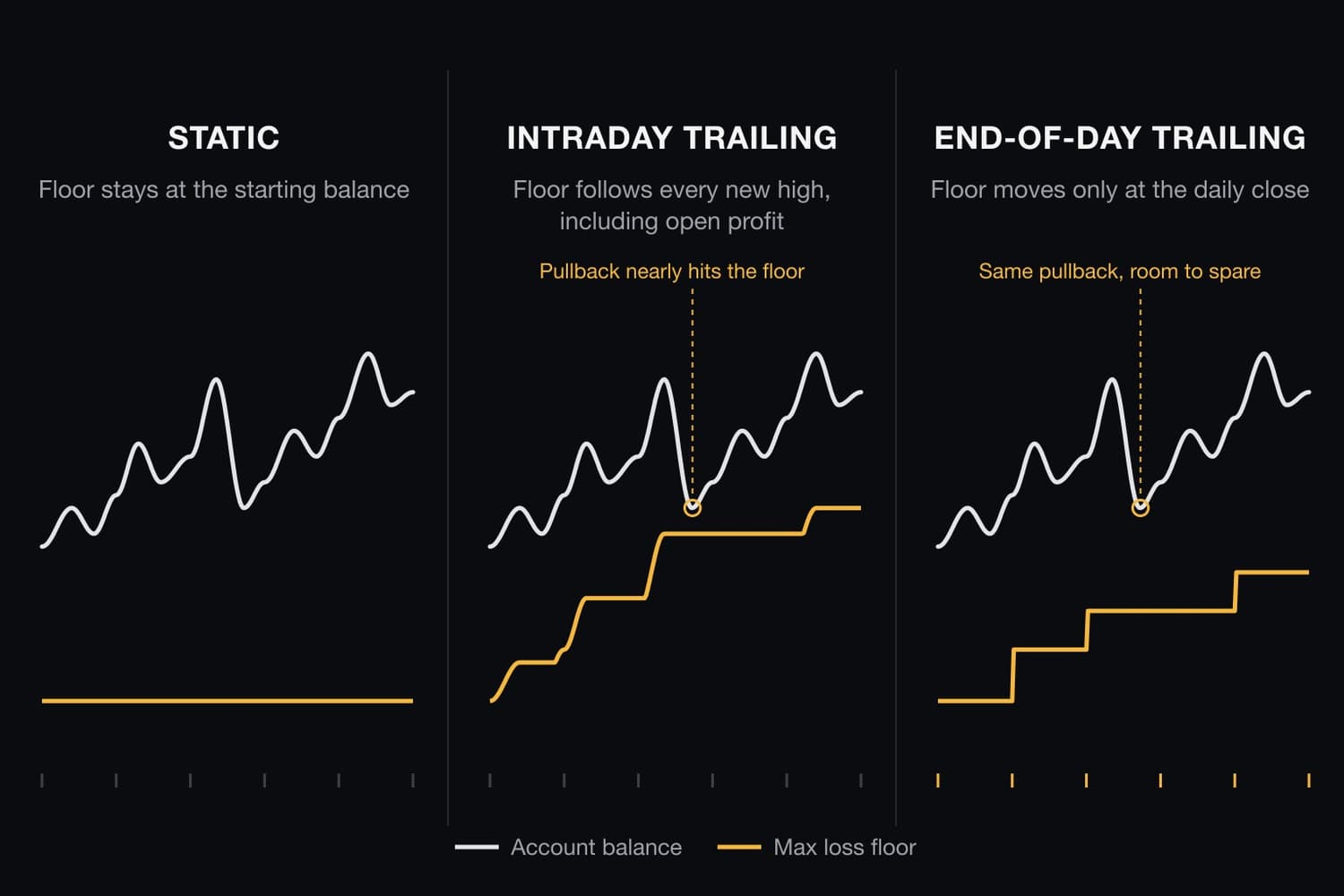
- Static (FTMO 2-Step, FundedNext CFD challenges): the floor stays fixed at your starting balance minus the max loss limit. If you start a $50K account with a 10% static drawdown, your floor stays at $45,000 forever, so a winning week gives you extra cushion to trade with.
- Intraday trailing (Apex Intraday): the floor chases every new equity high in real time, including unrealized profit on open trades. Apex's own help page states that the threshold "adjusts upward immediately even if the position is not closed" (explained). If a trade on a 50K account with a $2,000 trail runs up $1,500 in open profit and pulls back to break-even before you close it, your floor has already moved up by $1,500, leaving you $500 from blowing the account.
- End-of-day trailing (Topstep, FTMO 1-Step and futures, FundedNext futures, Apex EOD): the floor only recalculates once a day from your closing balance. Intraday spikes on open winners don't drag the floor up behind you, though every firm still enforces the current floor in real time if a trade goes against you mid-day.
Most trailing floors stop rising once they reach your starting balance. Topstep's locks at the starting balance ($0 on an Express account), and Apex's funded-account floor locks at the starting balance plus $100.
FTMO
FTMO (FTMO s.r.o. in Prague, co-founded by Marek Vašíček) sells 2-Step and 1-Step CFD challenges, plus FTMO Futures on a monthly subscription. US residents buy CFD challenges through its affiliated entity FTMO US (JV Prop Corporation) at ftmo.oanda.com. It has paid "$650 million in rewards" by its own count (trust FAQ) and finalized its acquisition of the retail broker OANDA in December 2025 for CZK 8.79 billion, about $422 million in its filings.
FTMO rules
FTMO's classic 2-Step challenge asks for a 10% profit target in Phase 1 and 5% in Phase 2, with a 5% daily loss limit, a 10% static max loss, at least 4 trading days per phase, and no time limit (trading objectives, compared in the rules table). Because that 10% floor stays fixed at your starting balance, every dollar you make gives you extra breathing room.
- How the daily limit works. FTMO tracks your 5% daily limit on live equity, including open floating losses, against your balance at midnight Prague time. If an open swing trade dips below that line before midnight, the account fails on the spot.
- The 1-Step alternative. You only need one 10% target, but the daily limit tightens to 3% and the 10% max loss trails your highest midnight balance instead of staying static. A Best Day Rule also caps your biggest day at 50% of total profitable days. Breaking that ratio doesn't fail you, you just have to keep trading until your other winning days catch up.
- News and weekend traps once funded. You can trade news and hold over weekends during the challenge, then FTMO flips the switch on a funded Standard account: no holding into the weekend, and no opening or closing trades within 2 minutes of listed news releases (news FAQ, see the forex table). If you swing trade, pick the Swing account at checkout for 1:30 leverage with no news or weekend rules.
- FTMO Futures. One evaluation phase with $3,000, $6,000 or $9,000 targets. The max drawdown trails end-of-day ($2,000 to $6,000 by size), locks once it reaches your starting balance, and requires you to be flat by 4:10 p.m. ET every afternoon (futures table). See how it stacks up in FTMO vs Topstep.
FTMO payout reality
You can request your first payout 14 days after placing your first funded trade, and FTMO states 1 to 2 business days for review plus 1 to 2 business days to send the money (withdrawal FAQ, compared in the payout table). Minimums are low at $20 for bank wire and $50 for crypto, while Visa Direct and Mastercard Send cap out at $20,000 and Skrill at $3,000. Rise isn't on the list, and FTMO doesn't name which coins it pays in.
Your profit split starts at 80% on the 2-Step and jumps to 90% once you hit the Scaling Plan: four months as a funded trader, 10% net profit across that window and at least two paid rewards. Hitting that mark also grows your balance by 25% every four months.
FTMO pricing and hidden fees
The global 2-Step costs €89, €250, €345, €540 or €1,080 for $10K to $200K. The 1-Step costs €79, €199, €319, €499 or €999. FTMO runs offers on individual sizes, and the prices here are list prices.
- Refund. FTMO says the 2-Step fee "may be refunded" with your first reward, and its terms let it offer FTMO Points as the form of that refund. The 1-Step fee is never refunded.
- Checkout surcharge. PayPal, Skrill and crypto add 3% at checkout. Cards, Apple Pay, Google Pay and Revolut Pay are free (payment methods).
- Currency adjustment. Since a terms update announced on 28 July 2026, FTMO takes 0.7% of realised profit or loss when an instrument's profit currency differs from your account currency, such as trading GBPUSD on a EUR account (trading update).
- Futures. $119, $169 or $229 a month on Growth, resets at $109 to $219, and a market data fee on Live funded accounts that FTMO doesn't publish. See FTMO Futures plans →
Topstep
Topstep runs CME futures only. Its affiliated Topstep Brokerage is a CFTC-registered Introducing Broker and NFA member (NFA ID 0567079) clearing through Plus500US, and its platform TopstepX is owned by ProjectX Trading LLC. Its help center lists only TopstepX and Quantower, with no support for NinjaTrader, Tradovate or Rithmic. You must be flat by 3:10 p.m. CT every day (products and hours).
Topstep rules
On the 50K Trading Combine, you need $3,000 in profit before touching a $2,000 end-of-day trailing Maximum Loss Limit (compared in the rules table). Step up to the 100K or 150K Combine and the targets move to $6,000 and $9,000 against a $3,000 or $4,500 loss limit. Although the floor only moves up at the market close, Topstep checks breaches in real time on open trades and "makes no exceptions" if a spike tags your floor mid-session (MLL).
- Daily loss limit. You decide whether to turn this on at checkout ($1,000 on a 50K), and you can't change your mind later. Unlike CFD firms where a daily breach kills the challenge, hitting Topstep's daily limit just liquidates your positions and locks you out until 5 p.m. CT (DLL).
- The 55% consistency rule. No single day can make up more than 55% of your Combine profit, which means you need at least 2 winning days in practice. Make $2,000 on day one of a 50K Combine and your target automatically stretches from $3,000 to $3,637 (best day ÷ 0.55, consistency). Plug your own days into the calculator to see the exact overage.
- Express Funded Account. Once funded, your balance starts at $0 with the loss floor at minus your drawdown amount ($2,000 on a 50K). That floor trails your end-of-day balance upward and locks permanently at $0 once you build $2,000 in profit or take your first payout, whichever comes first. Watch out for early withdrawals: taking a payout before you build a full cushion locks the floor at $0 and shrinks your remaining room to trade.
Topstep payout reality
When you activate an Express account, you lock in one of two payout tracks: 5 winning days of $150+ per payout on Standard, or 3 winning days of $150+ on the Consistency path with your best day kept at 40% or less of net profit (payout policy, compared in the payout table). Topstep takes 1 to 3 business days to approve requests.
- Caps by size. Each request can pull up to 50% of your account balance, capped at $2,000 on a 50K, $3,000 on a 100K, or $5,000 on a 150K Standard path. Turning on the optional daily loss limit at checkout doubles those caps under a "Limited Time" offer running since 2 June 2026, making the daily limit an easy yes for most traders.
- Method times and fees. US traders using Aeropay get instant transfers once approved with no Topstep fee, and Canadians get free Wise transfers in 1 to 3 business days. Standard ACH takes 1 to 3 business days and an international wire takes 5 to 10, each for a $30 fee. The minimum payout is $125, and there is no crypto, Rise or PayPal.
- The 90/10 split. Topstep retired its old 100% split on the first $10,000 for anyone who joined the new dashboard on or after 12 January 2026. Everyone else gets 90/10 from dollar one.
Topstep pricing and hidden fees
By size, the Standard Combine costs $49, $99 or $199 a month plus a $149 activation fee once you pass, while the No Activation Fee path costs $95, $149 or $229 a month (pricing).
- Resets cost the monthly price again and push your rebill date 30 days out. Every monthly renewal includes one free reset credit.
- Level 2 data adds $38 a month. Commissions come out of your simulated balance on every fill: $3.78 per round turn on ES or NQ in its fee table, and $3.80 in another article (fees).
- Live traders pay $133 per exchange per month for professional CME data beyond the one exchange Topstep covers, plus their own platform licence (live costs).
- Refund. A 14-day guarantee on your first Combine returns up to one monthly payment if you haven't passed.
FundedNext
FundedNext sells four CFD challenges (Stellar 2-Step, 1-Step, Lite and Instant) and three futures programs. FundedNext Ltd is registered in the Comoros, says it operates under the UAE framework, and calls all trading simulated (regulation FAQ).
FundedNext rules
FundedNext's Stellar 2-Step undercuts FTMO's Phase 1 target: you need 8% in Phase 1 and 5% in Phase 2, with a 5% daily loss limit, a 10% static max loss, a 5-day minimum per phase, and no time limit (2-Step page, compared in the rules table). If you want one phase, the Stellar 1-Step asks for a 10% target with a 2-day minimum, a 3% daily limit, and a tighter 6% static max loss.
The catch with FundedNext is that its own pages disagree on core rules, and the funded account adds three restrictions that didn't exist in the challenge:
- Conflicting daily limit math. The help center calculates the 5% daily loss as starting balance × 5%, while the tooltip on the program page calculates it from the previous day's closing balance.
- 3% open risk cap once funded. You cannot risk more than 3% of your starting balance across open trades at once. The first breach strips the profit from those trades (risk limits).
- The 60% news tax. News trading is fine in the challenge, but on a funded account FundedNext only counts 40% of the profit from trades opened or closed within 5 minutes of high-impact news (news rule, see the forex table).
- Bot ban at $50K and up. FundedNext bans expert advisors on accounts of $50,000 and above, while one of its own rule articles says EAs aren't allowed at all and the 2-Step sales page says they are. Ask support in writing before running a bot.
Futures. Flex is a single phase with a 40% consistency rule and an end-of-day trailing max loss of $1,500, $2,500 or $4,000 that locks at the starting balance plus $100. You must be flat by 3:10 p.m. CT.
FundedNext payout reality
When you buy a 2-Step or Lite challenge, you pick a payout schedule at checkout and can't change it later (reward share):
- Standard (80% split): First payout after 21 days, then every 14 days.
- 3-Day (60% split): Paid after three profitable days of 1% or more, at the cost of giving up 20% of your profit.
- On-Demand (90% split): Withdraw any day once your balance is up 2%, provided no single day makes up more than 40% of profit.
- Stellar 1-Step (80% split): Paid every 5 business days. The 1-Step split was cut from 90% to 80% for challenges bought from 12 January 2026.
FundedNext pays out via USDT (ERC20 and TRC20), USDC, RiseWorks, Confirmo, card (capped at $3,000), and bank transfer from a $1,000 minimum (withdrawals, compared in the payout table). Its 24-hour processing promise adds $1,000 to your payout if it misses the clock, though its help center excludes bank transfers while its reward page names wrong payout details as the only exception (24-hour promise). Futures accounts close after five payouts, and Flex withdrawals are capped at 50% of profit per request.
FundedNext pricing and hidden fees
The Stellar 2-Step costs $59.99 for $6K at list price (FundedNext runs coupon codes on the smallest size), then $119.99, $199.99, $299.99, $549.99 and $1,099.99 up to $200K. The fee comes back with your first reward on the 2-Step and your third on the 1-Step and Lite (fee refund).
- Payout fee. Up to 3.5% on every method, plus gateway charges (minimums and fees). That takes up to $70 off a $2,000 withdrawal.
- Add-ons are priced as a share of the challenge fee. A 95% lifetime split adds 30% on the 2-Step, Double Up adds 40% and swap-free adds 10% (add-ons).
- cTrader or Match-Trader adds a $25 platform fee, not refunded.
- Refund window. 7 days, and only if you haven't placed a trade.
- Futures fees are never refunded, and Flex prices differ between the product card, FAQ and help center. The 50K Flex list price is $133.99, and FundedNext runs coupon codes on its cards.
- Partner link. My FundedNext link (/go/fundednext) uses my partner tracking code, and I earn a commission when you buy through it.
Apex Trader Funding
The full rule set by account size is in Apex Trader Funding rules.
Apex is a Texas corporation headquartered in Austin, founded in 2021 and led by CEO Darrell Martin (terms of use). It replaced its whole product line on 1 March 2026, and has since put the old monthly accounts back on sale for a limited time. New evaluations are one-time purchases in Intraday Trail or EOD Trail versions, from 25K to 150K.
Apex rules
On a 50K evaluation, both the Intraday and EOD versions ask for a $3,000 profit target against a $2,000 trailing drawdown, with no minimum trading days and a hard 30-day window to pass (fees and access, compared in the rules table; every other size is in the Apex rules post). The Intraday version has no daily loss limit in the evaluation, but its $2,000 floor trails every tick of open unrealized profit. The EOD version adds a $1,000 daily loss limit that pauses your session for the day and recalculates its trailing floor at 4:59:59 p.m. ET from the closing balance (EOD evaluations).
Once you pass into a funded Performance Account, the rulebook gets much tighter:
- 50% consistency gate. There is no consistency rule in the evaluation, then Apex adds a 50% rule on every payout. It blocks the payout button instead of failing you: your largest profitable day must be under half of net profit since the last payout (consistency).
- Tiered daily loss limit. Your funded account gets a tiered daily loss limit that includes open losses.
- Mandatory stops and no bots. A stop loss is required on every trade, and bots and algorithms are banned (prohibited activities).
- Use it or lose it. You need two days with $50 or more net profit in every rolling 30 days, or the account closes (inactivity).
Apex payout reality
To request a payout on a 50K account, you need 5 qualifying trading days ($200+ net profit per day on Intraday, $250+ on EOD) and a $500 minimum withdrawal, paid via ACH in the US or Plane internationally (compared in the payout table). Apex no longer uses Wise or Deel, and its payout methods page tells traders to expect funds in 5 to 11 business days.
Three restrictions govern how much money you can actually pull out of a funded Apex account:
- The $52,100 safety net. You need a balance above $52,100 on a 50K before requesting a payout, and only profit sitting above that buffer can be withdrawn.
- Six payouts, then the account closes. Payout caps rise with each withdrawal: on a 50K Intraday they run $1,500, $2,000, $2,500, $2,500, $3,000 and $3,000, and after the sixth payout the account closes (intraday payouts). That puts a hard lifetime ceiling of $14,500 on a 50K Intraday and $13,000 on a 50K EOD, whatever the account earns.
- "No Payout Denials" vs automatic denials. The homepage promises "No Payout Denials", but a withdrawal request is denied automatically if you keep trading and your balance drops below the minimum after you submit it (requesting a payout).
Apex pricing and hidden fees
List prices are $167, $249, $790 and $1,190 for Intraday, and $490, $590, $1,190 and $2,190 for EOD. Apex discounts evaluations with coupon codes, which never apply to activation fees (coupon page).
- No resets and no refunds. A failed or expired evaluation is gone, and activation fees aren't refunded either (refund policy).
- Cards only. Visa, Mastercard or Discover in your own name. No Amex or crypto.
- Commissions come out of the simulated balance. They are $1.99 per side on ES or NQ through Rithmic, $1.55 through Tradovate (Rithmic commissions).
- Professional data. If you register as a professional trader, CME data costs at least $115 a month.
How prop firms make money, and why most challenge attempts fail
Retail prop firms are closer to a paid trading tournament than a Wall Street prop desk. You pay an entry fee to trade a simulated account under strict loss limits, and fees from failed attempts cover the firm's revenue and the payouts to the minority who pass and stay within the rules. All four rated firms state upfront that the funded account is simulated. FTMO provides "demo accounts with fictitious funds" (disclosure), and Apex calls its funded account a "Simulated Funded (Sim Funded) account" (PA rules).
Because the firms disclose the demo balance on day one, the simulated balance itself isn't the trap. You get caught by asymmetric drawdown math and payout gates: hitting an 8% to 10% profit target before touching a 5% daily loss limit, or surviving an intraday trailing floor that follows unrealized open profit on a winner and stops you out when the trade pulls back. Once funded, payout rules take over. Apex requires a 50% consistency score, a $52,100 safety net on a 50K before you can request profit above it, a six-payout cap before the account closes, and automatic denial if your balance dips below the minimum after you submit a request.
Why a trader still buys a challenge instead of funding a small broker account. On a $500 personal brokerage account, a disciplined 5% month is $25, which tempts traders to over-leverage and blow the account. A challenge caps your cash loss at the entry fee, gives you a $50K simulated balance with hard daily loss rails, and pays out in real cash if you beat the rules, provided you treat the fee as a tournament ticket you can afford to lose and pick a firm with clean payout rules.
How many fail depends on what you count. Per attempt, the published rates show 64% to 91% failing:
| Source | Passed | Failed | Counted as |
|---|---|---|---|
| Topstep, 2025 | 16.8% | 83.2% | Combines started (disclosures) |
| FPFX data, 2024 | 12% | 88% | About 300,000 accounts (Finance Magnates) |
| Tradeify, August 2025 to July 2026 | 17.2% | 82.8% | Evaluation accounts started (Tradeify) |
| Take Profit Trader, 2025 | 36.22% | 63.78% | Trading Tests (archived homepage) |
| Earn2Trade, 2025 | 8.89% | 91.11% | Subscriptions (Earn2Trade) |
The full table, with every firm that publishes a rate, is in prop firm pass rates.
So "90% fail" is close for attempts at some firms and well off at others. For people it is mostly wrong. Traders buy again after a fail, and Topstep says 51.8% of its 2025 participants reached a funded account at least once. FunderPro is the exception: it says only 7.35% of the traders who buy a challenge pass (FunderPro). FTMO, FundedNext and Apex publish no current pass rate.
Passing isn't getting paid, though people do win. Topstep reports that 33.3% of its funded traders received a payout in 2025, and 0.71% of Express traders moved to a live account. Combining Topstep's 51.8% funded rate with its 33.3% payout rate means roughly 17 in 100 people who started a Combine got paid. Across 10 firms, FPFX's 2024 dataset puts payouts at 7% of all traders, or 45% of funded traders (Finance Magnates). The top firms want those winners to get paid and post their payout certificates, because real payouts sell the next wave of challenges.
Nobody says how much is fees. None of the four discloses what share of revenue comes from fees. FTMO's filings come closest. Rewards tied to 2024 sales ran 82% above the reserve it had set aside, and net profit fell to CZK 782 million on CZK 8.81 billion of 2025 revenue (CzechCrunch). Returning clients made up close to 80% of its revenue (Finance Magnates).
The CFTC alleged in 2023 that My Forex Funds took about $310 million in fees and paid out about $137 million (complaint). Those claims were never tried. In May 2025, a court dismissed the case with prejudice because the CFTC had made false statements in bad faith (Reuters).
The daily limit ends more accounts than the max drawdown. In The Funded Trader's August to October 2023 breakdown (relayed by The Forex Chronicles), 71% of failures came from the daily drawdown and 29% from the max drawdown. Topstep's help center notes a similar pattern without citing a sample or period: "Over 63% of traders have lost account in a single day."
How to avoid the most common breaches:
- Size against the daily limit, not the target. On FTMO's 1-Step, 3% of a $100K account is $3,000. If your stop loses $1,000, three losing trades end the day.
- Prefer static or end-of-day floors if you let trades breathe. Intraday trailing punishes a winner that comes back.
- Track the limits outside the platform. I helped build Rize Trade, a trading journal whose tracker follows prop-firm daily loss, position size and drawdown rules on demo accounts.
How I rated them
| Firm | Payout reality (35%) | Rule fairness (30%) | Cost (20%) | Disclosure (15%) | Rating |
|---|---|---|---|---|---|
| FTMO | 4.5 | 4.8 | 3.9 | 4.0 | 4.4 |
| Topstep | 4.3 | 4.0 | 4.6 | 4.6 | 4.3 |
| FundedNext | 4.2 | 3.6 | 4.0 | 3.5 | 3.9 |
| Apex | 3.4 | 3.3 | 3.8 | 3.5 | 3.5 |
- Payout reality (35%): Weighs the wait to a first withdrawal, payout rails, fees, caps, and stated processing times.
- Rule fairness (30%): Weighs the drawdown model, daily loss rules, consistency gates, and funded-account traps such as FundedNext's 60% news deduction or Apex's six-payout account closure.
- Cost (20%): Based on the three-attempt 50K cost scenario at list price, plus fee refunds. I left coupon codes out because they change every week. FTMO loses ground here because €1,035 is the highest upfront bill, even if the €345 2-Step fee comes back with your first reward. Apex scores lowest at $846 on Intraday and $1,899 on EOD, with no resets and no refunds.
- Disclosure (15%): Rewards published pass and payout rates, and docks points when a firm's own pages contradict each other. Topstep is the only one of the four that publishes its full 2025 funnel, though it loses a few tenths because its pages disagree on payout caps, consistency wording, and all-time payouts ($1.4B+ vs $1.5B+). FTMO drops a full point for hiding its pass and payout rates, and keeps the rest for its public Czech corporate filings and consistent rulebooks. FundedNext and Apex both lose points for conflicting rules and numbers across their own help centers.
All figures, rules and payout timelines come from each firm's pricing pages, help center and terms as of 8 October 2026, without buying or trading a live evaluation.
Prop firm FAQ
Are prop firms a scam?
The established ones pay, though the business model runs like a paid trading tournament rather than a Wall Street prop desk. You pay a fee to trade a simulated balance under strict drawdown rules, and the fees from failed attempts fund the firm's revenue and the payouts to winners. People do get paid: at Topstep in 2025, 16.8% of Combines passed, 51.8% of participants got funded at least once, and 33.3% of funded traders took a payout, which works out to about 17 in 100 starters. FPFX's 2024 multi-firm dataset puts payouts at 7% of all traders (45% of funded). The real risk sits in tight drawdown rules and payout conditions, so treat the entry fee as a tournament buy-in you can afford to lose.
Is a prop firm account real money?
Not until a firm moves you to live. FTMO, FundedNext, Apex and Topstep all run evaluations and funded accounts on simulated balances. Topstep moved 0.71% of its Express traders to a live account in 2025. Apex's live program turns your simulated balance into a "Bonus Vault" that it says is "not real money" (live FAQ).
Which prop firm pays out fastest?
FundedNext publishes the shortest approval time, a 4.74-hour median, and a 24-hour promise outside bank transfers. Topstep's Aeropay is instant for US banks that support real-time payments once approval clears in 1 to 3 business days. FTMO states 1 to 2 business days of review plus 1 to 2 business days for payment. Apex states 5 to 11 business days.
What is the difference between trailing and end-of-day drawdown?
Intraday trailing raises the loss floor on every new high, open profit included. End-of-day trailing raises it once a day from the closing balance. Static never moves it. See the drawdown diagram.
Can I use a VPN with a prop firm?
Not at Apex or Topstep, which ban VPNs and proxies outright. FundedNext terminates MT4 and MT5 accounts after a second US IP address. FTMO does not list a specific VPN ban in its public FAQ, though trading from the country on your account is the safest approach.
Which prop firm is the cheapest?
Topstep is the cheapest to start at $49 a month for a 50K Combine. If you fail twice and pass on your third attempt, reaching a funded 50K account costs $296 at Topstep, about $839.97 at FundedNext, $846 at Apex (Intraday) and €1,035 at FTMO at list price. Active coupon codes can change that order.
Can I trade news with a prop firm?
It depends on the account. FTMO Futures and FTMO's Swing account allow it. FTMO's Standard funded account blocks trades 2 minutes either side of listed releases. FundedNext counts only 40% of the profit from trades opened within 5 minutes of high-impact news. Apex allows news trading but bans straddling a release.
How many funded accounts can I have?
Apex allows 20 at once per household. Topstep allows 5 Express accounts. FTMO caps total CFD allocation at $400,000 per trader before scaling, and FundedNext at $300,000 across its CFD accounts.
Which prop firm has the highest profit split?
Apex, at 100% on its current funded accounts. FTMO pays 90% on the 1-Step and 80% rising to 90% on the 2-Step. Topstep pays 90%, and so do Tradeify, MyFundedFutures and Lucid. FundedNext pays 80% as standard, with options from 60% to 90%. The split means little without the caps next to it. Apex's 100% comes with six payouts per account.
Do prop firms actually pay?
At the firms that publish payout rates, roughly a third of funded traders receive a withdrawal: 33.3% at Topstep in 2025, 28.5% at Tradeify and 39.2% at MyFundedFutures. FTMO, FundedNext and Apex publish cumulative totals or payout ledgers rather than percentage rates.
Which prop firms accept US traders?
None of the eleven firms in this post lists the United States as restricted. FTMO sells CFD challenges to US residents on a separate site, FTMO US, and excludes five states. FundedNext and FundingPips limit US residents to Match-Trader, and The5ers to TradingView on the web. Topstep, Apex, MyFundedFutures and Take Profit Trader pay US banks by Aeropay, ACH or Plaid.
Do prop firms refund the challenge fee?
FTMO says the 2-Step fee may be refunded with your first reward. FundedNext refunds it with the first reward on the 2-Step and the third on the 1-Step and Lite. Topstep refunds up to one monthly payment within 14 days of your first Combine if you haven't passed. Apex refunds nothing.