

- What died: Spray-and-pray cold blasts (
"Dear Webmaster, I loved your post...") now land under a 0.5% positive reply rate and burn sender domains within weeks. - What works in 2026: SERP backlink-gap prospecting + AI-cited listicle outreach, pitching the exact third-party articles that already rank on Page 1 of Google or get cited inside ChatGPT and Perplexity.
- Real publisher economics: Vetted publications with real organic traffic either link to genuinely novel primary data/tools for free or charge transparent editorial/sponsor fees; reseller spreadsheets selling "$40 DR 70 links" are almost exclusively zero-traffic guest-post farms.
- Done-for-you vs. DIY: Run the 5-step 1-to-1 workflow below in-house, or order vetted, traffic-verified placements per link through
 LinkDR (from $160 at DR 30+ to $500 at DR 60+, including outreach, copy, and live link monitoring).
Running LinkDR across dozens of SaaS and technical campaigns gives me an unfiltered look at thousands of real publisher replies every month. The gap between outreach that lands DR 65+ editorial placements and outreach that goes straight to spam comes down to one rule: pitch a specific live URL with a specific gap, never a generic domain.
In 2026, backlink outreach does double duty. A contextual dofollow link on a ranking industry article passes PageRank to your target page, and when that article is one of the 5-10 sources retrieved by ChatGPT Search, Perplexity, or Google AI Overviews, getting included on it puts your product directly inside AI recommendations too (see my Generative Engine Optimization guide).
Why cold blast outreach stopped working in 2026
Every editor at a real DR 60+ software or media site receives 30 to 100 templated link-begging emails a day. Google Workspace and Microsoft 365 spam filters fingerprint classic merge-tag templates ("I stumbled upon your amazing article", "win-win collaboration", 3 bullet points pitching an unrelated blog post) across sender domains before a human ever sees them.
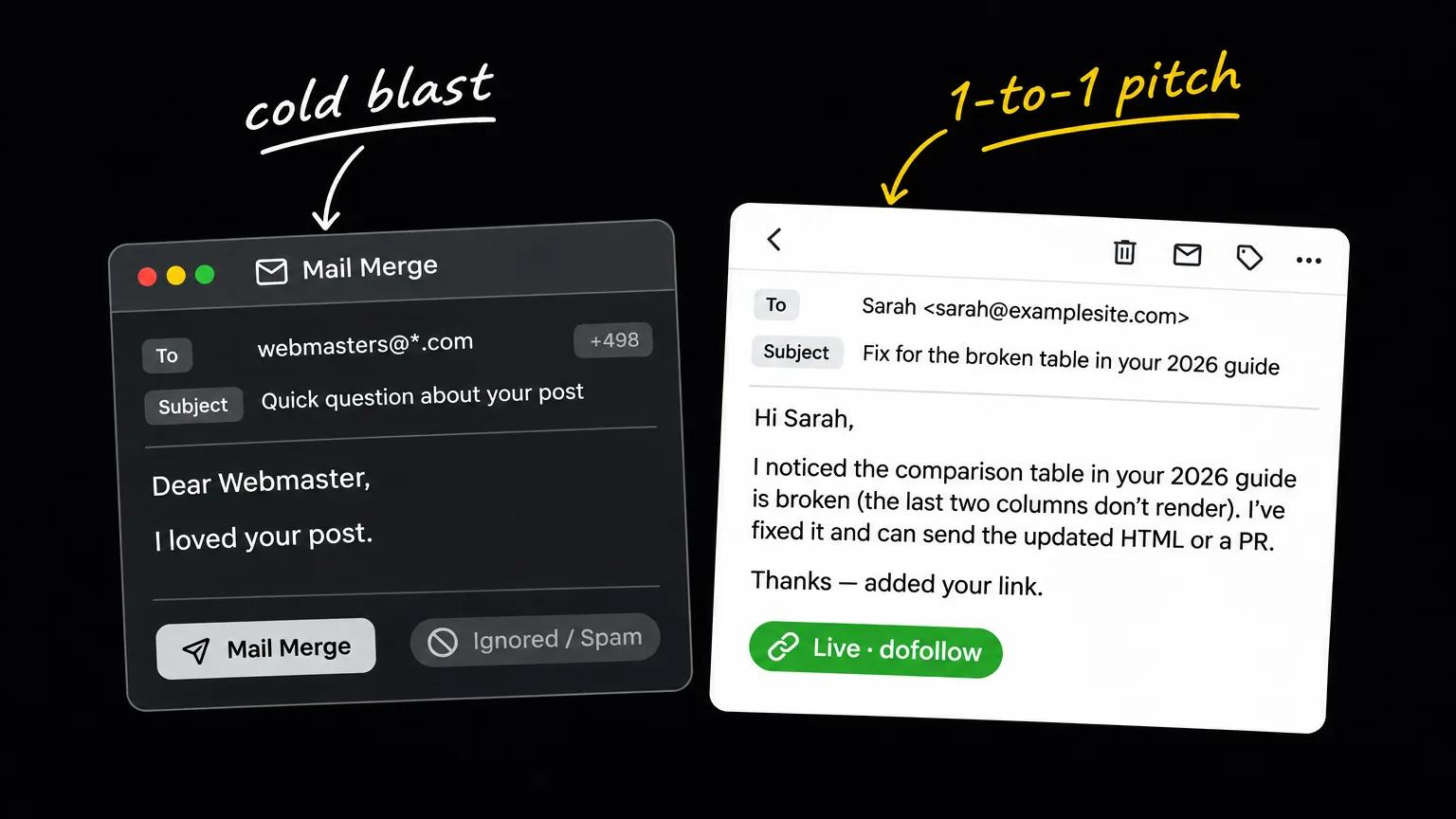
Sending 2,000 generic emails from warmed burner inboxes only surfaces one group of respondents: link farms and reseller middlemen who reply yes to everyone because selling unindexed guest posts is their entire business. Real editors reply when your subject line names the exact slug they manage and your first two sentences show an immediate improvement for that page.
Step 1: Prospect from SERP and AI citation gaps
Skip broad keyword scraping ("marketing" + "write for us"). Footprints like "write for us" or "submit a guest post" self-select for spammed link directories that Google already discounts. Build your prospect list from three high-signal sources instead:
- Competitor
"Best Links"intersect: Pull the top 3 domains outranking you for your money keyword in Ahrefs, enable the Best Links Only filter (dofollow,DR >= 35, linking page has organic traffic, exclude sitewide/footer links), and export pages linking to at least two competitors but not to you. - Ranking listicles & comparisons missing your tool: Search your core commercial queries (
"best [category] tools","[competitor] alternatives") down to position 30. Any independent blog, tech publication, or B2B media site ranking there already has Google's topical trust for your exact query. - AI-cited third-party URLs: Run 30-50 buyer prompts in AI SEO Tracker and pull the exact source URLs cited by ChatGPT, Perplexity, and Google AI Overviews. Landing an editorial mention + link on a single multi-cited roundup compounds across both organic search and AI answers.
Step 2: Filter out guest-post farms in 30 seconds
Before you spend five minutes researching a contact or paying an editorial fee, run every candidate domain through four fast disqualifiers:
| Check | Healthy Editorial Site | Link Farm / Reseller Trap (Skip) |
|---|---|---|
| Organic traffic trend | Steady or growing across niche-coherent topics | Cliff drop after a Google core/spam update, or <500 monthly visits despite DR 70 |
| Top ranking keywords | Ranks in US/UK/EU for real topics its readers search | Ranks only for random celebrity net worth, casino, CBD, and unrelated SaaS roundups |
| Outbound-to-inbound ratio | Selective external links to real products and primary sources | Every post has 2-4 exact-match commercial anchors to unrelated buyers |
| Indexing check | Recent posts appear in Google within 24-72 hours | New /sponsored/ or orphaned /guest/ posts stay unindexed in Search Console |
Cutting 70% of raw prospects at this step is why small, focused campaigns outperform 5,000-row CSV blasts.
Step 3: Find the real editor instead of generic inboxes
Pitching support@ creates a Zendesk ticket that gets closed in ten seconds. Match the inbox to the type of site:
- SaaS blogs & B2B companies (10-200 employees): Contact the Head of Content, Managing Editor, or Growth Lead directly (
firstname@domain.com), verified via Prospeo or Hunter so hard bounces stay below 2%. - Independent niche bloggers & founder sites: Email the founder or author address listed on
/aboutor the newsletterReply-Toheader. - Digital media & news publications: Check the article author first for factual updates or broken-stat replacements; use partnerships/editorial desks when proposing a contributed column or sponsored comparison update.
Step 4: Three 1-to-1 outreach templates that get replies
Keep every cold outreach email under 90 words, plain text (zero HTML tracking pixels, zero bold/colored fonts, zero attachments), and focused on one concrete URL.
Template A: Missing-option / stale-fact pitch on a ranking listicle
Use this when a blog ranks for "Best [Category]" and includes dead tools, outdated pricing, or competitors you beat on a specific constraint:
Subject: [Dead/changed tool] in your [topic] roundup

Hi [First Name],

Quick heads-up on your [exact article topic] guide ([short slug]) — #4 ([Tool Name]) raised its starter tier from $29 to $99/mo last quarter [or: shut down in April].

We built [Your Product] specifically for [1-line differentiator, e.g., Polar + Stripe teams who want 0% revenue fees at $19/mo]. Happy to send a 3-sentence summary + verified 2026 pricing row, or set up a free Pro workspace if you test tools hands-on before updating the list.

Worth sending over?

[Your Name]
Template B: Primary data or free interactive tool insertion
Editors hate linking to generic "Ultimate Guide" blog posts, but they gladly cite original benchmark numbers and free browser calculators that back up a claim they already make:
Subject: 2026 benchmark data for your [slug/topic] post

Hi [First Name],

In your piece on [specific topic], you mention [specific claim from paragraph 3]. We just ran a benchmark across [N samples / vendors] measuring [exact metric — e.g., year-3 VPN renewal jumps / 30-sample detector false positives] with the raw table published here: [URL].

If you refresh that section for 2026, feel free to pull any stat or chart from the dataset with attribution. Happy to share the underlying CSV if helpful.

Best,
[Your Name]
Template C: Technical guest article pitch (topic-locked to their gap)
Never ask "Do you accept guest posts?". Pitch two concrete headlines that match keywords their domain has the authority to rank for but hasn't covered yet:
Subject: Technical draft idea for [Site Name]

Hi [First Name],

Noticed [Site Name] ranks well for [Topic A] and [Topic B], but hasn't covered [adjacent high-intent topic] yet.

I built [Your Product / Engineering credential] and can write a practical, zero-fluff 1,500-word breakdown with real benchmarks and screenshots on either:
1. [Specific Headline 1]
2. [Specific Headline 2]

No AI slop — happy to match your exact house style. Does either fit your Q4/Q1 calendar?

[Your Name]
Step 5: Follow-ups, publisher pricing and link monitoring
Follow up once (maximum twice), never four times
Send one short reply in the same thread 4 to 5 business days later adding a single useful detail (such as a test login or a concrete 2-line blurb ready to paste). If there is no reply after 1 follow-up (or 2 at most on warm editorial desks), archive the thread and move on. Four-step "breakup email" sequences only train recipients to click Report spam.
What real placements actually cost in 2026
When you run outreach at scale, replies split into two buckets: pure editorial wins (where your free Pro license, founder quote, or benchmark data earns the link at $0 media cost) and commercial editorial updates (where independent publishers charge an insertion, review, or sponsored-update fee to cover editorial labor).
Across vetted, real-traffic SaaS and tech publications in late 2026:
- DR 30-45 niche blogs (
1k-10korganic visits/mo): typically $120-$250 direct to the owner (or earned via free annual product licenses). - DR 50-65 established software & industry sites (
10k-50kvisits/mo): typically $250-$450 direct. - DR 70-85+ Tier-1 tech & business publications (
50k-500k+visits/mo): typically $400-$1,000+ depending on editorial review requirements and permanent dofollow policy.
Verification rule: Never pay an invoice before confirming (1) the target article is indexed in Google right now, (2) the link will be contextual and dofollow without a noindex header, and (3) you monitor the live URL afterward. Roughly 8-12% of external links rot within a year due to CMS migrations, author edits, or URL restructures. Track every placement automatically with one of these backlink monitoring tools.
DIY backlink outreach vs. managed placements
Running outreach in-house makes sense when you have a recognizable developer brand, an original data study every month, or a dedicated growth hire spending 10+ hours a week prospecting, verifying emails, negotiating with editors, and writing custom drafts.
If you are a founder or lean SEO team who wants vetted placements without managing warmup domains, reseller traps, and publisher invoices, that is why I built LinkDR:
New to SEO fundamentals? Start with link building for beginners and the broader SaaS SEO strategy guide.
Frequently asked questions
What is a realistic reply rate for cold backlink outreach in 2026?
On unfiltered bulk lists, positive reply rates sit below 0.5-1%. On tightly filtered 1-to-1 SERP gap campaigns (where you email the actual editor about a specific live URL with an accurate product gap, broken reference, or primary dataset), expect 8-18% total replies and 3-8% live placements per 100 prospects contacted.
Are link insertions (niche edits) better than guest posts?
Link insertions on an already indexed, already ranking article with existing referring domains pass authority and send referral/AI-citation value much faster than a brand-new guest post starting at URL Rating 0 with zero internal links. Guest posts win when you need a dedicated 1,500-word tutorial or comparison anchor that doesn't exist on the host site yet.
Should I send outreach from my primary company domain?
Keep 1-to-1 relationship pitches from your main domain under 15-25 hand-written emails a day. If you run higher-volume prospecting sequences, send from a properly authenticated secondary domain (SPF, DKIM, DMARC aligned) that forwards web visitors cleanly to your brand so an accidental spam complaint never hurts transactional password-reset or billing emails.
How many backlinks per month does a SaaS page need to rank?
Check the referring domain gap on the specific SERP rather than chasing an arbitrary domain-wide quota. Many bottom-of-funnel "best [niche] software" or "[competitor] alternatives" pages reach the top 3 with 5 to 15 clean DR 50-80+ contextual links pointed directly at that guide alongside strong internal linking.