


As a SaaS startup, organic search traffic can be one of your most powerful channels for attracting new customers and driving sustainable growth.
However, ranking well on Google requires a comprehensive SEO strategy tailored to the unique challenges and opportunities of SaaS businesses. For more SEO resources, check out my SEO tools guide or link building guide. For tech tool reviews, see my NSFW AI chatbots guide.
In this guide, we'll walk through the key components of an effective SEO strategy for SaaS startups, including keyword research, on-page optimization, link building, technical SEO, and more.
We'll also look at real-world examples and case studies of SaaS companies that have used SEO to fuel their growth. Let's dive in!
Why SEO Matters for SaaS Startups
Before we get into the tactics, it's important to understand why SEO is so critical for SaaS companies, especially in the early stages.
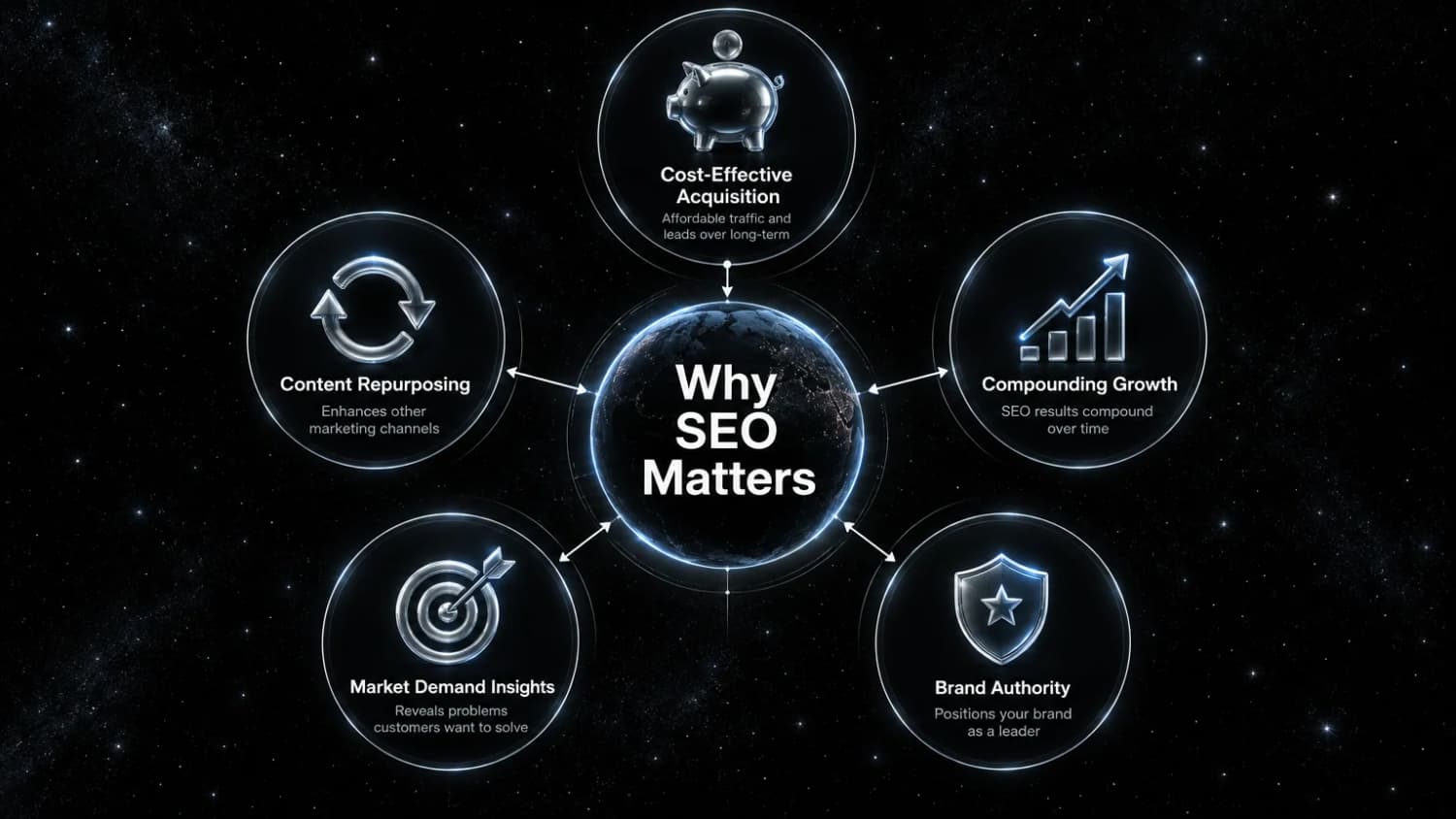
Here are a few key reasons:
- Cost-effective customer acquisition - Compared to paid advertising, SEO provides an affordable way to drive consistent traffic and leads over the long-term. This is especially important for startups with limited budgets.
- Compounding growth - The results of SEO compound over time as you build authority and rankings. Within 6-12 months, SEO can become your top channel for new signups.
- Builds brand awareness and credibility - Ranking at the top of search results for relevant keywords makes your brand more visible and positions you as a leader in your space.
- Helps you understand market demand - Keyword research reveals the problems your target customers are trying to solve and the solutions they are searching for. This insight is invaluable for product development and marketing.
- Enhances all your other marketing efforts - High-ranking SEO content can be repurposed for social media, email marketing, sales enablement, and more. It makes all your other marketing more effective.
Now that we've established the importance of SEO for SaaS, let's look at how to create an SEO strategy that gets results.
Understand Your Audience and Set the Right Goals
Every effective SEO strategy starts with a deep understanding of your target customers. Who are your ideal users? What are their key use cases, pain points, and jobs to be done? What types of solutions are they searching for?
Develop detailed buyer personas and map out the typical customer journey and marketing funnel. Identify the main stages your customers go through, from initial problem awareness to solution research to vendor evaluation and selection.
This exercise will help you determine the types of keywords to target and content to create at each stage. It ensures your SEO strategy aligns with the real needs and search behaviors of your audience.
Next, define the right goals and KPIs for your SEO program. The ultimate goal is usually revenue growth, but you'll want to measure leading indicators like organic traffic, keyword rankings, backlinks, and signups.
Choose 3-5 core metrics to focus on and establish aggressive but realistic targets. Make sure to get buy-in from key stakeholders on these goals.
Conduct Extensive Keyword Research
With your audience and goals defined, it's time for keyword research. This is the process of identifying the search queries your target customers use to find solutions like yours.
Start by brainstorming an initial list of keywords, focusing on your product's core features and benefits. Put yourself in the shoes of your ideal customer. What would you search for?
Use keyword research tools like Ahrefs, SEMrush, and Google Keyword Planner to expand your list and get search volume and difficulty scores. Look for relevant keywords with high search volume but low to medium competition.
In addition to "head" keywords that define your product category, go after long-tail keywords that align with specific use cases, features, and customer pain points. While these have lower search volume individually, they can really add up.
Categorize your keywords by intent, such as informational, navigational, commercial investigation, and transactional. Match these to the appropriate stages of the marketing funnel.
Competitive research is also key. Analyze the keywords your top competitors are targeting to find gaps and opportunities. Tools like Ahrefs allow you to see any website's top organic keywords.
Create a Content Strategy and Calendar
With your keyword research complete, map out a content strategy and calendar to target those terms. Your content strategy should include:
-
Product and feature pages - Dedicate pages to your core product, key features, and major use cases. Optimize these for your most important commercial keywords.
-
Blog posts and articles - Create informative, valuable content that targets your informational and top-of-funnel keywords. The goal is to attract your target audience and build authority.
-
Guides and tutorials - Develop comprehensive resources and how-to content to rank for "commercial investigation" keywords. Help potential customers understand how to solve their problems.
-
Case studies and proof - Showcase successful customers and data-driven results to build credibility for bottom-of-funnel searches. Prove the value of your solution.
-
Comparisons and reviews - Target "[your product] vs [competitor]" and "[your product] reviews" keywords with honest, objective content. Provide third-party validation.
Prioritize your content based on keyword priority and create a calendar to keep you on track. Aim to publish new optimized content at least 1-2 times per week.
Implement On-Page SEO Best Practices
As you create content, make sure to follow on-page SEO best practices:
- Include your target keyword in the title, meta description, URL, and H1 tag
- Use short, descriptive URLs
- Optimize your title tag and meta description for clicks
- Use your keyword and variations naturally throughout the copy
- Break up text with keyword-rich headings and subheadings
- Optimize images with descriptive alt text
- Link internally to other relevant pages on your site
- Improve page load speed and mobile friendliness
A tool like Yoast SEO can help you optimize individual pages and posts. Perform an SEO audit of existing content and make updates as needed.
Earn High-Quality Backlinks
Backlinks from other authoritative websites are a key Google ranking factor. They act as "votes of confidence" that show your site is trustworthy and relevant.
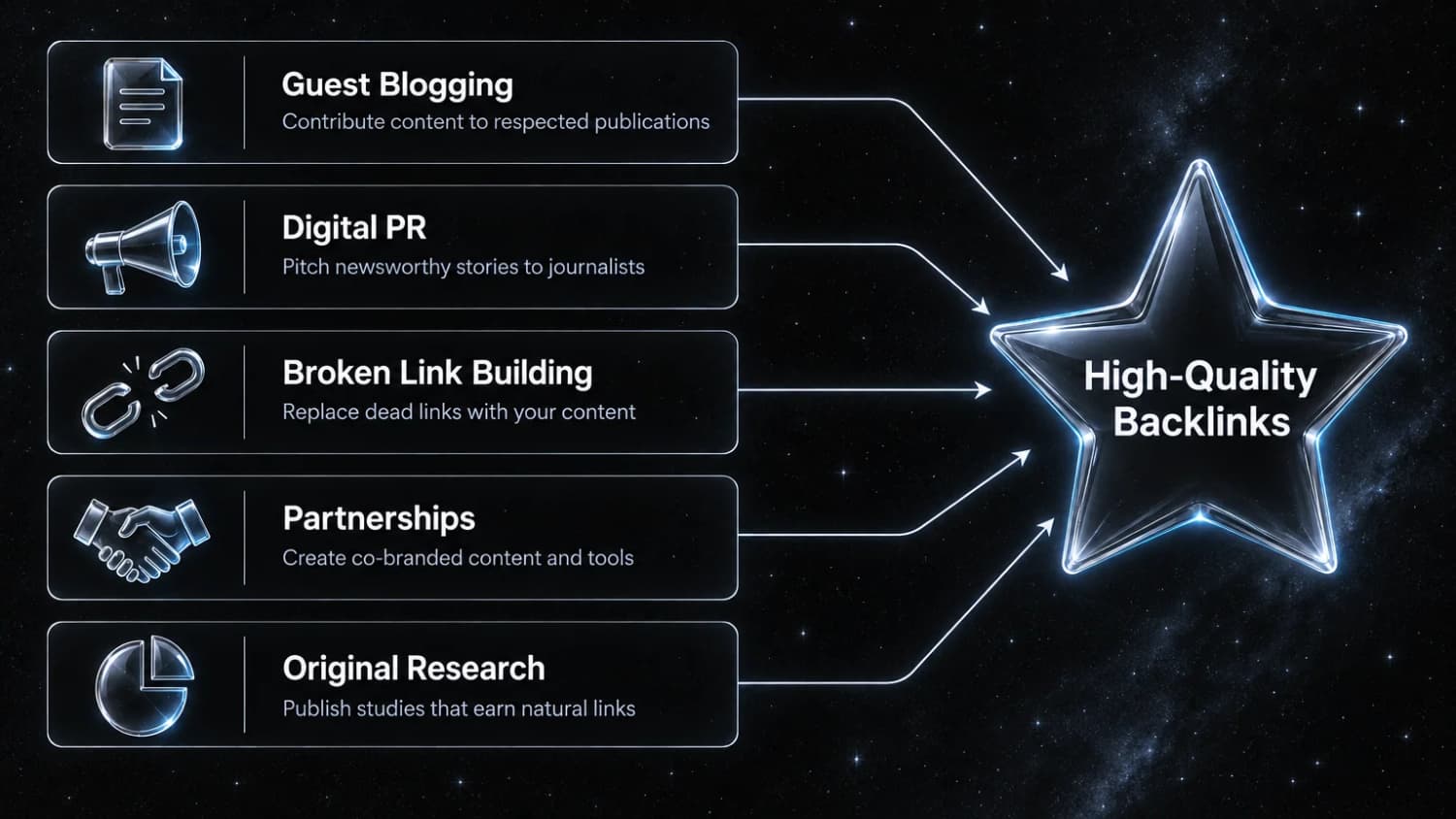
However, not all backlinks are created equal. Focus on earning links from high-quality, relevant websites in your industry. Avoid spammy tactics that could get you penalized.
Some effective link building strategies for SaaS startups include:
-
Guest blogging - Contribute content to respected publications and blogs in your space. Include a natural link back to your site in the author bio or body copy.
-
Digital PR - Pitch newsworthy data and stories to journalists and media outlets. If they cover it, they'll often link back to you as the source.
-
Broken link building - Find relevant broken links on other sites, then ask them to replace the dead link with a link to your content.
-
Partnerships and co-marketing - Team up with complementary brands to create co-branded content, research, tools, or events. Promote and link to each other.
-
Original research and data - Publish original studies, surveys, and data reports. These tend to earn a lot of natural backlinks.
Focus on quality over quantity when it comes to link building. A few high-value links will do more for your SEO than dozens of low-quality ones.
Don't Neglect Technical SEO
Technical SEO ensures your website can be properly crawled and indexed by search engines. Some key technical SEO considerations for SaaS sites include:
-
Site architecture - Organize your site hierarchy in a logical way and use a flat site structure. Make sure all important pages are linked to and can be found within 3 clicks from the homepage.
-
Navigation and internal linking - Implement clear navigation menus and use keyword-rich anchor text for your internal links. Create a sitemap to help search engines find all your pages.
-
Duplicate content - Avoid duplicate versions of the same content. Use 301 redirects, rel=canonical tags, or parameter handling to consolidate.
-
Site speed - Optimize your code, leverage caching, compress images, and use a CDN to improve page load times. Site speed is a ranking factor.
-
Mobile optimization - Make sure your site is responsive and optimized for mobile devices. Google now uses mobile-first indexing.
-
Structured data - Implement Schema markup to help search engines better understand your content. This can enable rich snippets that improve click-through rates.
-
HTTPS - Install an SSL certificate and migrate your site to HTTPS. This is a small ranking factor and is important for security.
Use tools like Google Search Console, Screaming Frog, and DeepCrawl to audit your technical SEO and identify issues to fix. Prioritize any problems that are hindering indexation.
Promote Your Content and Drive Engagement
Creating optimized content is only half the battle. You also need to promote that content to drive engagement and earn social signals and backlinks.
Share your content across all your social media channels, both organically and using paid promotion. Engage in relevant online communities like Reddit, Quora, and Facebook/LinkedIn groups.
Build an email list and send new content to your subscribers. Encourage them to share, comment, and link to it.
Reach out directly to influencers and publications in your space to share your content. A mention or share from a prominent figure can really amplify your reach.
Consider repurposing your content into other formats like videos, infographics, and slide decks. This allows you to promote it on additional channels.
Track your content's performance using tools like Google Analytics. Look at metrics like organic traffic, bounce rate, time on page, and conversions. Use these insights to optimize and improve your content over time.
Measure, Iterate, and Scale
Finally, continuously measure and analyze your SEO performance using tools like Google Analytics, Google Search Console, and Ahrefs. Track your target keywords, organic traffic growth, backlink profile, and conversions.
Identify your top-performing content and look for opportunities to update, expand, or repurpose it. See which keywords are driving the most traffic and conversions, and find ways to rank for more related terms.
Perform regular technical SEO audits to find and fix any issues. Monitor your site's speed, mobile friendliness, and crawlability on an ongoing basis.
As you start to see SEO success, reinvest the additional revenue into creating more optimized content, earning more high-quality backlinks, and scaling your efforts.
SEO is a long-term, iterative process. But with the right strategy, tactics, and commitment, it can become your most powerful growth channel.
Get Expert Help with SEO Audit
While implementing these strategies can significantly improve your SEO, sometimes it's valuable to get an expert outside perspective. This is where professional SEO audit services—such as those from SEO Roast—can be incredibly helpful.
SEO Audit offers various levels of SEO analysis, from quick video audits to comprehensive full-service audits. Their team of experts can provide:
- In-depth analysis of your current SEO performance
- Identification of critical issues and hidden opportunities
- Actionable recommendations to improve your search rankings
- Insights into competitor strategies
For busy founders and marketers, these professional audits can save time and provide valuable insights that might be missed in an internal review. SEO Audit's services range from $180 for a public video audit to $3,735 for a full-service SEO audit and strategy, making it accessible for startups at different stages of growth.
By combining your ongoing SEO efforts with periodic professional audits, you can ensure you're on the right track and maximize your organic search potential.
SaaS SEO Case Studies
To illustrate these strategies in action, here are a few examples of SaaS companies that have used SEO to drive impressive growth:
Zapier
Zapier, a popular automation tool, has built a massive organic presence in a competitive space. They've done it by:
- Creating comprehensive guides and tutorials on automation and productivity
- Targeting long-tail keywords related to connecting different apps
- Building a free tool that recommends Zaps based on your tech stack
- Earning backlinks from major publications like Forbes and Entrepreneur
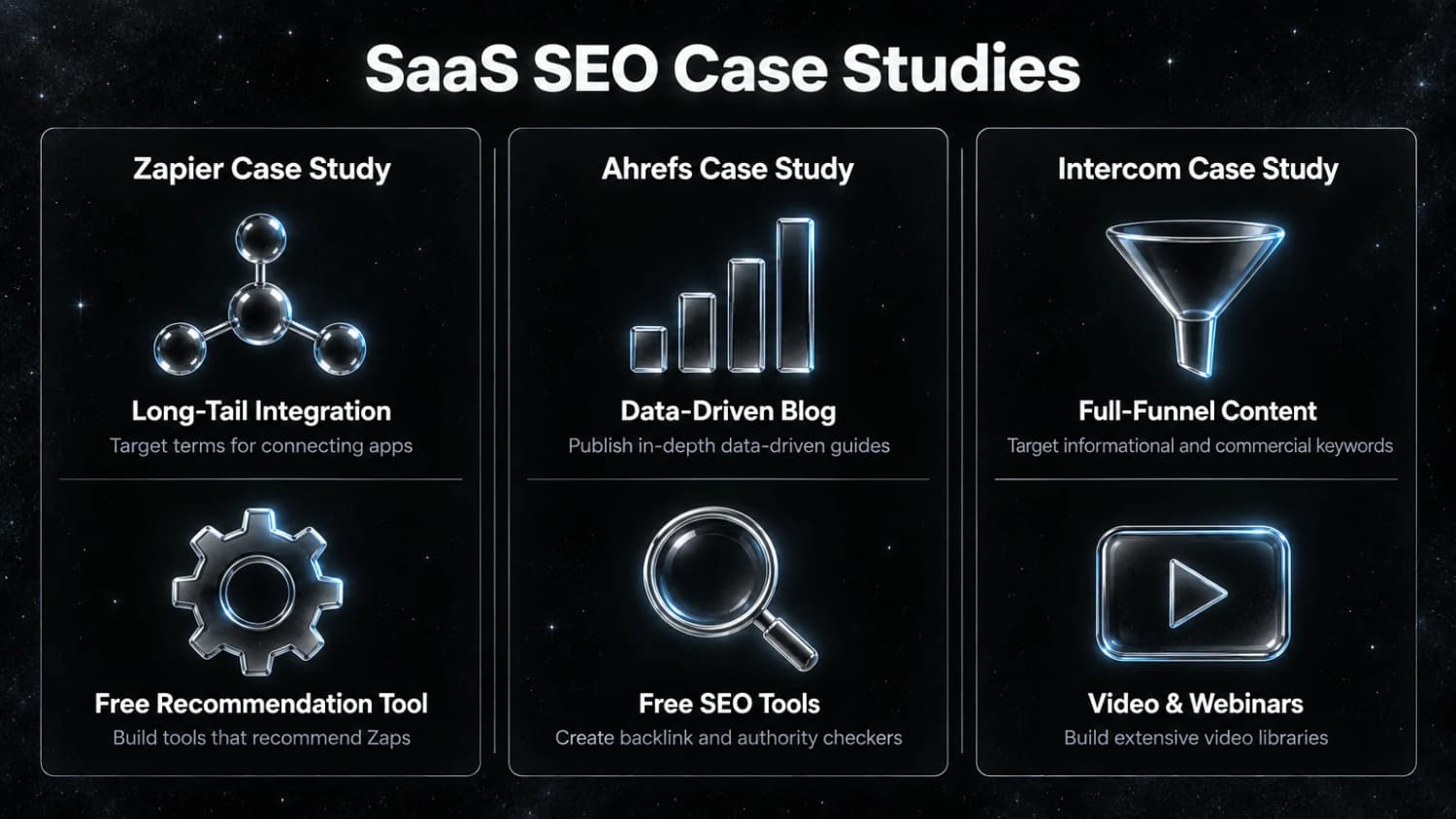
Today, Zapier gets an estimated 1.8M organic visits per month and ranks for over 400,000 keywords.
Ahrefs
Ahrefs, an SEO tool suite, has used its own product to fuel its SEO growth. Their strategy involves:
- Publishing in-depth, data-driven blog posts and guides
- Developing free tools like a backlink checker and website authority checker
- Partnering with influencers on content like roundups and interviews
- Promoting content to their 200k+ email subscribers and social media followers
Ahrefs now generates over 500k monthly organic visits and ranks in the top 100 for highly competitive terms like "SEO" and "backlinks".
Intercom
Intercom, a customer messaging platform, has focused on creating content for every stage of the funnel. They've grown their organic presence through:
- Ranking for informational keywords with educational blog content
- Targeting commercial keywords with product pages, guides, and case studies
- Creating an extensive library of video content and webinars
- Guest posting and partnering with SaaS blogs and publications
Intercom's organic traffic has grown steadily year over year and now accounts for a significant portion of their new user signups.
These are just a few examples, but they demonstrate the power of a comprehensive SEO strategy for SaaS growth.
Conclusion
SEO is a critical growth lever for SaaS startups. By understanding your audience, targeting the right keywords, creating valuable content, earning high-quality backlinks, and optimizing for technical SEO, you can drive sustainable organic traffic and signups.
The key is to approach SEO holistically and invest in it for the long-term. Don't expect overnight results, but know that the compounding effects of SEO can be transformative for your business.
Start implementing these SEO strategies today and make organic search a core part of your SaaS growth engine. With the right approach and consistent execution, the results will follow.