

- Most accurate in our November 23 test: Originality.ai. It scored raw Claude Opus 5.5, GPT-5.6, Gemini 4 Neon and Grok 4.7 text at 92 to 95% AI, gave both real human essays 0%, read a draft that was 48.5% AI as 49%, and flagged all 9 humanizer rewrites. 100 free guest credits; Pro from $12.95/mo yearly.
- Best for teachers and authorship proof: GPTZero. It scored Opus 5.5 and GPT-5.6 at 100% AI with every sentence flagged, and Writing Replay shows a Google Docs draft being typed. Guests get 3 scans a day.
- Best free detector with image checks: Undetectable AI. 99% on all four AI models, 51% on the half-AI draft, and it caught an AI image with its metadata stripped. Its own checker even flagged its own rewrites at 66% and 82% AI.
- Best for scanned PDFs and OCR: Winston AI. A Cloudflare Turnstile check blocked our automated text test, so it has no score this round. It has a Remote MCP server, and code BF50 cut Essential to $5/mo yearly on November 23.
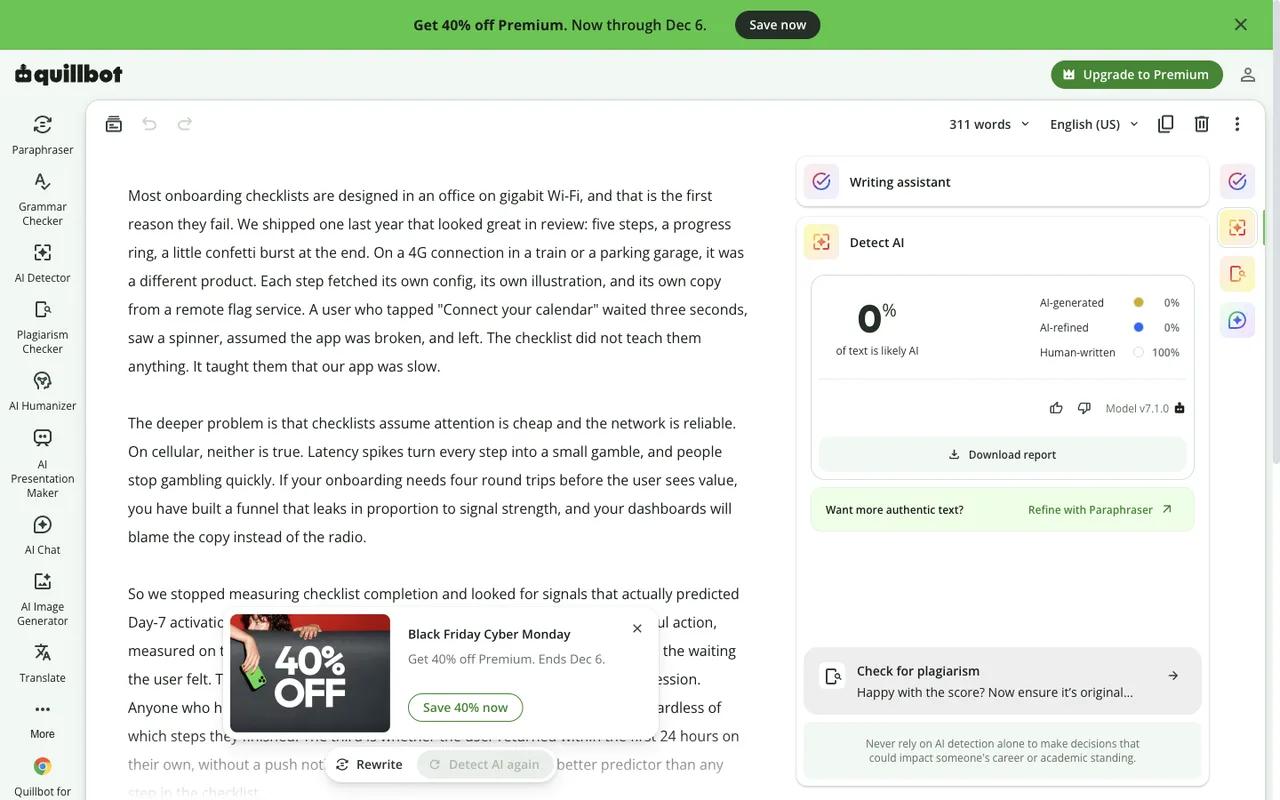
- Skip for detection: QuillBot scored Claude Opus 5.5, GPT-5.6 and Gemini 4 Neon at 0% AI, and StealthGPT's free checker gave a real 2013 essay 47% AI.
Testing AI detectors on a raw "write 500 words about climate change" prompt tells you nothing in 2026: every scanner catches that. The real test is whether a detector clears human essays, reads a half-AI draft correctly and resists humanizers.
On November 23, 2026 we ran 11 detectors on the same eight texts: one prompt answered by Claude Opus 5.5, GPT-5.6, Gemini 4 Neon and Grok 4.7, two real human essays (a 1911 book and a 2013 Paul Graham essay), a draft that was 48.5% AI, and a careful human-style edit of the GPT-5.6 text. Then we ran 9 humanizer rewrites back through three independent detectors and had a blind two-model editorial jury grade the prose. The full 11-tool lab report, with every screenshot, lives at awesome.tools. This post ranks 8 popular detectors and humanizers. ZeroGPT, Copyleaks, QuillBot and Pangram are in the full results table and the "also tested" notes below.
1. Originality.ai: most accurate detector in our 2026 test
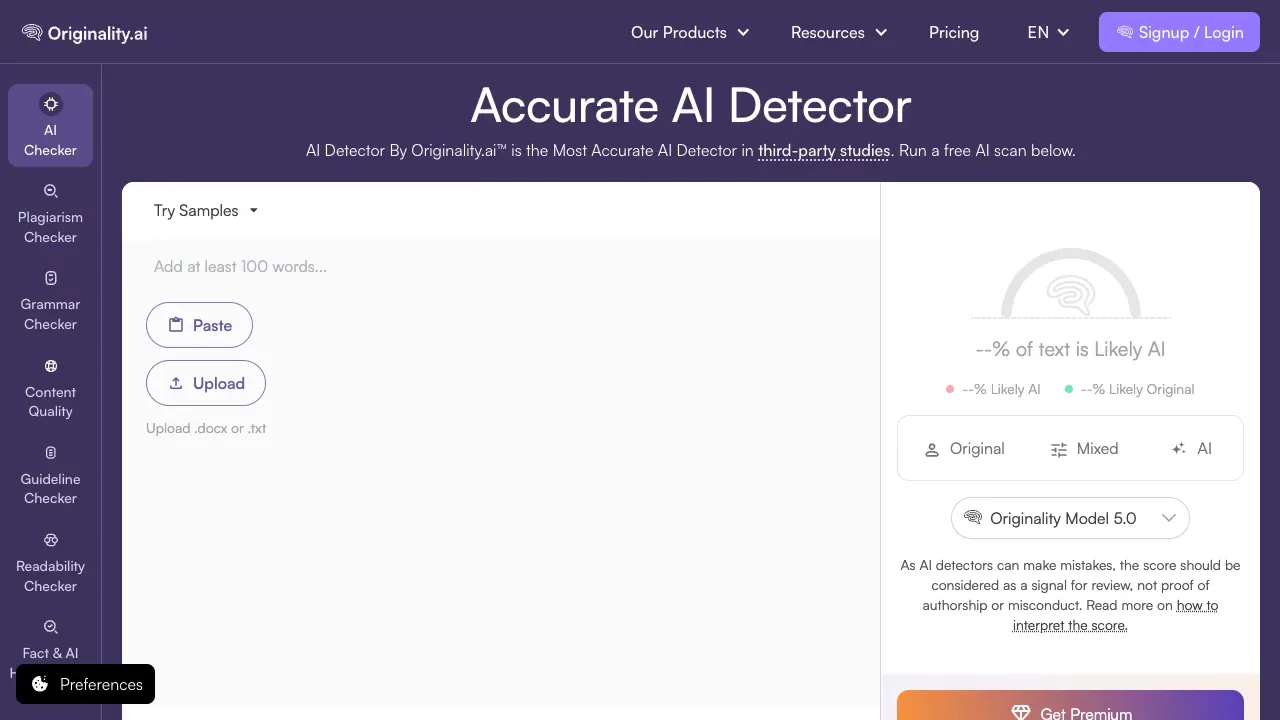
Originality.ai had the most balanced results of any tool we ran. Model 5.0 scored the four raw AI texts at 92, 95, 94 and 93% AI. It gave the 1911 book excerpt and the 2013 Paul Graham essay 0%. And on our spliced draft (153 human words followed by 144 Claude words, 48.5% AI), it said 49% and colored the text right at the splice.
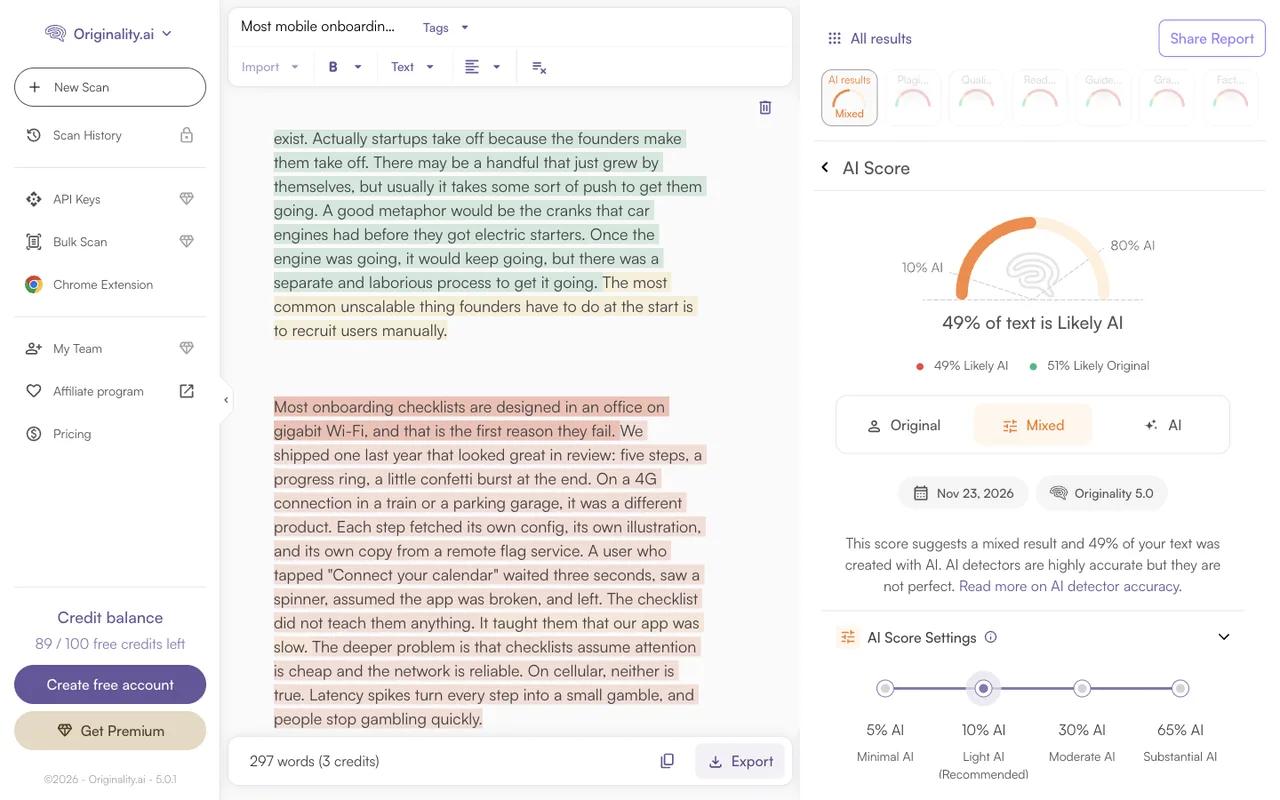
It was also the only detector that flagged every humanizer rewrite: all 9 scored between 60 and 96% AI. A careful human-style edit of the GPT-5.6 text still scored 95%, so cleaning up phrasing alone does not get past it.
Originality.ai is built for content teams who commission freelance writers. You get AI detection, plagiarism, readability and fact checks in one workspace, plus an official MCP server. The guest scanner at app.originality.ai gives you 100 free credits without an account. Paid plans: $30 pay-as-you-go (3,000 credits, about 300,000 words) or Pro at $12.95/mo yearly ($14.95 monthly). The API sits on the Enterprise plan ($136.58/mo), it has no image detector, and purchases are non-refundable.
2. GPTZero: best for teachers and Writing Replay
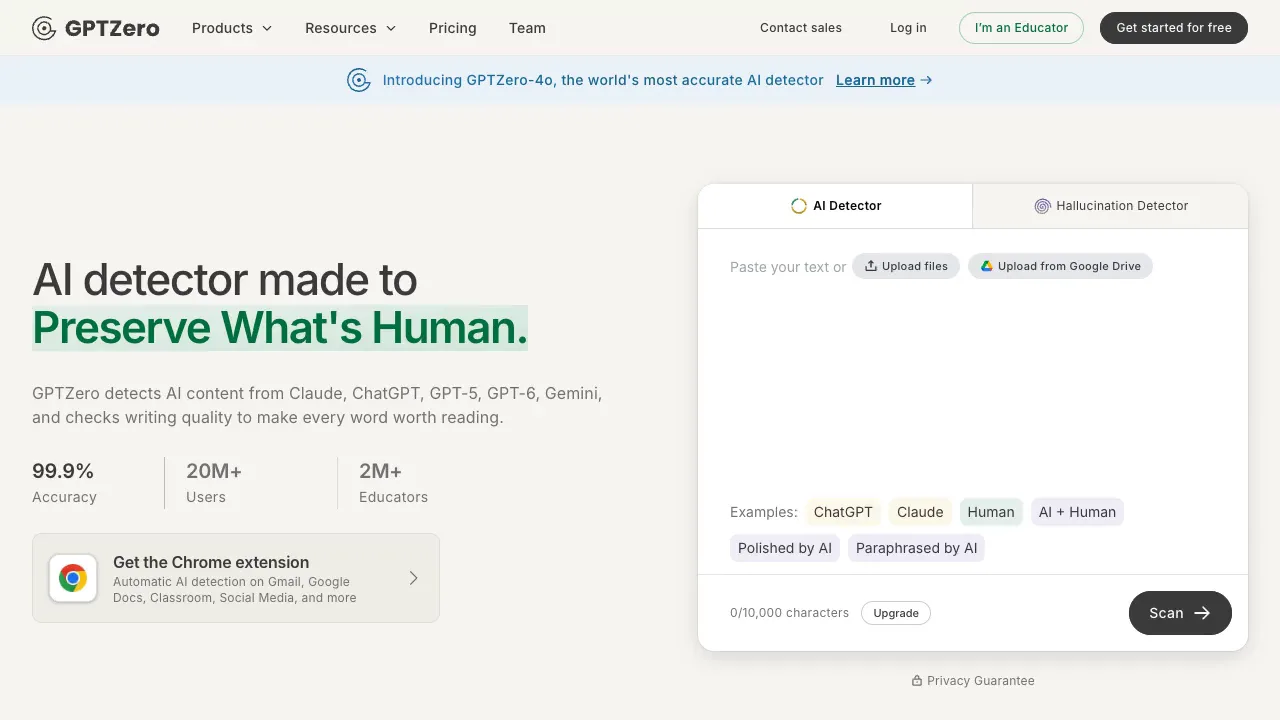
GPTZero model 5.0b scored the Claude Opus 5.5 and GPT-5.6 texts at 100% AI and highlighted every sentence. That is as strong as any tool in the test. The catch: guests get 3 scans a day, then an HTTP 429 error and a signup wall. We hit that limit before the human and hybrid samples, so GPTZero's false-positive rate is untested in this round.
Where GPTZero still wins is the classroom. It labels text as Human, Mixed or AI per sentence, connects to Canvas and Google Classroom, and its Writing Replay (the Origin extension for Google Docs) plays back how a draft was typed. That gives a student a way to prove authorship beyond a single percentage.
A free account covers 10,000 words a month. Paid plans start with Premium at $12.99/mo yearly ($23.99 monthly), and the Canvas and Google Classroom integrations come with Professional ($24.99/mo yearly). The API starts at $45/mo; there is no MCP server.
3. Undetectable AI: best free detector with image checks
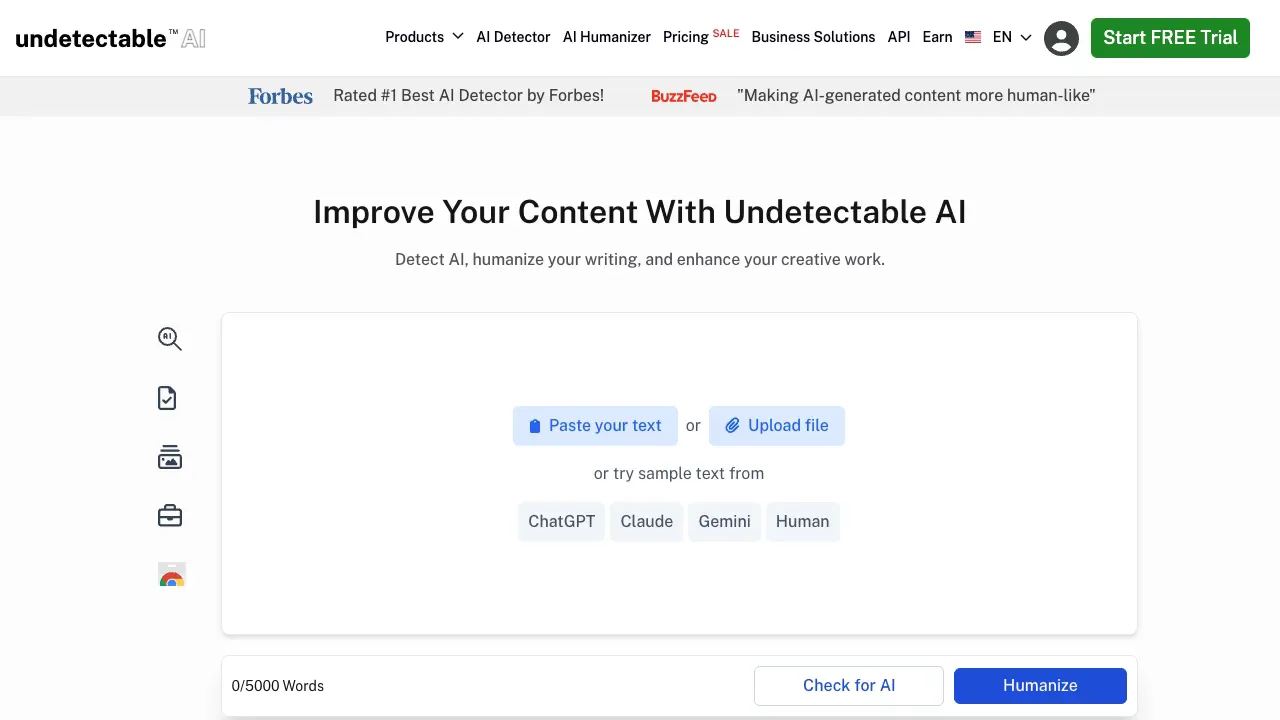
Undetectable AI is best known for its humanizer, but its free detector was one of the most consistent in the test. It scored all four AI models at 99%, read the 48.5% draft as 51%, and scored the careful edit at 96%. It gave the 1911 text 1% and the 2013 essay 10%, a small but real nudge on human writing.
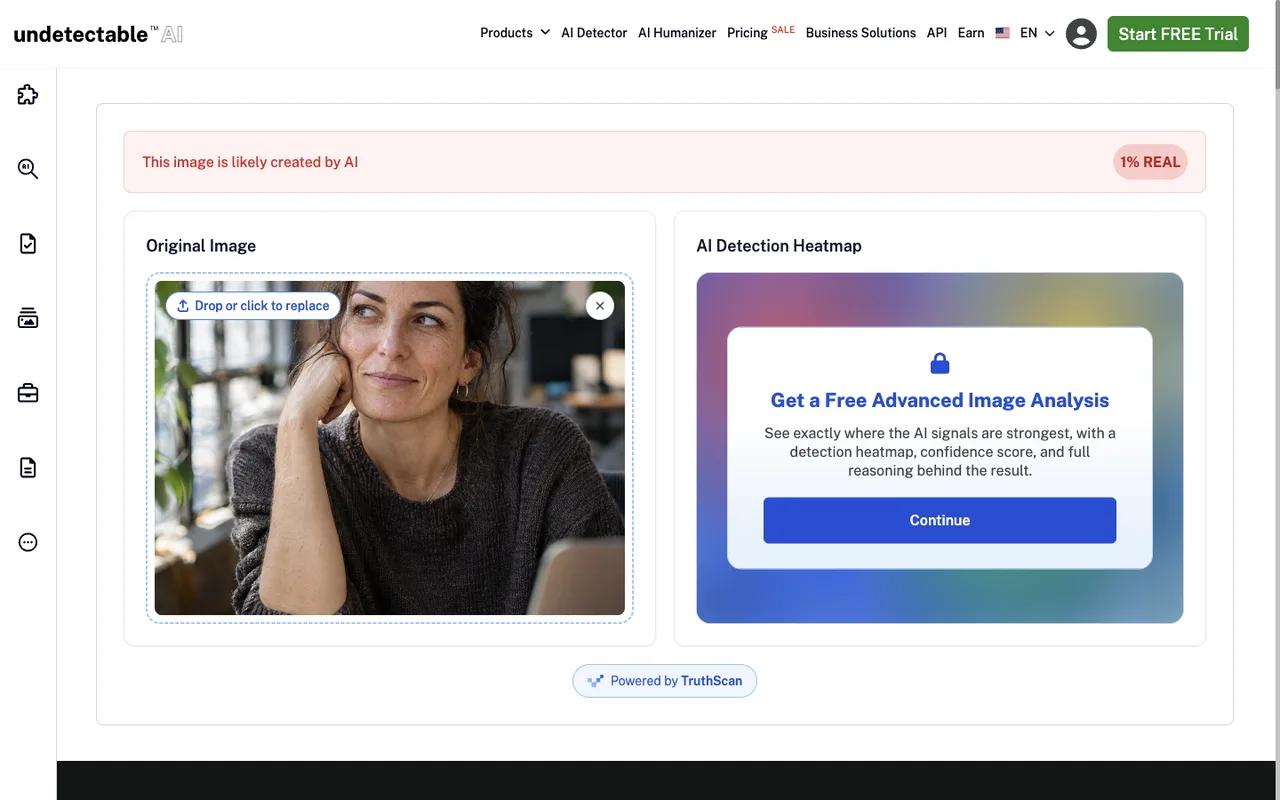
The image check (powered by TruthScan) went 3 for 3. It scored our AI image at 99% with and without its C2PA metadata, and a real 2012 DSLR photo at 2.82%.
The most honest moment in the whole test came from Undetectable AI itself. We ran its Basic humanizer on the Opus 5.5 and GPT-5.6 texts, then pasted the output back into its own checker. It rated the rewrites 66% and 82% AI. Originality.ai, Copyleaks and ZeroGPT agreed (94 to 100%), so the free Basic humanizer does not get you past detectors. It also grew the text by 50 to 80%.
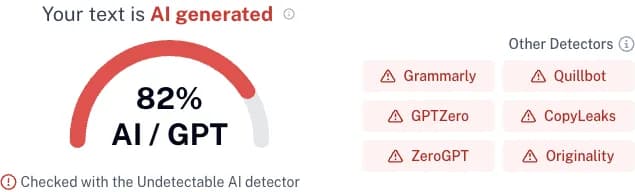
The guest detector takes up to 10,000 words per scan. Paid plans start at $5/mo yearly ($9.99 monthly) for 10,000 words a month, and the REST API starts at $29/mo. The "Other Detectors" row is Undetectable's own estimate of how GPTZero, Copyleaks and others would score the text, not a live scan on those tools.
4. StealthWriter: free detector that read every sample right
StealthWriter (a separate company from StealthGPT) surprised us. Its V2 detector got all 8 samples right by direction: 100% AI on all four models and on the careful edit, 0% on both human essays, and 53% on the 48.5% draft. Its Deep Scan colored the human half of that draft green and the AI half red.
The scores are blunt. Pure samples land at exactly 0 or 100, so it tells you which side a text is on, not how much was edited. We could not test the humanizer, because signup rejected our test email domains.
The free tier resets daily: 10 guest scans of 500 words, or 10 scans and 10 Ghost 5.2 Mini rewrites a day up to 1,000 words with a free account. Starter is $20/mo for 50 runs a day and Ghost 5.2 Pro. There is no API or MCP server.
5. Winston AI: best for OCR scans and PDF reports
Winston AI has no score in this round. It offers no guest text scan, and on November 23 its signup page showed a Cloudflare Turnstile check that blocked our test browser twice. That is why it sits below StealthWriter, which we could test.
What we could check: its free Readability Checker scored the Opus 5.5 text 59/100 and the GPT-5.6 text 38/100. Winston also runs the most agent-ready Remote MCP server we found, at https://api.gowinston.ai/mcp/v1, with OAuth 2.1 or an API key and tools for AI text (1 credit per word), AI images (300 credits) and plagiarism (2 credits per word).
Winston is still the pick when your input isn't clean text. Drop in a multi-page DOCX, a scanned PDF or a phone photo of a printed page, and its OCR extracts the prose, runs AI and plagiarism checks, and exports a shareable PDF report.
Pricing is credit-based. Essential is $10/mo yearly ($18 monthly) for 100,000 credits, and Advanced is $16/mo yearly ($29 monthly) for 200,000 credits and 5 seats. On November 23 code BF50 took 50% off (Essential $5/mo yearly). The free tier is a one-time 14-day, 2,000-credit trial, and purchases are non-refundable.
6. WriteHuman: fast free checker, weak humanizer
WriteHuman has two tools, and they tested very differently.
The detector is fast and correct on clean samples. It scored Opus 5.5, GPT-5.6 and Gemini 4 Neon at 100% AI and the 2013 essay at 0%, in about one second per scan, with sentence highlights. But it scored the 48.5% draft at 100% AI too, so it cannot show partial AI use. Guests get 5 scans a month.
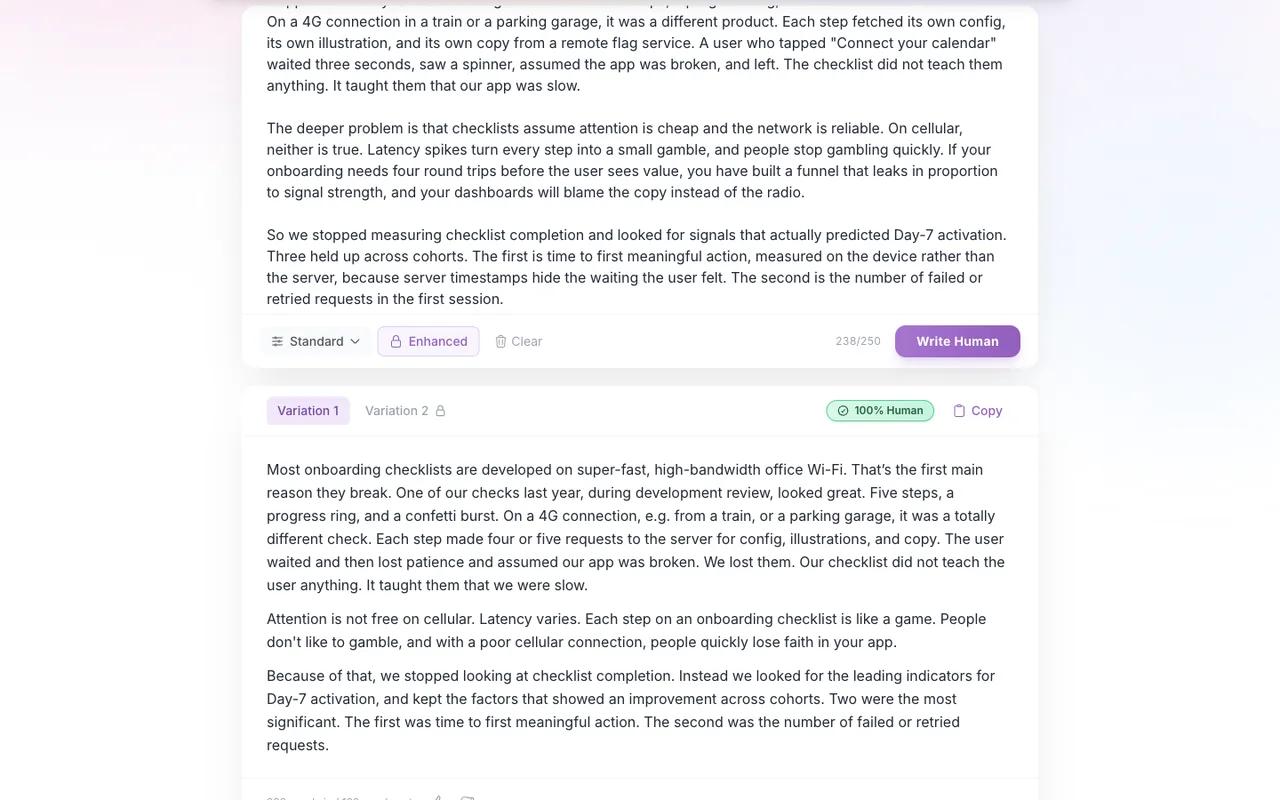
The humanizer is where it fell apart. Its Standard-mode rewrite of the Opus 5.5 text earned WriteHuman's own "100% Human" badge. Originality.ai scored the same text 85% AI and ZeroGPT 79.9%. Our blind jury gave it 4.00 out of 10, and both judges called it unreadable. It invented "four or five requests to the server" per step and dropped the story about a user who waited three seconds on a "Connect your calendar" spinner. Our test essay names three activation signals. The rewrite shows only two because the 250-word guest cap cut the input at 238 words, so that gap is not the rewriter's fault.
Paid plans start at $12/mo yearly ($20 monthly) on Basic, and Pro ($19/mo yearly) adds an MCP server. The API costs $0.14 per 1,000 words.
7. StealthGPT: readable humanizer, unreliable free checker
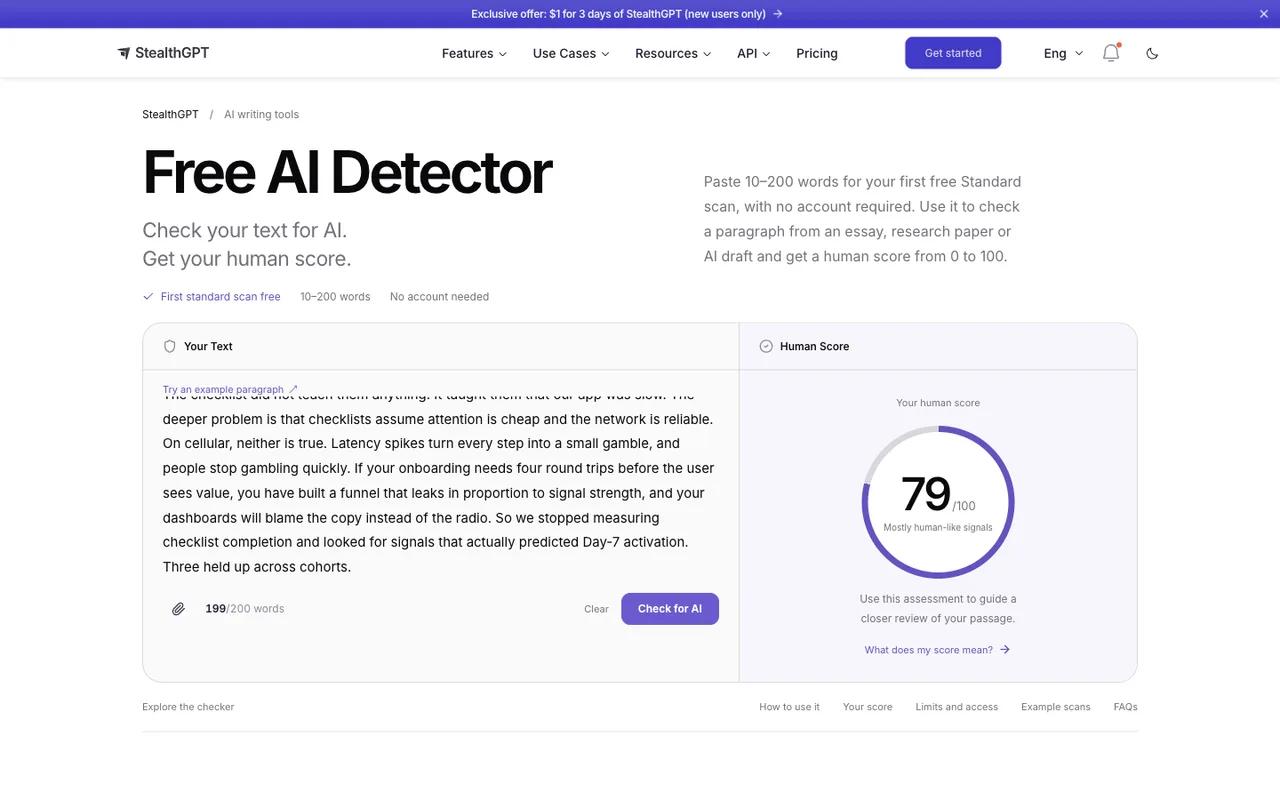
StealthGPT should not be your detector. Its free checker scored raw Opus 5.5, GPT-5.6 and Grok 4.7 text at 21, 19 and 30% AI, which means it called AI text mostly human. It then scored the real 2013 Paul Graham essay at 47% AI, higher than any of the AI texts.
Its humanizer did better. The Super mode rewrite of the Opus 5.5 text got the best jury score of any commercial humanizer: 7.17 out of 10, "needs a light edit" from both judges. It passed Copyleaks at 0% AI, but Originality.ai still flagged it at 65%.
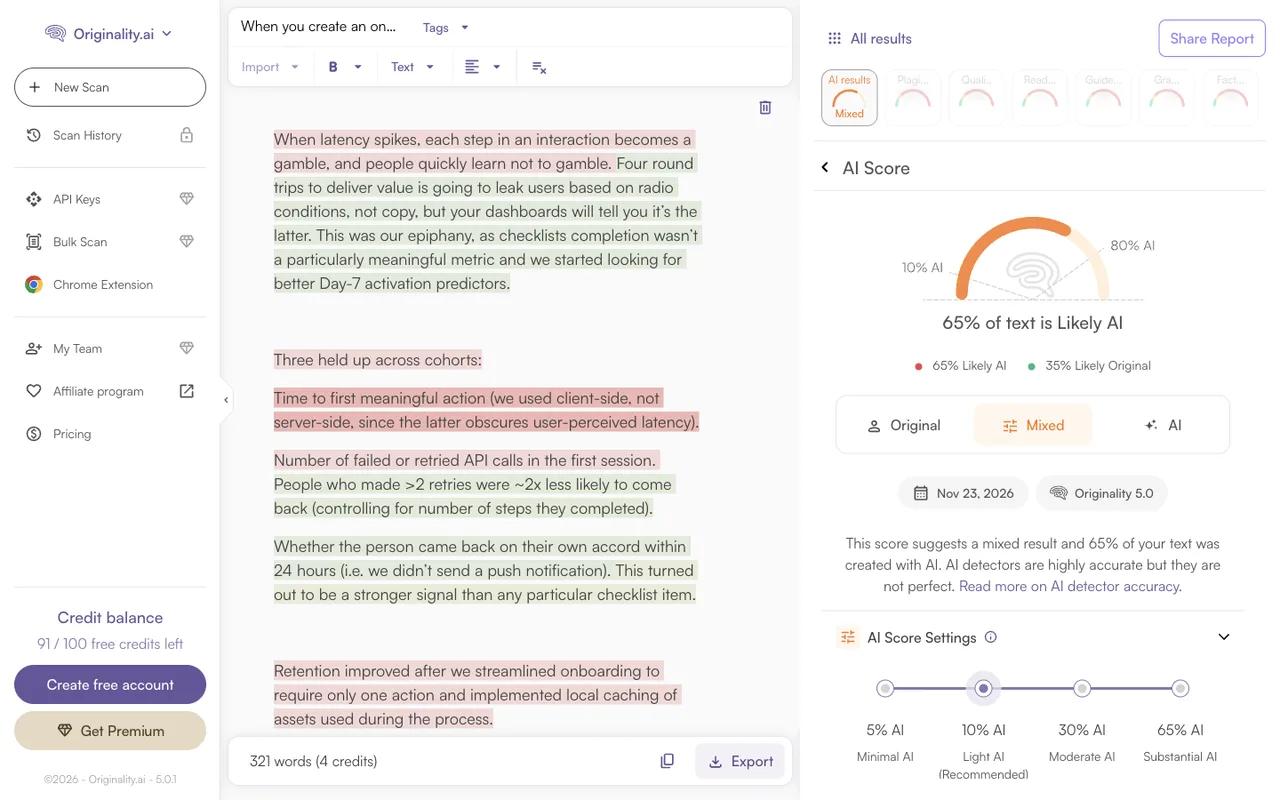
The GPT-5.6 rewrite went wrong. It passed Copyleaks and ZeroGPT at 0%, but both judges rated it unreadable because it reversed the article's main point: "do not need fewer boxes" became "Shorter onboarding checklists are great." Pricing: $1 for 3 days, then Pro at $29.99/mo. Pro and up include a Remote MCP server; the REST API is on Enterprise.
8. BypassGPT: short-snippet rewriter (not re-tested)
We did not re-test BypassGPT in the November 23 round, so treat this entry as a feature summary, not a result. It pairs a basic multi-detector check bar with Fast, Creative and Enhanced rewrite modes. Web plans start around $12/mo billed yearly for 10,000 words, and the API starts at $19/mo for 50,000 words. The free trial caps inputs at roughly 80 to 150 words, and the output needs manual editing to keep technical terms right.
AI detector test results (November 2026)
AI % from each detector. Higher is better on the AI columns, lower is better on the human columns, and the best answer on the half-AI draft is 48.5. "Quota" means the free limit ran out; "gated" means we could not get a guest scan.
| Detector | Opus 5.5 | GPT-5.6 | Gemini 4 Neon | Grok 4.7 | 1911 human | 2013 human | Half-AI (48.5%) | Edited AI |
|---|---|---|---|---|---|---|---|---|
| Originality.ai | 92 | 95 | 94 | 93 | 0 | 0 | 49 | 95 |
| ZeroGPT | 100 | 100 | 100 | 100 | 0 | 0 | 42.1 | 100 |
| StealthWriter | 100 | 100 | 100 | 100 | 0 | 0 | 53 | 100 |
| Undetectable AI | 99 | 99 | 99 | 99 | 1 | 10 | 51 | 96 |
| Copyleaks | 100 | 100 | 100 | 100 | 0 | 0 | 100 | 100 |
| GPTZero | 100 | 100 | quota | quota | quota | quota | quota | quota |
| WriteHuman | 100 | 100 | 100 | quota | quota | 0 | 100 | quota |
| QuillBot | 0 | 0 | 0 | quota | 0 (earlier run) | 0 | 0 | quota |
| StealthGPT (free checker) | 21 | 19 | gated | 30 | gated | 47 | 19 | gated |
| Pangram | gated | gated | gated | gated | 0 (earlier run) | gated | gated | gated |
| Winston AI | gated | gated | gated | gated | gated | gated | gated | gated |
Seven of the nine detectors we could run scored raw Opus 5.5 and GPT-5.6 text at 92 to 100% AI. Six gave 0% to every human text they scanned. The closest reads on the half-AI draft came from Originality.ai (49), Undetectable AI (51), StealthWriter (53) and ZeroGPT (42.1). Copyleaks and WriteHuman called the whole draft AI.
The edited column matters most for writers. A careful human-style edit of the GPT-5.6 text scored 95 to 100% AI on every detector that scanned it, even though our jury rated it the best writing in the test (9.33 out of 10). Better prose does not change where the text came from.
Do AI humanizers beat detectors?
No humanizer beat all three independent detectors. We scored each rewrite on Originality.ai, Copyleaks and ZeroGPT, then had a blind two-model editorial jury (Claude Fable 5.2 and Gemini 4 Neon, labels hidden) rate fidelity, readability and leftover AI tells from 0 to 10.
| Rewrite (source text) | Originality.ai | Copyleaks | ZeroGPT | Jury (0 to 10) | Jury verdict |
|---|---|---|---|---|---|
| Human-style edit (control) | 95 | 100 | 100 | 9.33 | Publishable |
| StealthGPT Super (Opus 5.5) | 65 | 0 | 70.4 | 7.17 | Needs light edit |
| ZeroGPT Paraphraser (Opus 5.5) | 91 | quota | 100 | 6.17 | Needs light edit |
| ZeroGPT Paraphraser (GPT-5.6) | 96 | quota | 100 | 6.00 | Needs light edit |
| Undetectable AI Basic (Opus 5.5) | 94 | 100 | 100 | 5.00 | Split |
| StealthGPT Super (GPT-5.6) | 60 | 0 | 0 | 4.33 | Unreadable |
| Undetectable AI Basic (GPT-5.6) | 95 | 100 | 100 | 4.33 | Split |
| ZeroGPT Humanizer (GPT-5.6) | 95 | quota | 100 | 4.33 | Split |
| WriteHuman Standard (Opus 5.5) | 85 | 0 | 79.9 | 4.00 | Unreadable |
| ZeroGPT Humanizer (Opus 5.5) | 91 | quota | 100 | 3.17 | Unreadable |
Three patterns stood out:
- Originality.ai flagged all 9 rewrites at 60 to 96% AI.
- Copyleaks has a humanizer blind spot. It scored both StealthGPT rewrites and the WriteHuman rewrite at 0% AI, while Originality.ai flagged the same texts at 60 to 85%.
- The only rewrite that passed two detectors broke the article. StealthGPT's GPT-5.6 rewrite passed Copyleaks and ZeroGPT, and both judges called it unreadable.
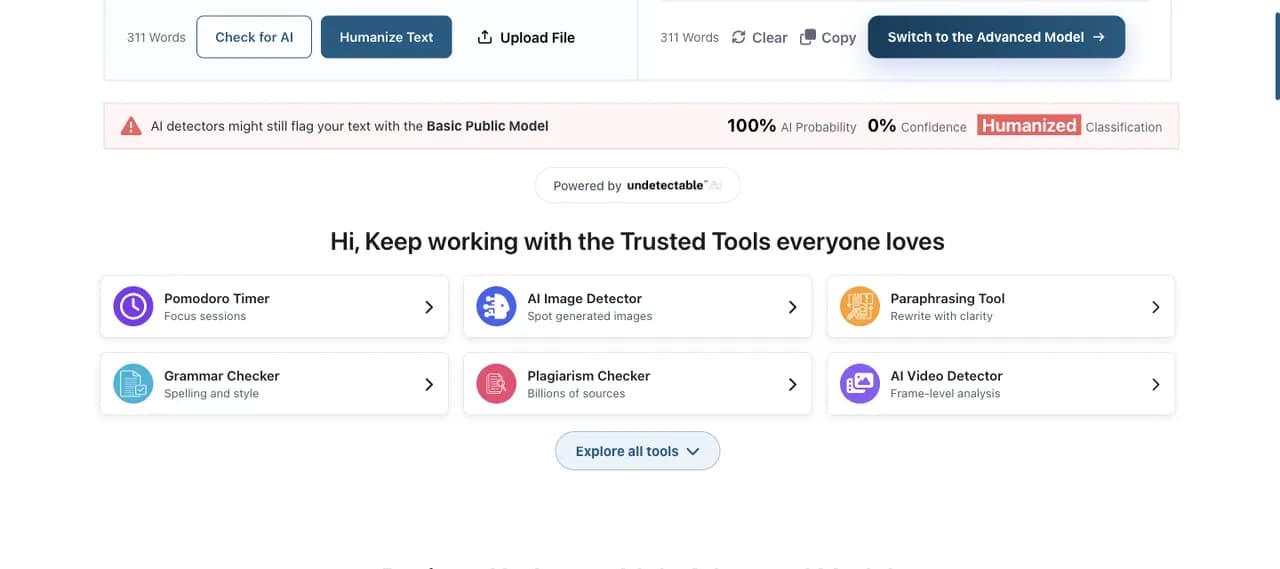
"Humanized" labels are marketing. ZeroGPT's Humanizer (which says "Powered by undetectable") broke grammar ("Anyone who hit than two retries") and its own checker still said 100% AI right next to the word "Humanized."
If you want writing that reads human, edit it yourself. My guide to writing blog posts with AI without sounding generic covers the workflow. Just don't expect a better edit to change a detector score.
Can AI detectors spot AI images?
We tested one AI image with its C2PA content credentials, the same image with all metadata stripped, and a real photo taken on a DSLR in 2012.
| Detector | AI image with C2PA | Same image, metadata stripped | Real 2012 photo |
|---|---|---|---|
| Copyleaks | 100 | 100 | 0 |
| ZeroGPT (TruthScan) | 99 | 99 | 3 |
| Undetectable AI (TruthScan) | 99 | 99 | 2.82 |
| QuillBot | 89 | 52 | quota |
Copyleaks, ZeroGPT and Undetectable AI judged the pixels, not the metadata: their scores did not move when we stripped it. QuillBot fell from 89% to 52%, so a screenshot or a re-save is enough to get past it. Winston AI and WriteHuman need an account for image scans, Pangram had no free credits left, and Originality.ai, GPTZero, StealthGPT and StealthWriter do not offer one.
Also tested: ZeroGPT, Copyleaks, QuillBot and Pangram
These four are not in the top 8, but they round out the full 11-tool benchmark.
- ZeroGPT: 100% on all four AI models, 0% on both human texts, 42.1% on the half-AI draft. The free box takes 15,000 characters per scan, and we never hit a limit. Its Paraphraser earned 6.17 and 6.00 from the jury (needs a light edit), while its Humanizer scored 3.17 and 4.33. PRO costs $8.99/mo yearly ($14.99 monthly).
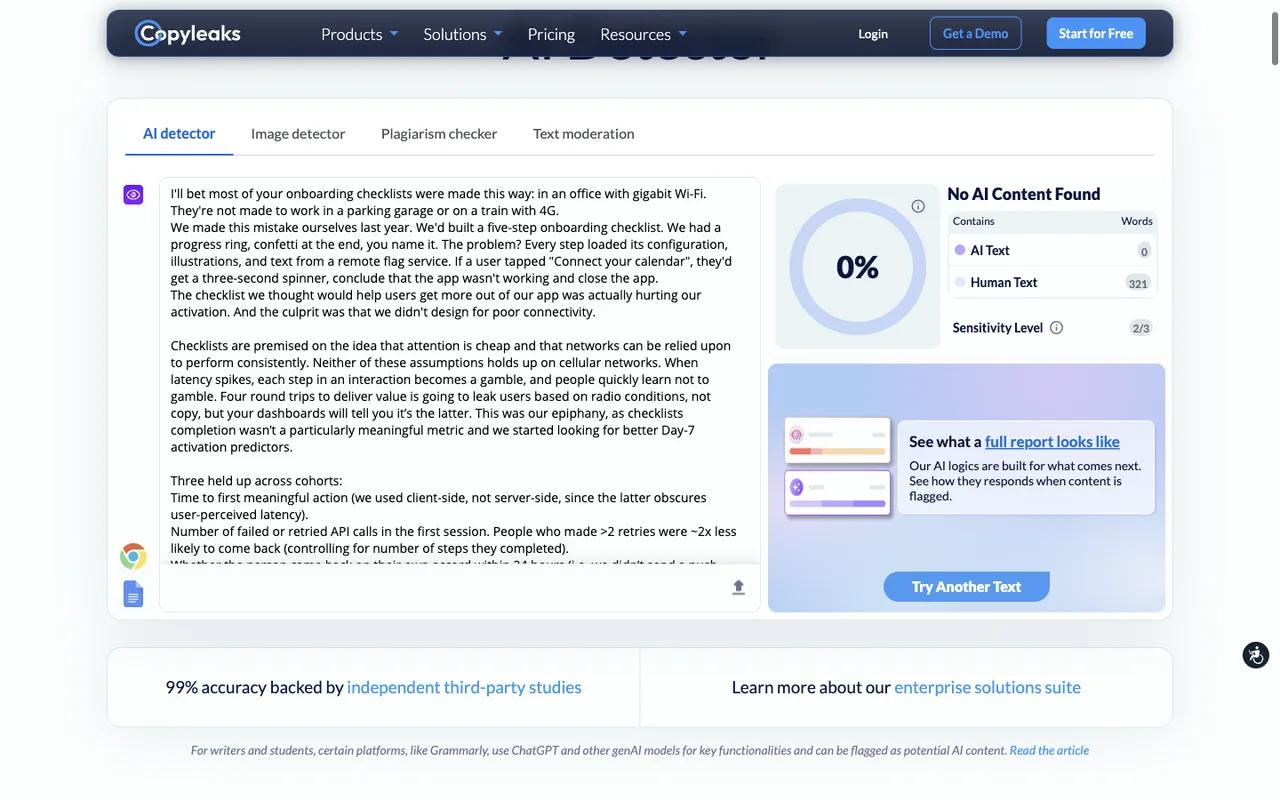
- Copyleaks: 100% on all AI text, 0% on both human texts, and 3 for 3 on images. It over-flagged the half-AI draft at 100% and missed three humanizer rewrites at 0%. About 13 guest scans before a 429 error; Personal costs $13.99/mo yearly.
- QuillBot: scored Claude Opus 5.5, GPT-5.6, Gemini 4 Neon and the half-AI draft at 0% AI. In our earlier run it caught an older-style AI essay at 96%, so it seems to lag behind 2026 models. Its image check dropped from 89% to 52% without metadata.
- Pangram: the guest credit pool was spent when we ran this round, so it has no score on the 2026 models yet. In our earlier run it scored an AI essay at 100%, the 1911 text at 0%, and split a hybrid draft at the exact sentence where the AI part began. A re-run is pending. Individual costs $15/mo yearly, and the API is $0.05 per 100 words.
Pricing and free limits compared (November 2026)
| Tool | Free without signup | Starting paid price | API / MCP | Human texts in our test |
|---|---|---|---|---|
| Originality.ai | 100 guest credits | $12.95/mo yr or $30 PAYG | MCP; API on Enterprise | 0% and 0% |
| GPTZero | 3 scans a day (10k words/mo with free account) | $12.99/mo yr | API from $45/mo | not tested (quota) |
| Undetectable AI | Up to 10,000 words per scan | $5/mo yr ($9.99 monthly) | API from $29/mo | 1% and 10% |
| StealthWriter | 10 scans a day (500 words) | $20/mo Starter | None | 0% and 0% |
| Winston AI | None (14-day trial with account) | $10/mo yr ($5 with BF50) | Remote MCP + API | not tested (Turnstile) |
| WriteHuman | 5 scans a month | $12/mo yr ($20 monthly) | MCP on Pro, API $0.14/1k words | 0% (2013 essay) |
| StealthGPT | Checker up to 200 words | $1 for 3 days, then $29.99/mo | Remote MCP on Pro; API on Enterprise | 47% (2013 essay) |
| BypassGPT | ~125-word trial | ~$12/mo yr | API from $19/mo | not re-tested |
Prices were checked on November 23, 2026. Most of these vendors sell non-refundable credits, so use the free tier on your own writing before you pay.
How we tested
- One prompt, four models. Claude Opus 5.5, GPT-5.6 Sol, Gemini 4 Neon and Grok 4.7 each wrote about 300 to 330 words on why mobile onboarding checklists fail on 4G and which three signals predict Day-7 activation.
- Two human controls. 332 words from F.W. Taylor's 1911 book and 312 words from Paul Graham's 2013 essay "Do Things That Don't Scale".
- One hybrid. 153 Paul Graham words followed by 144 raw Opus 5.5 words, 48.5% AI by word count.
- One edited control. The GPT-5.6 text after a careful human-style editorial rewrite.
- A blind jury. Claude Fable 5.2 and Gemini 4 Neon graded every rewrite with the tool names hidden.
We used each tool's free guest tier, with no paid accounts, on November 23, 2026. Every screenshot and raw score is in the awesome.tools benchmark.
Do AI detectors actually matter for Google SEO?
Google does not use GPTZero or Originality.ai scores as a ranking penalty. Google's spam policies target scaled content abuse: mass-publishing low-value pages that add no original information, whether a person, a script or an LLM wrote them.
Where AI writing does hurt is reader engagement and AI search citations. A post that opens with 150 words of filler, quotes 2024 pricing and repeats the same template under every H2 sends readers back to Google in five seconds. Paying for a humanizer will not fix that, and as the test above shows, it will not reliably fool a detector either. Verify live numbers, cut filler, and add screenshots and test results no model could make up.
Frequently asked questions
Which AI content detector is the most accurate in 2026?
In our November 23, 2026 test, Originality.ai was the most balanced: 92 to 95% AI on Claude Opus 5.5, GPT-5.6, Gemini 4 Neon and Grok 4.7, 0% on both human essays, 49% on a draft that was 48.5% AI, and it flagged every humanizer rewrite. GPTZero scored the two frontier samples it could scan at 100%, and StealthWriter and Undetectable AI were close behind.
Can AI detectors falsely accuse real human writing?
Yes. Six detectors gave 0% AI to every human text they scanned, but StealthGPT's free checker scored a real 2013 Paul Graham essay at 47% AI and Undetectable AI gave it 10%. Short passages, textbook grammar and formal technical writing raise the risk. Never fail a student or reject a writer on one score; ask for the draft history in Google Docs or Word.
What is the best free AI detector without signing up?
ZeroGPT (15,000 characters per scan, no limit hit in our test), Originality.ai's guest scanner (100 free credits), Undetectable AI (up to 10,000 words per scan) and StealthWriter (10 scans a day). GPTZero allows 3 guest scans a day, and a free account raises that to 10,000 words a month.
Can Originality.ai detect human-edited ChatGPT text?
Yes, in our test. A careful human-style edit of GPT-5.6 text still scored 95% AI on Originality.ai, and 96 to 100% on the other four detectors that scanned it. Editing for style does not hide where a text came from. Text you write yourself, with your own structure and first-hand numbers, is the only kind that reliably reads as human.
Do AI humanizers work against detectors?
Not reliably. Originality.ai flagged all 9 humanizer rewrites we tested at 60 to 96% AI. The one rewrite that passed both Copyleaks and ZeroGPT reversed the article's main point, and our blind jury rated it unreadable.