

- Video teardown ($250 public / $550 private): SEO Roast delivers a 30 to 40 minute 1080p screen recording by me, raw Ahrefs competitor CSVs, a live AI search check, and a ranked Top-5 roadmap in 2 to 5 business days.
- Backlink + AI citation audit ($0 on Order #1): LinkDR bundles a 10-competitor DR 30+ backlink audit, clean Google SERP scan, and ChatGPT/AI Overview citation audit free with your first link order (from $136/mo monthly or $135 net one-time).
- AI search / GEO audit ($49 one-time): AI SEO Tracker scans up to 50 buyer prompts daily for 7 days across ChatGPT, Perplexity, Gemini, Copilot, and Google AI Overviews with permanent PDF/report access.
- Freelancer ($300 to $2,500) vs. Agency ($1,500 to $8,600+): Hire MagicSpace SEO ($5,250 standalone audit or free 15-min live call) or an agency like WebFX ($8,600 published package), OuterBox, or Onely when you need multi-department execution or enterprise JavaScript fixes.
- DIY (Free to $139/mo): Pair Google Search Console, Ahrefs Free (5,000 crawl credits/mo), Screaming Frog (free up to 500 URLs), and our open-source
seo-roastagent skill. - What to demand: A short, ordered list of fatal, revenue, and AI-citation fixes, not a 100-page automated PDF of 400 warnings.
Most SEO audits fail the same way. You pay an agency or consultant, wait three weeks, receive a 90-page exported crawler PDF listing 412 "warnings," and ship nothing because nobody separated the one robots.txt line blocking search traffic from 300 missing image alt tags.
An SEO audit service should hand you the opposite: a short list of high-impact changes, in exact execution order, backed by real competitor data, Google Search Console reality, and live AI search checks across ChatGPT, Perplexity, and Google AI Overviews. After recording over 100 SaaS audits on SEO Roast, auditing client sites at MagicSpace SEO, and tracking thousands of AI prompts in AI SEO Tracker, here is what SEO audit services actually cost in November 2026, how the top options compare, and how to pick one that ends in shipped fixes.
Quick-pick comparison: 2026 SEO audit options
| Service / Option | Category | Verified Price (Nov 2026) | Turnaround | AI Search Check | Best For |
|---|---|---|---|---|---|
| SEO Roast | Async video teardown | $250 public / $550 private | 2 to 5 business days | Yes (live ChatGPT, AI Overviews, Perplexity, Gemini) | SaaS founders who want a ranked fix list + raw Ahrefs CSVs fast |
| MagicSpace SEO | SaaS SEO agency | Free 15-min call; $550 video; $5,250 full audit | 1 to 3 weeks | Yes (Google + AI search) | Software teams that want the audit followed by done-for-you execution |
| LinkDR | Backlink + AI audit (Order #1) | $0 bundled with first link ($135 to $136+) | Included before outreach | Yes (ChatGPT + Google AI Overviews) | Sites whose bottleneck is authority, listicles, and missing AI citations |
| AI SEO Tracker | Dedicated AI visibility audit | $49 one-time (7-day daily scan) | 7-day scan, permanent report | Yes (5 AI engines, 50 prompts) | Measuring exact ChatGPT, Perplexity, Gemini, Copilot, and AIO gaps |
| WebFX / OuterBox / Onely | Mid-market & enterprise agencies | WebFX $8,600 (70 pages); OuterBox & Onely custom quote | 4 to 8 weeks | Included or custom | Large e-commerce stores, JS-heavy web apps, and enterprise migrations |
| Freelance consultants | Independent specialists | $300 to $2,500 ($75 to $200/hr) | 1 to 2 weeks | Ask upfront | Small to mid-size sites that want manual review on a set budget |
| DIY & automated tools | Self-serve software | Free to $139/mo ($199/mo w/ Semrush AI) | Same day | Add-on or manual | Technical teams with time to crawl, diagnose, and prioritize in-house |
How much does an SEO audit cost?
In November 2026, a standalone SEO audit costs anywhere from $49 for an automated multi-engine AI visibility report to $250 to $550 for a manual video teardown, $300 to $2,500 for a freelance consultant, $1,500 to $8,600 for a full-service agency audit, and $10,000+ for enterprise sites with 100,000+ URLs or server-log analysis.
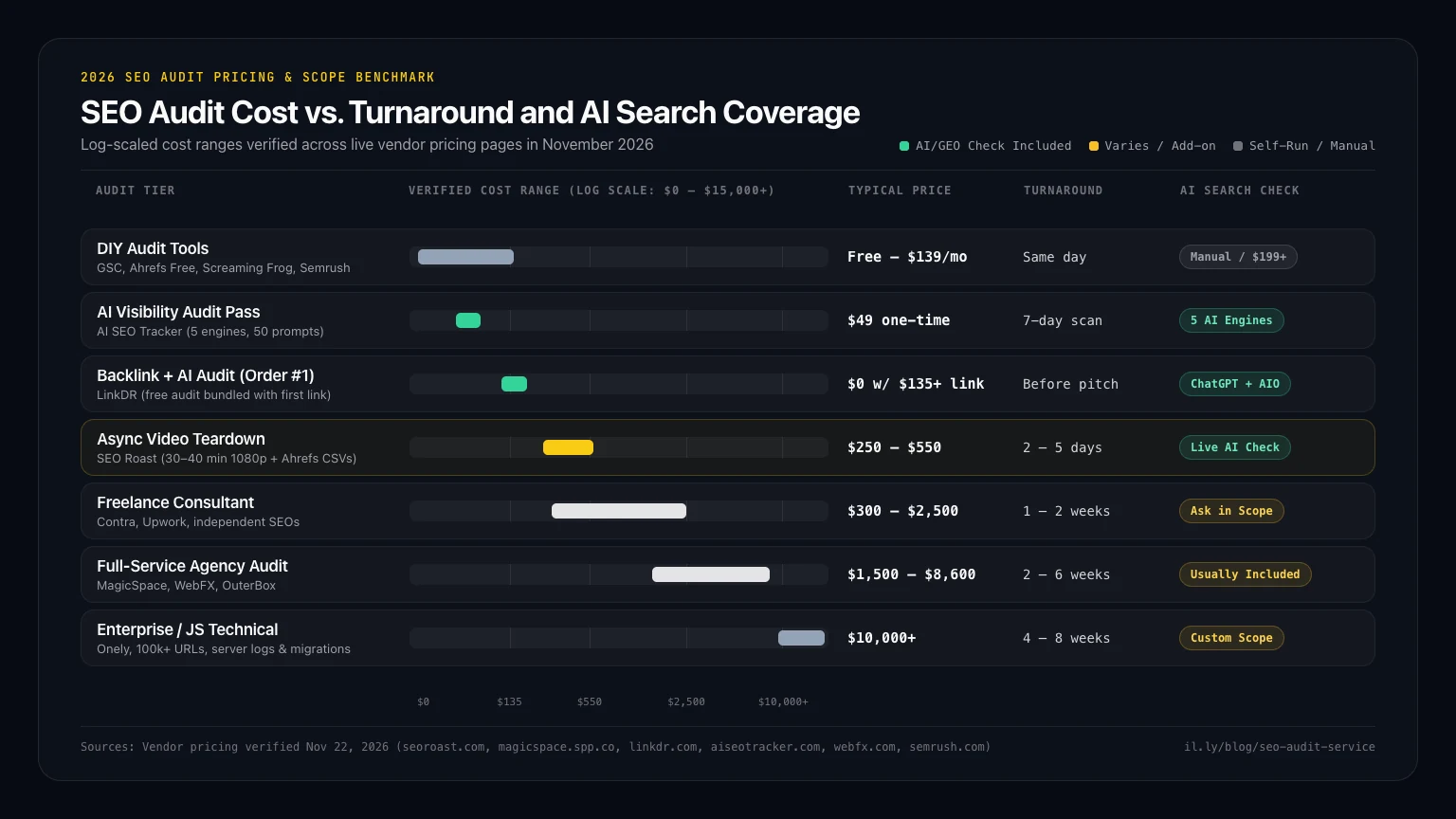
Four variables move the quote more than anything else:
- URL count and technical architecture. Auditing a 40-page Next.js SaaS site takes hours. Auditing a 250,000-URL Magento or faceted e-commerce catalog requires log-file analysis, JavaScript rendering checks, and crawl-budget modeling.
- Off-page and AI search depth. A crawler check only inspects your own HTML. A commercial audit checks why competitors outrank you: their clean backlink profiles, which third-party listicles Google AI Overviews and ChatGPT cite instead of you, and which high-CPC pages you have not built yet.
- Conversion and revenue prioritization. Checking whether ranking pages actually convert visitors into trials or leads takes human judgment. Automated crawlers cannot tell you that 81% of your organic visits land on a free tool with a weak sidebar CTA.
- Whether implementation is bundled. Agencies often absorb part of the audit cost into a $2,500 to $7,500/mo retainer. If you already pay a monthly SEO retainer, a baseline technical audit should be included in month one, not billed as a separate five-figure invoice.
For most SaaS companies and small businesses under 500 pages, $250 to $2,500 buys every diagnostic insight your engineering and content team can realistically ship over the next quarter.
The $3,000 PDF trap to avoid in 2026: Many low-effort agencies sell a "comprehensive SEO audit" that is just a white-labeled export from Semrush, Ahrefs, or Screaming Frog pasted into Google Slides. You get 100 pages of generic warnings ("meta description over 160 characters," "low text-to-HTML ratio," "missing alt text") with zero revenue ordering. Before paying anyone over $300, ask for a redacted sample deliverable and check whether page 1 names the exact 3 to 5 fixes to ship first.
The best SEO audit services
The right service depends on what is actually blocking your growth: missing clarity on what to fix, lack of in-house hands to ship the fixes, weak off-page authority, invisibility in AI answers, or enterprise-scale technical debt. Here is how each tier compares in practice.
1. SEO Roast
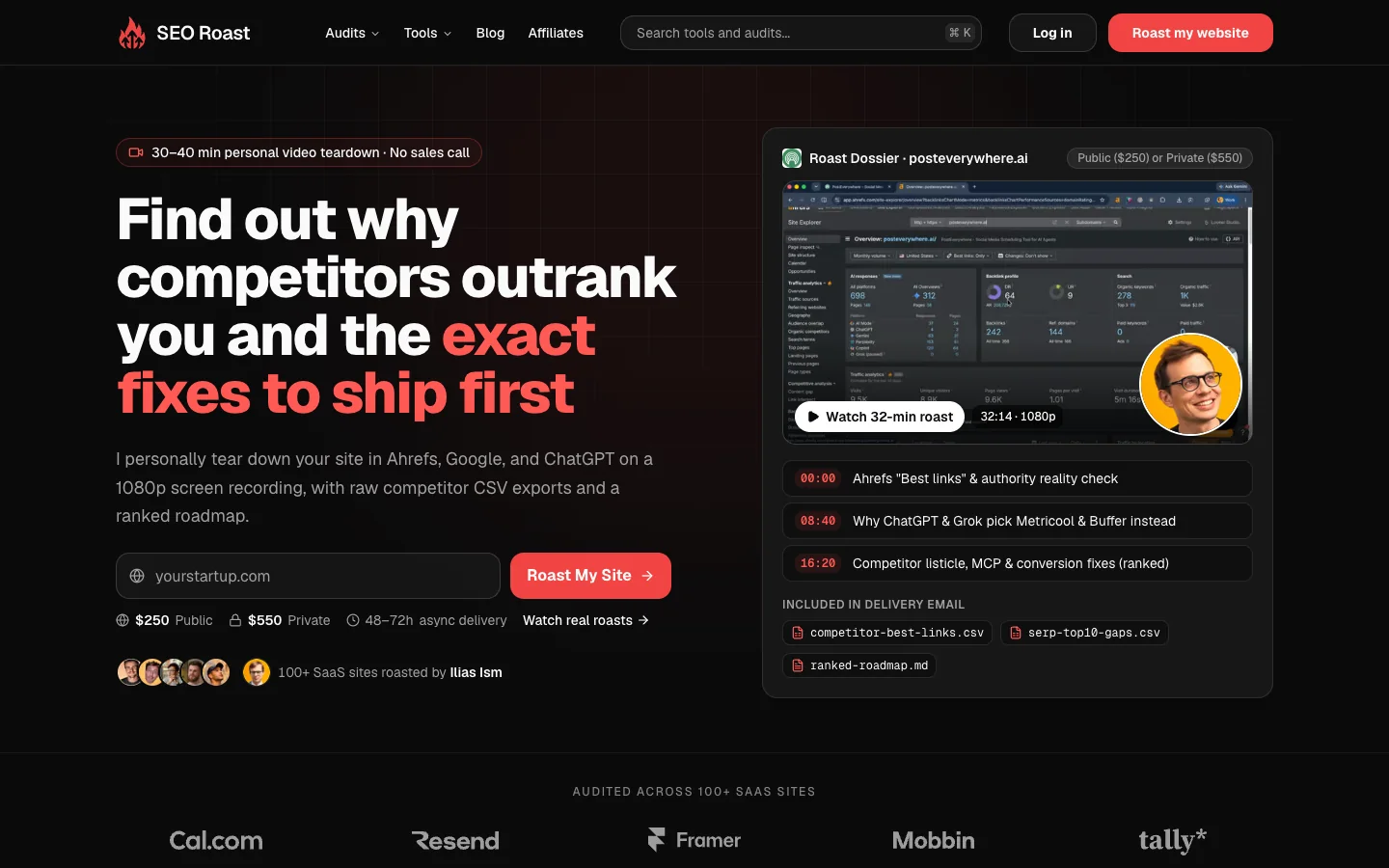
SEO Roast is the async video audit service I run for SaaS founders and lean marketing teams. Instead of a static slide deck, I personally open your website, Ahrefs, Google SERPs, and live AI engines (ChatGPT, Perplexity, Gemini, and Google AI Overviews) on a 30 to 40 minute 1080p screen recording and walk through the exact 5 moves that will grow revenue first.
 Visit site
Every delivery email attaches the raw Ahrefs CSV exports (competitor "Best links" targets with scraper spam stripped, competitor top pages, and top-10 SERP exports) alongside a timestamped watch page, searchable transcript, and ranked Top-5 roadmap your team or coding agent can ship immediately. Public audits are $250 (published on seoroast.com with a permanent backlink), and Private audits are $550 (secret unlisted watch page, never shared publicly). Typical async turnaround is 48 to 72 hours (up to 3 to 5 business days when the queue is full).
You can watch 50 real public audits at seoroast.com/audits before spending a dollar. Three concrete examples of what a manual teardown catches that automated crawlers miss:
- Posterly (
seoroast.com/posterly): Caught that 81% of organic traffic (1,409 of 1.7K monthly visits) sat on one free Instagram handle checker while commercial pages ranked only for the brand name, then exported 1,048 clean referring domains linking to competitor Hopper HQ. Founder Alex Thorp reported daily visits climbing from about 480 to 800 (+68%), peaking at 905 on Oct 14, after acting on the feedback. - PostEverywhere (
seoroast.com/posteverywhere): Already had DR 64 and a working MCP server, yet live prompts in ChatGPT and Grok skipped Google completely and recommended Metricool and Buffer from their native plugin catalogs, while PostEverywhere's own comparison listicles lacked product screenshots. Founder Jamie Partridge shipped the recommended in-app review loop after 10+ successful posts within hours and saw a surge in organic 5-star reviews, daily trials, and trial-to-paid conversion. - Lindo (
seoroast.com/lindo): Showed DR 70 in Ahrefs but only 210 monthly search visits. Digging past the headline metric revealed that the DR came from customer cookie-policy and footer links pointing straight at an app sign-in wall, leaving almost no editorial mentions in "best website builder" listicles or AI Overviews.
2. MagicSpace SEO
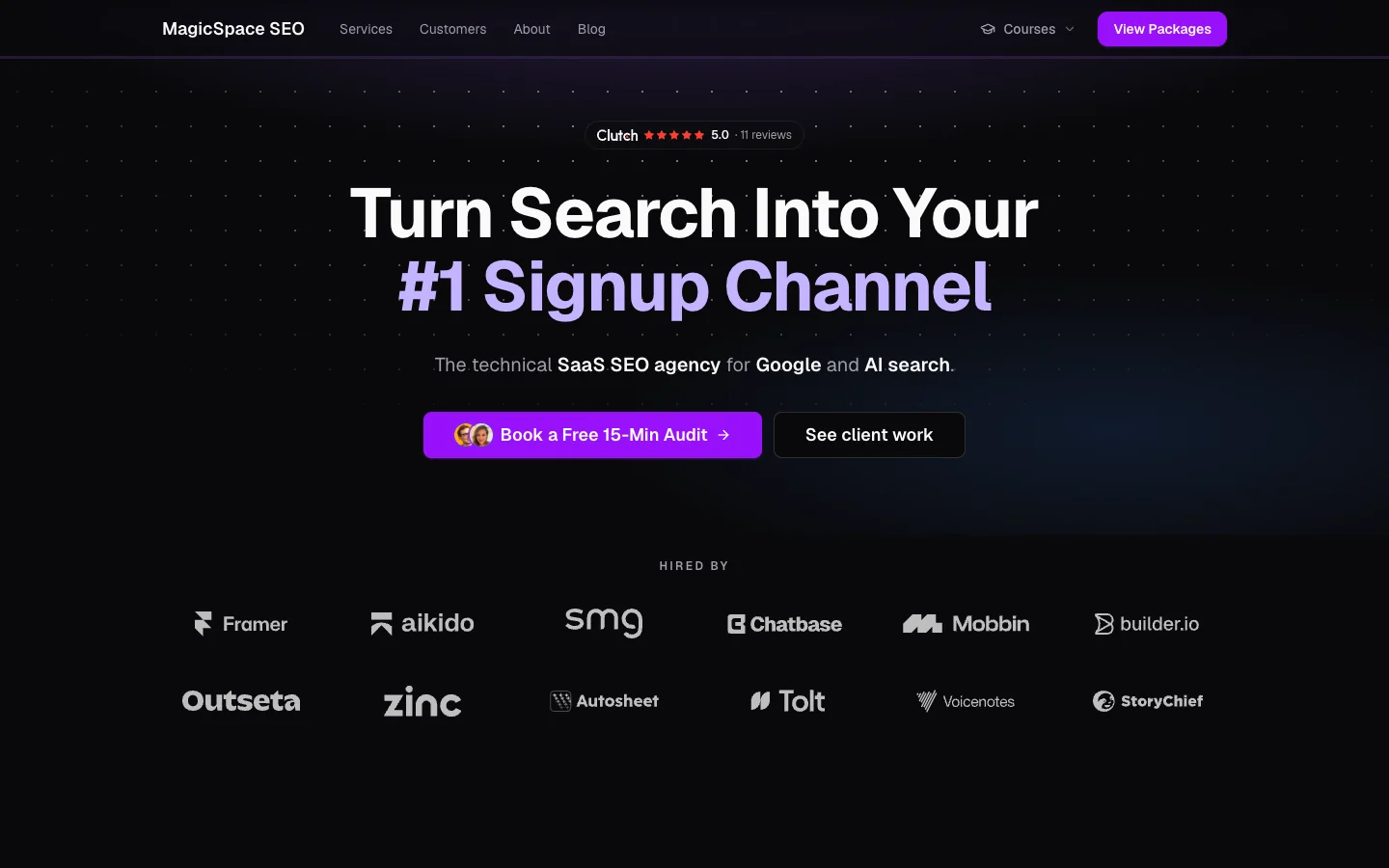
MagicSpace SEO is the SaaS SEO agency I co-run for software teams that want an audit followed by ongoing technical SEO, content, link building, and AI search execution. It holds a 5.0 rating across 11 verified Clutch reviews and has publicly audited and advised software companies including Framer (auditing 1,000 Framer sites alongside framer.com), Mobbin (100k+ pages audited with scripted metadata), and Tolt (.io to .com domain migration).
 Visit site
You can start at three entry points depending on how much support you need:
- Free 15-minute live audit call: Live screen-share looking at your site's biggest ranking or AI-visibility bottlenecks before you spend anything.
- Standalone Paid Audits (
magicspace.spp.co/order/seo-audit): Either a $550 recorded video roast or a $5,250 Full SEO Audit for deeper technical, content, and competitor architecture reviews. - Monthly execution plans (
magicspace.spp.co/order/plans): Starter at $2,500/mo, Growth at $5,000/mo, and Enterprise at $10,000/mo when you want the team implementing content, technical fixes, and citations each month.
3. LinkDR
LinkDR is my managed backlink platform, and it belongs in an audit comparison because of one specific reality in 2026: on roughly half the SaaS sites I inspect, technical on-page SEO is already "good enough." The real reason they sit on page 2 and stay invisible in ChatGPT is an off-page authority and third-party listicle citation gap.
 Visit site
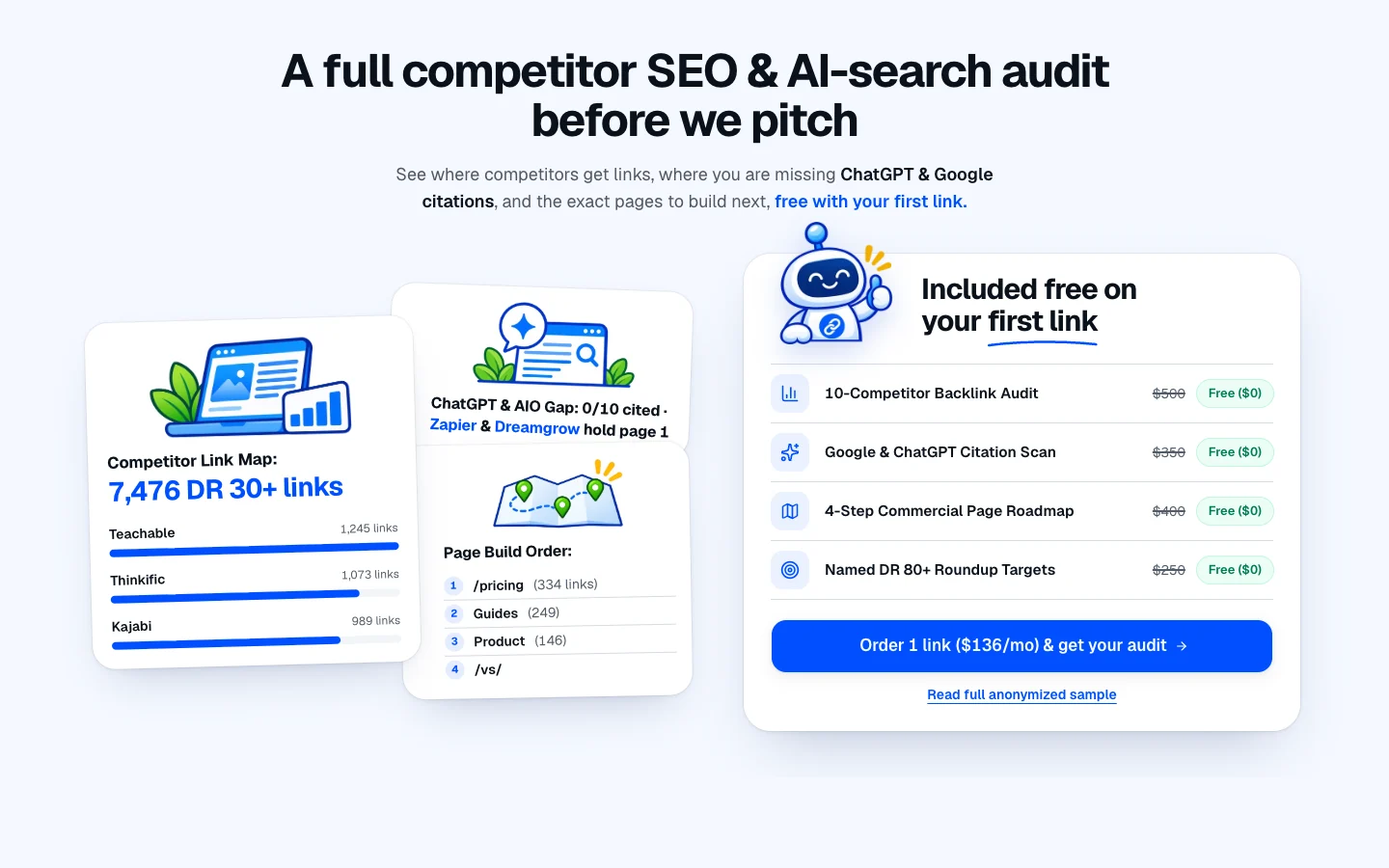
Every first LinkDR order includes a free competitor SEO and AI-search audit ($0) before outreach starts, even if you only test a single DR 30+ link ($136/mo monthly with 15% off and cancel-anytime billing, or $135 net one-time after the $25 first-order credit on the $160 base rate). You can read the full anonymized course-platform sample directly on linkdr.com/#seo-audit: it audits 7,476 clean DR 30+ backlinks across 10 rivals (filtering out spam and user storefronts), runs live ChatGPT and Google AI Overview citation scans (0/10 client citations vs. Zapier and Dreamgrow), maps the 4 commercial page types earning links (/pricing, buyer guides, product pages, /vs/ comparisons), and names exact DR 80+ roundup pitch targets.
4. AI SEO Tracker
If you specifically searched for an AI SEO audit service or want to know why ChatGPT, Perplexity, and Google AI Overviews recommend your competitors instead of you, AI SEO Tracker gives you a dedicated audit without a monthly subscription lock-in.
 Visit site
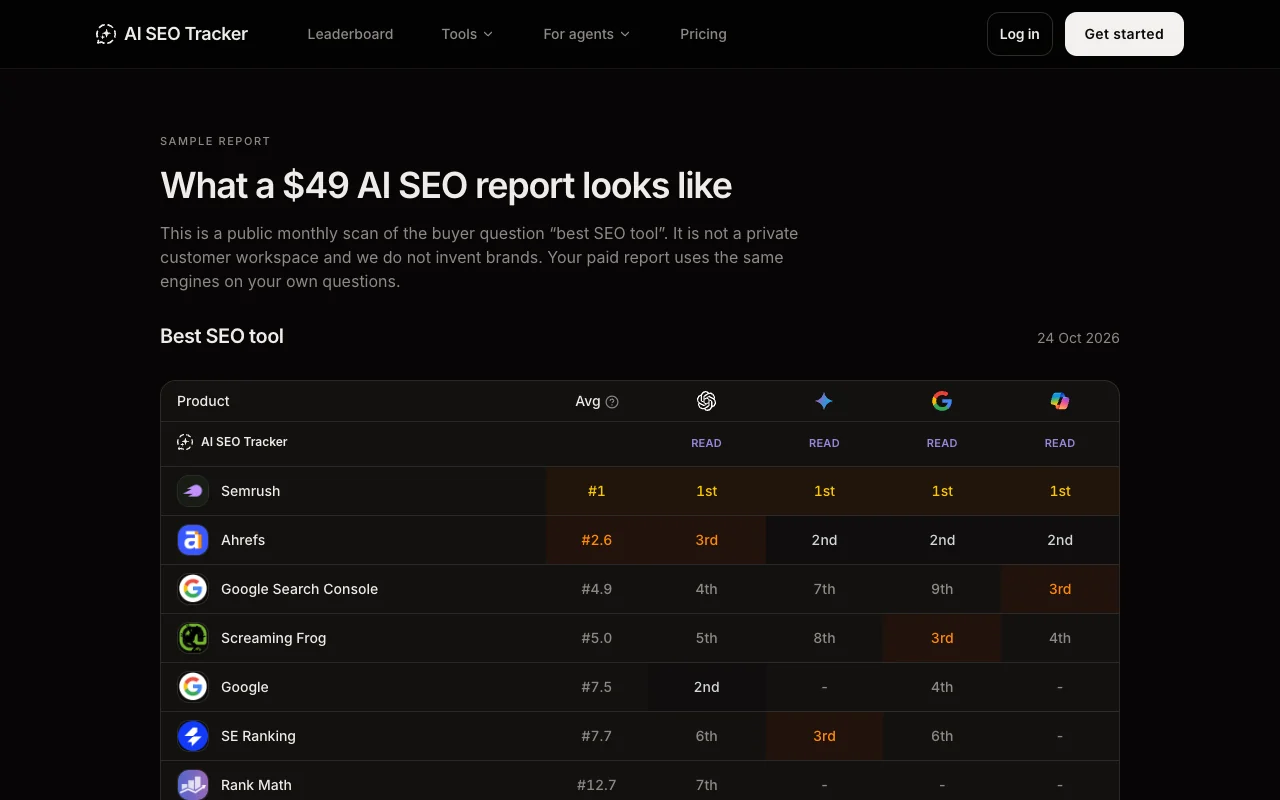
The $49 one-time AI SEO Audit Report generates up to 50 buyer prompts from your website URL, scans them daily for 7 days across five AI search engines (ChatGPT, Perplexity, Gemini, Microsoft Copilot, and Google AI Overviews), surfaces competitor visibility gaps and the exact third-party URLs being cited, and leaves you with permanent read, print, and PDF export access. Across the 343 monthly public leaderboards on aiseotracker.com/leaderboard, 70% of all cited pages are third-party listicles, while vendor homepages account for only 21%. If you want ongoing weekly tracking afterward, paid plans run $79/mo (Basic, 50 prompts, 1 brand) or $199/mo (Pro, 500 prompts, unlimited brands and team seats), and you can query reports directly from Claude Code or Cursor via its remote MCP server (https://aiseotracker.com/api/agent/mcp). You can also test their free 1-question ChatGPT checker and /page-inspector at aiseotracker.com/tools, or read my full breakdown of AI SEO Tracker and Generative Engine Optimization (GEO).
5. Full-service and technical SEO agencies
For large e-commerce catalogs, multi-region sites, or JavaScript-heavy web applications where one bad migration can wipe out millions in revenue, an established agency makes more sense than a lightweight solo audit. Three well-known options that consistently rank on page 1 serve distinct niches:
- WebFX: One of the few large US agencies that publishes concrete audit numbers. Its structured SEO audit package lists $8,600 covering up to 70 pages over a 45-day turnaround (with WebFX's broader pricing guide noting market audits range from $650 to $14,000+ by scope). Best suited to mid-market companies that want a formal agency process, cross-channel reporting, and optional retainer handoff.
- OuterBox: Custom quote (no fixed public audit rate card; OuterBox's 2026 pricing guide cites $100 to $250/hr, $3,000 to $7,500/mo retainers, and $5,000 to $50,000 for larger project engagements). Strong reputation for technical e-commerce audits on Shopify Plus, Magento/Adobe Commerce, and BigCommerce where faceted navigation and filter bloat kill crawl efficiency.
- Onely: Custom quote (discovery call required). Boutique technical SEO specialists known for heavy JavaScript rendering diagnostics, indexing research, server log analysis, and enterprise architectures (100,000+ URLs).
6. Freelance SEO consultants
Hiring an independent SEO consultant through Contra, Upwork, or direct practitioner referrals typically costs $300 to $2,500 for a one-off audit (roughly $75 to $200/hr) with a 1 to 2 week turnaround.
A strong freelance consultant gives you senior attention without agency account-manager overhead. The catch is extreme variance: half the profiles selling "$200 Complete SEO Audits" just run your domain through Semrush or SEOptimer and export the PDF. Always filter freelancers with three questions before paying:
- "Can you send one anonymized sample audit from the last 6 months?"
- "Will you review Google Search Console and competitor commercial gaps, or only run a site crawler?"
- "How many ranked priorities will be on page 1?" (Look for 5 to 10 ordered fixes, not 200 unranked checkboxes.)
7. DIY and automated SEO audit tools
If you have technical comfort and a few hours this week, software catches almost every mechanical crawl error for free or a low monthly fee. Remember what tools do and do not do: crawlers tell you what broke, not which three fixes will bring paying customers.
| Tool | Verified Price (Nov 2026) | Free Tier / Limits | Best Use in an Audit |
|---|---|---|---|
| Google Search Console | Free | Full site data | Ground truth for indexing, real clicks/impressions, and Core Web Vitals |
| Ahrefs Webmaster Tools (Ahrefs Free) | Free (paid Lite $129/mo) | 5,000 crawl credits/mo per verified site; top 1,000 links & keywords | Best free site audit + clean backlink check for domains you verify |
| Screaming Frog SEO Spider | £199 / $279 / €245 per year | Free up to 500 URLs | Desktop technical crawl for status codes, canonicals, redirect chains, and JS rendering |
| Semrush Site Audit | SEO $139/mo ($117.33/mo annual); Semrush One w/ AI $199/mo | Limited free account / trial | 140+ automated technical checks plus optional AI visibility tracking |
| SEOptimer | DIY $29/mo; White Label $39/mo; Embed $59/mo | Quick instant single-page scan | Fast single-page scorecard and white-label PDF reports for agencies |
| SEO Site Checkup | Basic $39/mo ($29/mo yr); Webmaster $69/mo; Pro $129/mo | 7-day trial + instant checks | Quick technical monitoring with bundled LLM visibility checks |
| Backlinko Free SEO Checker | Free | Instant no-signup scan | 60-second Semrush-powered page sanity check for meta tags and on-page basics |
(For a deeper breakdown of crawlers, keyword suites, and rank monitors, read my full SEO tools comparison and backlink monitoring guide.)
What a good SEO audit includes
Every checklist from 2022 stopped at six boxes: crawl, speed, titles, keywords, backlinks, and conversions. In late 2026, skipping AI search citations and clean vs. fake backlink filtering leaves half the picture invisible. A real 2026 SEO audit evaluates seven pillars and sorts findings strictly by Fatal → Revenue → Compounding priority.
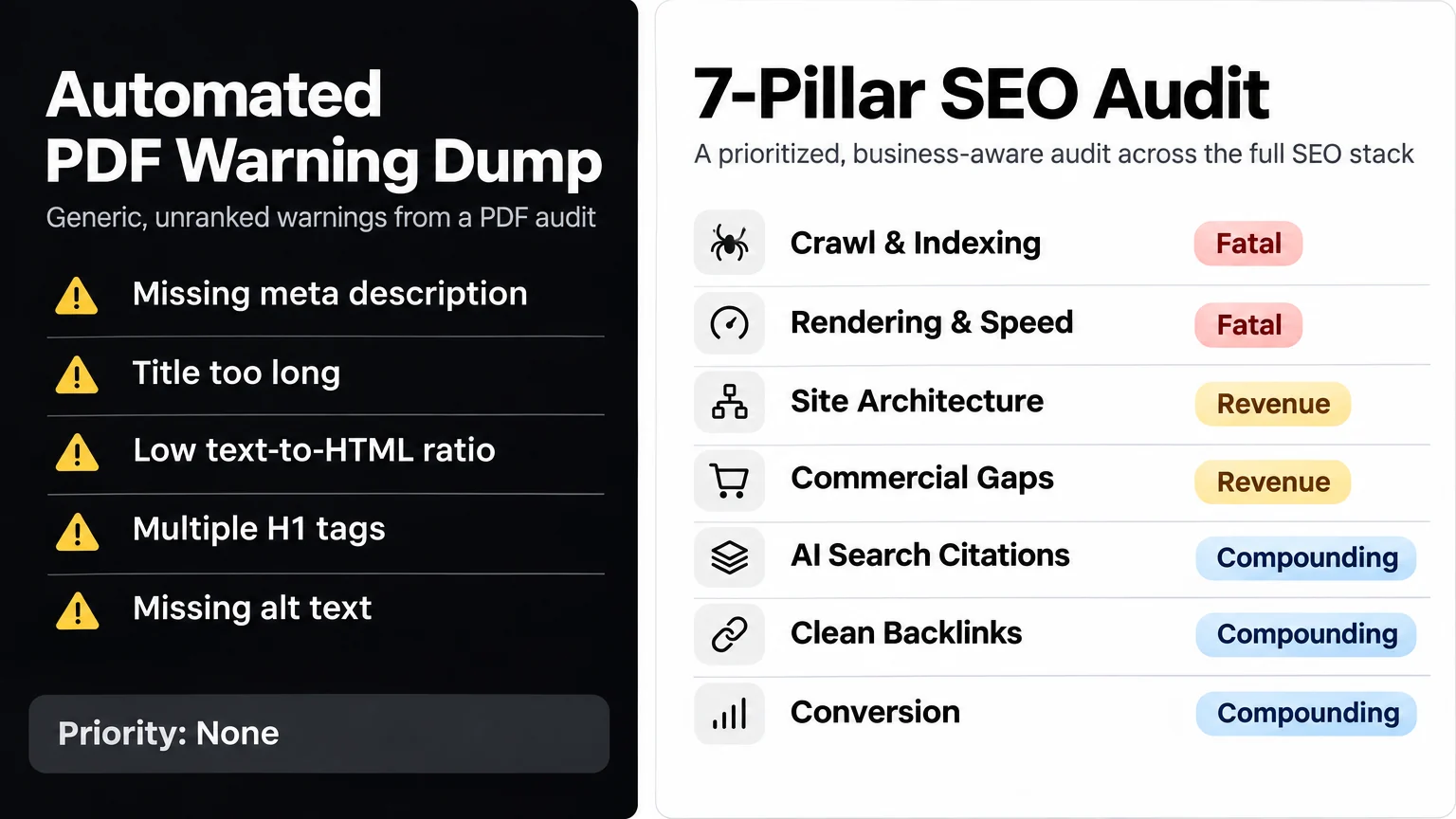
- Crawlability, indexing, and
robots.txt(including AI & Bing crawlers). Check Search Console'sPagesreport for revenue URLs stuck inCrawled - currently not indexed, accidentalnoindexheaders, broken canonicals, and overly aggressiverobots.txtrules. One common bug I keep catching in 2026 audits: default-denyrobots.txtsetups that allow Googlebot while blockingBingbot,OAI-SearchBot, orPerplexityBot. Because Bing's index feeds ChatGPT Search and Copilot, one bad rule silently removes your product from AI recommendations. - Rendering, Core Web Vitals, and mobile UX. Fetch your core landing and pricing pages without JavaScript (
curlor an AI-crawler user agent). If your pricing table or feature list renders only client-side, search and AI retrieval parsers see an empty shell. Check real mobile field data (LCP, INP, CLS) in Search Console rather than chasing a 100/100 lab Lighthouse badge. - Site architecture, URL patterns, cannibalization, and internal linking. Map whether multiple blog posts fight for the same commercial keyword, whether old staging or locale routes return soft
200copies instead of404, and whether high-traffic informational guides pass contextual internal links into your/pricingand product pages. - SERP intent and commercial page gaps (sorted by Traffic Value). Do not copy a competitor's top traffic pages blindly. Sort competitor Top Pages in Ahrefs by Traffic Value (CPC × traffic) instead of raw visits. High-CPC pages ($5 to $50+ CPC) show where advertisers already pay for buyers, exposing missing
/vs/comparisons, use-case pages, and commercial landing pages worth building first. - AI Search / GEO and citation audit. Test your top 15 to 50 buyer prompts across Google AI Overviews, ChatGPT, and Perplexity to see which brands get recommended and which third-party listicles, Reddit threads, and YouTube videos get cited as sources. One late-2026 caveat worth knowing: anti-scraper defenses hit several third-party SERP APIs hard in fall 2026, causing stale or poisoned rank-tracker snapshots. Always cross-check suspicious rank drops against Google Search Console (
US + Desktopand query filters) and live unpersonalized SERPs before rewriting pages that did not actually drop. - Backlink quality and "Best Links Only" gap. Headline Domain Rating lies constantly. As the public Lindo roast proved, a site can sit at DR 70 from customer cookie-policy or footer links while holding almost zero editorial mentions. Filter every competitor backlink report to dofollow, in-content, non-CDN, real-traffic links (see my exact Ahrefs Best Links Only settings) to measure the true authority gap.
- Conversion and revenue leakage. Ranking #2 for a 5,000/mo keyword means nothing if the page hides the product UI, buries the CTA, or forces a 6-field signup form before showing value. Every commercial audit should review above-the-fold clarity and signup friction on your top 10 organic landing pages (see my full SaaS landing page audit checklist).
Red flags of a bad SEO audit:
- A 60 to 100 page PDF with no executive top-5 priority list on page 1.
- "Critical" warnings about meta description length, text-to-HTML ratio, or H3-before-H2 tags ranked above broken indexing or missing commercial pages.
- Zero mentions of your actual competitors, Google Search Console clicks, or AI search citations.
- Copy-paste advice ("publish more high-quality blog content and build backlinks") that could apply to any website on earth.
Can ChatGPT do an SEO audit?
Partly, but not by pasting your URL into a chat box. Raw ChatGPT or Claude cannot reliably crawl a full website, inspect your server responses across 500 URLs, or see your Google Search Console impressions and competitor backlinks. If you paste a homepage link and ask "Audit my SEO," the model guesses generic meta-tag tweaks and frequently hallucinates issues that do not exist in your HTML.
Where AI models genuinely excel in 2026 is structured data synthesis and code execution once you feed them real exports and repo access:
- Triaging raw CSVs: Upload your Google Search Console export (
Queries+Pages), Screaming Frog crawl CSV, and Ahrefs Competitor Top Pages CSV, then ask Claude or ChatGPT to cluster queries by intent, flag cannibalized URLs, and highlight position 5 to 20 near-wins. - Auditing inside your codebase: Running Claude Code, Cursor, or Codex directly inside your git repo lets the agent inspect
robots.txt,sitemap.ts, canonical logic, dynamic[locale]soft-404 traps, and client-only pricing components, then open a real pull request fixing the fatal blockers instead of writing another PDF. - Using opinionated decision trees (
SKILL.md): Open-ended prompts list 40 unranked observations. An explicit skill file enforces a strictFATAL → REVENUE → COMPOUNDING → FLUFFgate so the agent fixes crawl blockers before touching alt text.
If you already use Claude Code, Cursor, or Codex, install our MIT-licensed seo-roast skill from Illyism/seo-skills (30 open-source skills browsable at /skills):
Run a revenue-first SEO teardown of your site and codebase, fix crawl and layout blockers in a PR, and ship a prioritized roadmap.
# SEO Roast: Revenue-First Teardown That Ends in a Merged PR

Most audits ship a 50-page PDF of 400 warnings: missing alt text, meta descriptions 4 characters too long, H3 before H2. The site keeps losing money because the 3 issues that matter sit on page 31. A roast does the opposite: find what blocks revenue, say it bluntly, fix it in code, and order the rest by money.

**When invoking:** Open with a one-line verdict ("Your robots.txt hides you from every engine except Google"), then run the procedure. Never open with a score out of 100.

## Core Rule: Fatal First, Fluff Never (Until Fatal Is Dead)

```
issue found
├── FATAL: blocks crawling, indexing, or rendering of a revenue page
│   └── Fix in this PR. Nothing else ships until this tier is empty.
├── REVENUE: page indexes but cannot rank or cannot convert
│   └── Fix in this PR if it takes under 1 hour of code, else top of roadmap.
├── COMPOUNDING: authority, links, AI visibility
│   └── Roadmap with owner and first action.
└── FLUFF: alt text, meta length, heading order, minor schema warnings
    └── One line at the bottom of the roadmap. Do not fix while FATAL or REVENUE rows remain.
```

Why: an alt tag on a page Bing cannot crawl earns nothing, and teams that fix fluff first feel productive while the blocker stays live for another quarter.

## Intake (2 minutes)

1. Domain, the 1-3 money pages, and the main conversion (signup, demo, purchase).
2. Repo access: detect framework from `package.json`, find `robots.txt`/`robots.ts`, `sitemap`, middleware, dynamic routes (`app/**/[slug]`, `pages/**/[slug]`).
3. If available: GSC top pages, Ahrefs or DataForSEO access (see ahrefs-research and dataforseo-serp).

## The 6-Point Roast Decision Procedure

Run in order. Each point has a check, a pass/fail threshold, and the fix you ship.

### 1. Self-Own Crawl and SafeSearch Blockers

**1a. Default-deny robots.txt**

```bash
curl -s https://deployfast.dev/robots.txt
```

Fail pattern:

```
User-agent: *
Disallow: /

User-agent: Googlebot
Allow: /
```

This blocks Bingbot, DuckDuckBot, Brave, Yandex, Naver, and every AI search crawler. Why it is fatal: Bing's index feeds ChatGPT search, Copilot, and DuckDuckGo, so this one file erases the site from most AI answers.

**Fix shipped:** default-allow, block only private paths.

```
User-agent: *
Allow: /
Disallow: /api/
Disallow: /app/
Disallow: /admin/

Sitemap: https://deployfast.dev/sitemap.xml
```

Never disallow `/_next/`, `/static/`, or CSS/JS paths. Why: Google renders the page with those files, and blocking them makes it see a broken layout. For blocking AI training crawlers while keeping AI search, use the block-ai-scrapers skill instead of a blanket deny.

Disallow only private paths that exist in this repo (`/api/` yes, `/app/` only if the dashboard lives there). If `curl -s https://deployfast.dev/sitemap.xml` does not return XML, ship a sitemap (`app/sitemap.ts` in Next.js) in the same PR. Why: a `Sitemap:` line pointing at a 404 or an HTML page wastes the fix.

**1b. Locale sprawl**

Count locale prefixes in the sitemap (`/de`, `/fr`, `/ru`, `/es`, ...). No sitemap: read the route tree (`app/[locale]`, `i18n` config, middleware locale lists) instead.

```
locale trees
├── >= 8 locales, or any locale with English strings left in templates, or hreflang not reciprocal
│   └── FAIL. Keep a locale only if it earns >= 5% of the default locale's clicks or revenue
│       AND you translate every string on it in this PR (max 3 kept).
│       Others: noindex + remove from sitemap, or 301 to the English page.
│       No locale qualifies → keep the default locale only, ship no hreflang.
└── <= 3 locales, fully translated, reciprocal hreflang + x-default → PASS
```

Why: half-translated locale trees are thin near-duplicates that split crawl budget and read as low-quality machine translation. Reciprocal means every page in the set lists every other page, including itself; one-way hreflang gets ignored.

**Fix shipped:** hreflang generator that emits the full reciprocal set for kept locales, `noindex` guard in the layout for dropped locales, sitemap filtered to kept locales. For 301s in Next.js `redirects()`, write 2 rules per dropped locale: `/fr` -> `/` and `/fr/:path+` -> `/:path+`. Why: a single `/fr/:path*` -> `/:path*` rule sends bare `/fr` to an empty `Location` header. Next.js `permanent: true` returns 308, which Google treats like a 301.

**1c. SafeSearch demotion**

Check for borderline or NSFW media in crawlable HTML: user-uploaded avatars and galleries, suggestive stock heroes, adult-adjacent UGC. Compare `site:domain` result counts with SafeSearch on vs. off. A large gap on a clean product is a FAIL. Why: Google classifies explicit content at page and site level, and SafeSearch is on by default for many users, so a few explicit images can filter clean head-term pages.

**Fix shipped:** move UGC media pages behind `noindex` or auth, and add `<meta name="rating" content="adult">` only to pages that are adult, which tells Google to isolate them instead of judging the whole site.

**1d. Catch-all soft 404s**

```bash
curl -s -o /dev/null -w '%{http_code}\n' https://deployfast.dev/no-such-page-xyz   # must print 404
```

Any 200 is a FAIL. The usual cause is a top-level dynamic segment (`app/[locale]/page.tsx`, `pages/[slug].tsx`) that renders for every path, including `/sitemap.xml` and `/robots.txt` when no static file wins. Why: every typo URL becomes an indexable duplicate of the homepage, and the sitemap URL serves HTML.

**Fix shipped:** `export const dynamicParams = false` (App Router) or `fallback: false` (Pages Router) on the segment, and `notFound()` for unknown params.

### 2. Programmatic SEO Traps and Contradictory Counts

List every dynamic route and sample 20 live URLs per route from the sitemap. No sitemap: enumerate them from `generateStaticParams` or the data file the route reads.

| Check | Fail threshold | Fix shipped |
|---|---|---|
| Thin result pages | > 10% of sampled pages show 0-1 results | `noindex, follow` when `results < 3`, drop from sitemap |
| Numeric or ID slugs | `/near/18234`, `/tools/a7f3` | Slugify from the entity name, 301 old IDs |
| Missing transactional noun | "Property near X" | Template: "Condos for Rent near X (42 listings)" |
| Boilerplate FAQs | Same FAQ answer text on > 30% of child pages | Inject entity variables (count, price range, top item) or delete the block |
| Search URL bloat | `?q=`, `?sort=`, `?page=` URLs indexed | `noindex` first, `Disallow` only after they drop out of the index |
| Contradictory counts | H1, FAQ, and `llms.txt` state different numbers | One source constant read by all three |

Why each matters:
- Thin pages train Google that the whole route pattern is low value, which drags down the good pages on the same template.
- A searcher types the action ("for rent", "for sale", "free"), and a title without it loses the click to one that has it.
- `noindex` before `Disallow`, because a disallowed URL cannot be recrawled to see the `noindex`, so it stays indexed.
- Google and LLMs quote one number. When the H1 says 1,200, the FAQ says 900+, and `llms.txt` says 800, neither trusts any of them.
- A static `public/llms.txt` cannot import the count constant. Replace it with a route handler (`app/llms.txt/route.ts`) that renders counts and prices from the same constants as the pages, and delete the static file.
- Derive the constant from the data (`TEMPLATES.length`), never a typed number. Why: a typed count drifts the first time someone adds a row to the data.

### 3. Above-the-Fold Layout and Demo-Wall Fix

**3a. Layout**

Load the money page and the main programmatic template at 1366x768 and 390x844.

```
first viewport
├── map, hero animation, or video takes >= 50% of the viewport
│   AND no result card or internal hub link is visible
│   └── FAIL. Collapse the map behind a "Show map" toggle, render cards first.
├── card attributes are icon-only SVGs (bed icon + "2")
│   └── FAIL. Write them as text: "2 bedrooms, 1 bathroom, 65 m²".
└── cards and hub links visible without scrolling → PASS
```

Why: crawlers and users both weight what loads first, and icon-only attributes are invisible text to Google and to LLMs reading the HTML.

**3b. Demo wall**

```
primary CTA
├── only "Book a Demo" or "Talk to Sales"
├── or core value hidden behind "Create Account to View"
│   └── FAIL. Ship an instant interactive element on the page:
│       lookup, calculator, sample report, or live preview with no login.
│       Capture the email after the user sees their result.
└── visitor gets value in < 30 seconds without an account → PASS
```

Why: a search visitor arrives cold and leaves in seconds, and a demo calendar asks for 30 minutes before showing anything. An instant result converts the same visitor and gives Google an engagement signal.

### 4. Fake Authority vs. Competitor Best Links Reality Check

Pull the site's and 3 competitors' DR, `org_keywords`, and clean referring domains (ahrefs-research Workflow B: dofollow, in-content, 1 per domain, referring page traffic > 10).

```
site profile
├── DR >= 40 and org_keywords < 100
│   └── FAIL: inflated. Links come from sitewides, widgets, or farms. Stop buying that kind.
├── competitor ranks top 3 on 25-40 clean editorial domains, site has fewer
│   └── That gap is the link target. Put the exact number in the roadmap.
└── clean domain count >= competitors' → links are not the bottleneck. Look at points 2, 3, 6.
```

Why: DR is easy to inflate and costs nothing to fake, while clean editorial domains are what a lean competitor ranks on. Name the real number so the team stops chasing a vanity metric.

**Built-in product backlink loops.** Check whether the product earns links as people use it:

- `"Powered by [Brand]"` or `"Verified on [Brand]"` badge on customer-facing outputs (status pages, forms, invoices, reports).
- Public share URLs (`/s/<id>`, `/r/<slug>`) that are indexable and carry a brand link.
- Embeddable widgets, maps, or charts with an attribution link.

**Fix shipped:** a badge component and an embed snippet. Link to the homepage with the brand name as anchor. Why: Google treats keyword-rich anchors in widgets as a link scheme, while brand anchors from real usage compound without outreach.

### 5. AI Search Entity and Pricing Visibility

```bash
for UA in GPTBot OAI-SearchBot PerplexityBot ClaudeBot; do
  echo "$UA: $(curl -s -A "$UA" https://deployfast.dev/pricing \
    | perl -0pe 's/<script\b.*?<\/script>//gs; s/<!--.*?-->//gs; s/<head>.*?<\/head>//s' \
    | grep -oE '\$[0-9][0-9,.]*' | sort -u | tr '\n' ' ')"
done
```

Strip scripts, comments, and `<head>` before grepping. Why: Next.js inlines its RSC payload in `<script>` tags where `$1` and `$9` are references, which makes a JS-only pricing page pass a raw grep; React also splits `${price}` into `$<!-- -->29`, which makes a fixed page fail it; and a price in `<title>` is not a price table. No deploy yet: run `next build && next start` (or the framework's production server) and point the loop at `localhost`.

```
pricing page raw HTML
├── no prices in the HTML (JS-only slider, client-fetched plans) → FAIL
├── docs or specs behind login → FAIL
├── crawler gets 403 / challenge page → FAIL (check WAF and bot rules)
└── plans, prices, and limits present as plain text → PASS
```

Why: most AI crawlers do not run JavaScript, so a JS-only pricing slider tells ChatGPT, Perplexity, and Claude the product has no public price, and they recommend a competitor whose price they can read.

**Fix shipped:** server-render the pricing table as text, publish public docs for core features, add `Product`/`Offer` JSON-LD with the same prices, and make `llms.txt` match the page exactly.

### 6. Money-Page Indexation and Internal Link Reality

For each money page:

| Check | Fail |
|---|---|
| In sitemap | Missing |
| Indexed (GSC URL Inspection or `site:` query) | Not indexed |
| Canonical | Points elsewhere, or missing on a page with query variants |
| Linked from homepage or main nav | No |
| Contextual body links pointing in (nav and footer excluded) | Fewer than 3 |
| Status | Any redirect chain or soft 404 |

Why: money pages often sit 4 clicks deep while the blog gets the homepage links, so Google ranks the blog for the money keyword and the conversion never happens.

**Fix shipped:** nav or homepage link, canonical fixed, sitemap entry added. Then run the internal-linking skill for 3+ contextual links from the top-traffic posts; it uses the same nav-excluded count, so its orphan list and this check agree.

## Required Shipped Outputs

### 1. The fix PR

Apply every FATAL and fast REVENUE fix directly in the codebase: `robots.txt`, hreflang and noindex guards, programmatic title templates, count constants, crawlable pricing and cards, badge component, internal links. PR description format:

```markdown
## SEO Roast fixes
Verdict: <one blunt line>

### Fatal (fixed)
- robots.txt default-deny blocked Bing and AI crawlers → default-allow
### Revenue (fixed)
- /near/[slug] titles now "Condos for Rent near {city} ({count} listings)"
### Verify
- curl -A Bingbot https://<domain>/robots.txt
- view-source pricing page shows $ amounts
```

### 2. `seo/roast-roadmap.md`

Ordered by revenue impact, not by audit category:

```markdown
# SEO Roast Roadmap: invoicekit.io (2026-11-12)

Verdict: Google could see you. Nobody else could.

| # | Tier | Issue | Revenue impact | Fix | Owner | Status |
|---|---|---|---|---|---|---|
| 1 | FATAL | robots.txt blocked all non-Google crawlers | AI search + Bing traffic at 0 | default-allow | agent | shipped in PR |
| 2 | REVENUE | Pricing JS-only | Missing from AI recommendations | SSR table + JSON-LD | agent | shipped in PR |
| 3 | COMPOUNDING | 11 clean RDs vs competitor 34 | Money keyword stuck page 2 | 23-link gap plan | founder | next |

## Fluff (ignore until rows above ship)
- 14 images missing alt text
```

Revenue impact column states what money it blocks in one plain sentence. No severity scores, no traffic-light colors.

### 3. Optional client deck

When the roast goes to a founder, board, or client, turn `seo/roast-roadmap.md` into a `.pptx` with [GenPPT](https://genppt.com): one slide per FATAL issue with before/after, then the roadmap table.

## Where to Go Next

- **Human teardown:** for a blunt 20-minute video roast of the site recorded by Ilias, use [SEO Roast](https://seoroast.com).
- **Closing the link gap from point 4:** [LinkDR](https://linkdr.com) (`https://linkdr.com/SKILL.md`) places vetted DR 30-60+ editorial links and listicle mentions, so the 23-link gap becomes an order instead of a quarter of outreach.
- **Verifying AI search recovery from points 1a and 5:** [AI SEO Tracker](https://aiseotracker.com) (MCP: `https://aiseotracker.com/api/agent/mcp`) tracks whether ChatGPT, Perplexity, Gemini, and Google AI Overviews start citing your pages once the crawl and pricing fixes ship.

## Done Checklist

- [ ] FATAL tier empty, every fix in the PR
- [ ] Fast REVENUE fixes in the PR, the rest at the top of the roadmap
- [ ] `seo/roast-roadmap.md` ordered by revenue impact with owners
- [ ] Verification commands in the PR description pass
- [ ] Fluff listed once at the bottom, untouched

## Related

- Competitor gaps and clean backlink math: ahrefs-research, https://il.ly/skills/ahrefs-research
- SERP intent, clustering, and AI citation sources: dataforseo-serp, https://il.ly/skills/dataforseo-serp
- One money page to page one in 30 days: blitz-seo, https://il.ly/skills/blitz-seo
- AI crawler policy: block-ai-scrapers, https://il.ly/skills/block-ai-scrapers
- Routing blog traffic into money pages: internal-linking, https://il.ly/skills/internal-linkingHow to do a basic SEO audit yourself
If you have two to three hours this week and want to audit your own site without hiring anyone, run this five-step sequence pairing free Google/crawler data with your coding agent:
- Pull ground-truth indexing and near-wins from Google Search Console. Open Indexing → Pages and check whether any commercial URL sits under
Crawled - currently not indexedorDuplicate without user-selected canonical. Then open Search results, filter to the last 28 days, and export queries ranking in positions 5 to 20 with high impressions. Refreshing those near-win pages is usually the fastest organic traffic win on your entire domain. - Crawl up to 500 URLs free with Screaming Frog (or 5,000/mo in Ahrefs Free). Fix 404 internal links, redirect chains, missing or duplicate
<title>tags, and broken canonicals. Test your/pricingand main landing pages withcurlto confirm core copy and pricing exist in raw server HTML, not only after client JavaScript executes. - Run the
seo-roastskill inside your repo (optional for dev teams). Install the skill (npx skills add Illyism/seo-skills --skill seo-roast), point Claude Code or Cursor at your repo plus your exported GSC/crawl CSVs, and ask it to fix everyFATALcrawl or rendering blocker in one PR and write a revenue-ordered roadmap. - Diff competitor Top Pages and "Best links." Export the Top Pages (sorted by Traffic Value) and Best Links of 3 real search competitors in Ahrefs. List the top 3 commercial landing pages or free tools they rank for that you have not built yet, plus the top 20 real-traffic articles linking to them.
- Spot-check AI search visibility and page conversions. Ask ChatGPT, Perplexity, and Google your top 10 buyer questions (or run a $49 AI SEO Tracker scan) to list which third-party roundups get cited. Then open your top 5 organic landing pages on a phone viewport and verify a cold visitor understands what you sell and how to sign up within 5 seconds.
# Install the free open-source audit skill in Claude Code, Cursor, or Codex
npx skills add Illyism/seo-skills --skill seo-roast

# Verify Bingbot and AI crawlers are not blocked in robots.txt
curl -s -A "Bingbot" https://yourdomain.com/robots.txt
curl -s -o /dev/null -w "%{http_code}\n" https://yourdomain.com/nonexistent-soft-404-check
If you want the full 30-day execution system for turning one audited money page into page-one rankings, grab my book Blitz SEO (il.ly/blitz), which includes the sprint checklists and companion skill files.
How to choose an SEO audit service
Match the audit format to your actual budget, site size, and execution bottleneck:
- Under $100 budget and already ranking fine on Google, but missing in ChatGPT: Run the $49 AI SEO Tracker one-time report plus free Google Search Console and Screaming Frog checks.
- SaaS founder or marketer with an in-house dev/coding agent who needs clear priorities this week: Order a $250 public or $550 private SEO Roast. You get the exact ranked roadmap and raw Ahrefs CSVs in days without sitting through sales calls.
- Technical site health is fine, but competitors crush you on authority and AI listicles: Place a starter link on LinkDR ($135 to $136+) and take the bundled Order #1 competitor backlink and AI-citation audit for $0.
- Growing software company ($50k+ MRR) that wants someone else to execute: Book the free 15-minute live audit at MagicSpace SEO or scope a $5,250 full audit / monthly plan.
- 100,000+ URL e-commerce store, complex migration, or JavaScript rendering crisis: Budget $8,600 to $15,000+ for a specialized enterprise audit team like WebFX, OuterBox, or Onely.
Whatever option you pick, ask one final question before paying: who is going to ship the fixes next Monday? An unimplemented $8,000 audit produces zero traffic. A $250 video teardown or weekend DIY sprint where you actually deploy all five fixes wins every time.
FAQ
How much does an SEO audit cost?
In 2026, DIY audit tools run from free (Google Search Console, Ahrefs Free, Screaming Frog up to 500 URLs) to $139/mo for Semrush. A dedicated AI visibility audit costs $49 one-time (AI SEO Tracker), an async human video teardown costs $250 to $550 (SEO Roast), freelance consultants charge $300 to $2,500, full-service agency audits run $1,500 to $8,600 (for example, $5,250 at MagicSpace SEO and $8,600 published at WebFX), and enterprise audits for 100,000+ URL sites start at $10,000+.
What are SEO audit services?
SEO audit services evaluate why a website is losing search traffic, rankings, or AI citations and produce a prioritized fix plan. A thorough 2026 service inspects seven areas: crawlability and indexing, JavaScript rendering and Core Web Vitals, site architecture and internal links, commercial keyword gaps, AI search/GEO citations (ChatGPT, Perplexity, Google AI Overviews), clean backlink authority, and landing-page conversion leaks.
Can ChatGPT do an SEO audit?
ChatGPT cannot crawl an entire website, verify HTTP status codes at scale, or access live Google Search Console and Ahrefs backlink data by pasting a URL alone. However, ChatGPT and Claude are very effective once you feed them real CSV exports from Search Console, Screaming Frog, and Ahrefs, or run an agent like Claude Code directly inside your codebase with structured audit skills such as seo-roast.
Is SEO dead or evolving in 2026?
SEO is evolving, not dead. Google Search still drives the largest share of commercial discovery, while ChatGPT, Perplexity, and Google AI Overviews have added a second layer on top of search indexes. Live AI answers rely on search retrieval (Google and Bing) plus cross-domain consensus from independent third-party listicles and reviews. Sites that combine clean technical SEO with proof-backed commercial pages and third-party citations win both channels.
Is it worth paying for SEO services?
Paying for an SEO audit or execution service is worth it when organic search has proven buyer intent in your category (check whether competitors bid $3+ CPC on your core keywords) and you have the engineering or agency capacity to implement the fixes. It is a waste of money if nobody ships the recommendations or if you pay thousands for an unprioritized automated crawler PDF.
How long does an SEO audit take?
Automated tools and AI visibility checks return initial findings in minutes to 7 days. Async video teardowns like SEO Roast take 2 to 5 business days. Freelance consultant audits typically take 1 to 2 weeks, full-service agency audits take 2 to 6 weeks (WebFX lists 45 days for its full audit), and enterprise technical audits with log-file analysis can take up to 2 months.
How often should you do an SEO audit?
Run a full strategic and technical audit once a year, plus a focused technical check immediately before and after any site redesign, domain migration, URL restructure, or major Google Core Update. Between full audits, review Google Search Console indexing and position 5 to 20 opportunities monthly.
What does an AI SEO audit check?
An AI SEO (or GEO) audit checks whether ChatGPT, Perplexity, Gemini, Copilot, and Google AI Overviews mention your brand for buyer prompts, whether your robots.txt or client-side JavaScript blocks AI crawlers (OAI-SearchBot, PerplexityBot, Bingbot), and exactly which third-party listicles, comparison guides, Reddit threads, or YouTube videos the AI engines cite instead of your site.
Is a free SEO audit worth it?
Free automated tools like Google Search Console, Ahrefs Webmaster Tools, Screaming Frog (up to 500 URLs), and Backlinko's Free SEO Checker are great for spotting broken links, indexing errors, and missing metadata. What most free audits cannot give you is commercial prioritization, competitor backlink strategy, or conversion fixes, unless it is a live founder call (like MagicSpace SEO's 15-minute audit) or a bundled client audit (like LinkDR's Order #1 audit).