
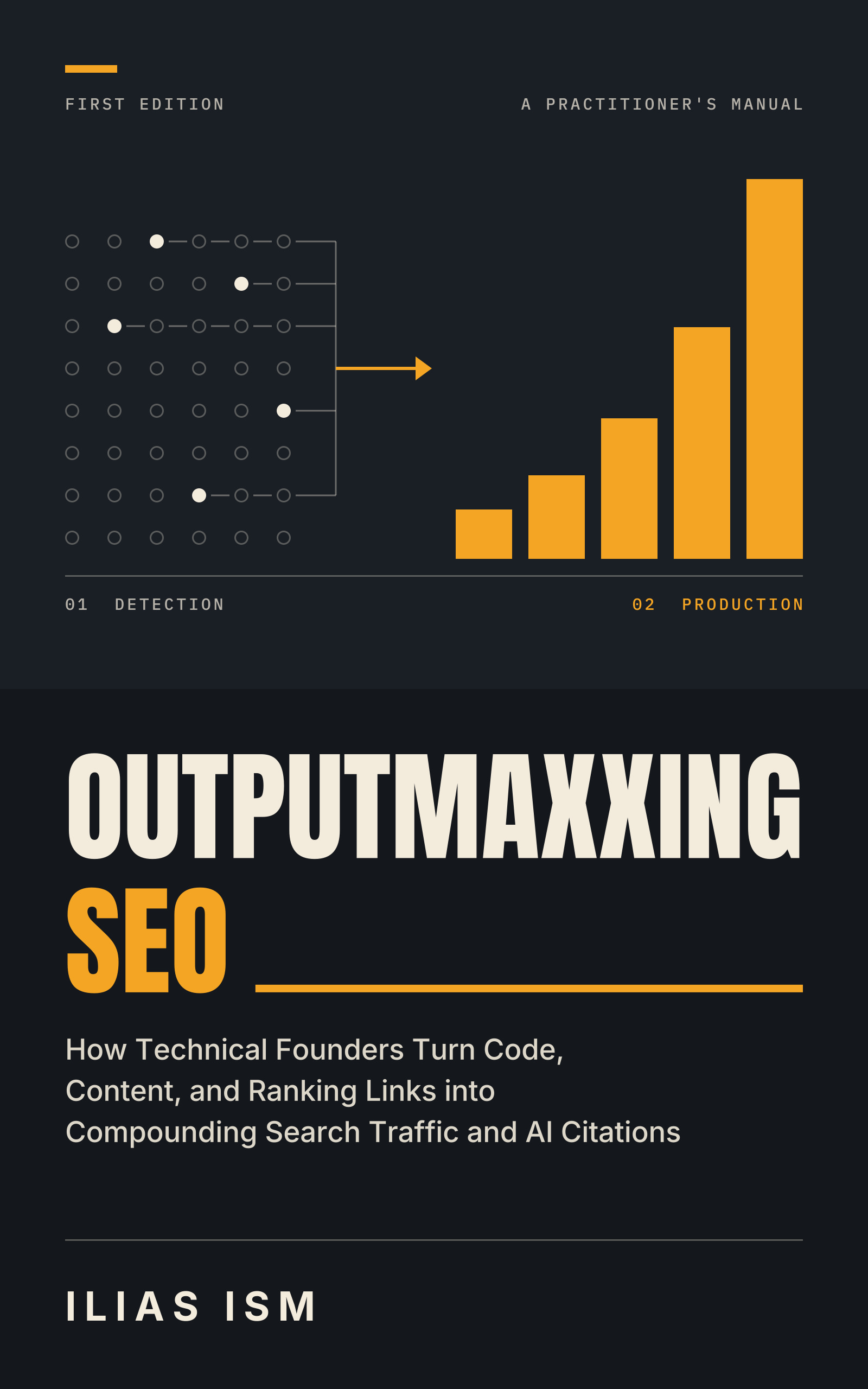
Outputmaxxing SEO
How Technical Founders Turn Code, Content, and Ranking Links into Compounding Search Traffic and AI Citations
By Ilias Ism, First Edition
A practitioner manual for technical founders who would rather merge a fix than read an audit. It treats organic search as software engineering: triage what blocks revenue, build the pages buyers search for, earn links from pages that already rank, and get cited by AI answer engines, with every step ending in something shipped.
Store links for Google Play Books, Kindle, and paperback go here when the listings are live. Until then, every chapter below links to an essay or skill you can read now.
What’s inside
The outputmaxxing test
One question to ask of every SEO task and tool: after this step runs, what exists in the world that did not exist before? If the answer is a report, cut it.
Triage in the repo
A four-tier triage (Fatal, Revenue, Compounding, Fluff) that fixes crawl and rendering blockers as pull requests before anyone touches alt text.
Pages that convert
Comparison pages, alternatives pages, and data-backed programmatic templates built on first-hand proof that both Google and AI answers can quote.
Ranking-page links
Why Domain Rating misleads, how to find pages that already rank for your buyer query, and how to pitch authors like a human operator.
Entities and SEO as code
Entity homes, Schema.org graphs, and deterministic SKILL.md workflows that let Claude Code, Cursor, and Codex ship SEO work every week.
Table of contents
10 chapters. Each one points to live essays and skills on the same subject.
- 01
Detection Doesn't Pay, Production Does
Finding out what is wrong with a website used to cost thousands because diagnosis was hard. Coding agents made diagnosis cheap, yet dashboards and audits still change nothing until somebody ships the fix. A controlled look across a live software portfolio shows why tools and workflows that produce finished outputs win.
- 02
Triage Before Aesthetics: Fatal, Revenue, Compounding, Fluff
Most technical audits bury one fatal indexing bug under eighty cosmetic warnings. Sort every issue into four buckets (Fatal, Revenue, Compounding, and Fluff), verify raw server HTML before trusting browser devtools, and merge the blocking pull requests the same afternoon.
- 03
Bottom-of-Funnel First: Comparisons, Alternatives, and Buyer Hubs
Start where buyers already have a card out. Build comparison pages, alternatives hubs, and use-case pages grounded in real product receipts, honest trade-offs, and live SERP intent before writing top-of-funnel glossary articles.
- 04
Programmatic SEO Without Thin Slop
When one template deserves five hundred pages and when it earns sitewide deindexing. How to pair proprietary data or interactive tools with programmatic routes so every generated URL satisfies a distinct query.
- 05
Blitz SEO: Moving Money Pages from Page Two to the Top Three
Pages sitting in positions four through fifteen already passed Google relevance checks and generate zero revenue. Run a focused 30-day sprint on one money page: tighten title click-through, close subtopic gaps, route internal links, and earn targeted placements.
- 06
Why Domain Rating Lies and Ranking Pages Win
Domain Rating scores a root domain, not the orphan URL your link sits on. Evaluate link prospects by whether the specific page ranks in Google, holds real keyword positions, and sends referral buyers today.
- 07
Outreach That Sounds Like a Human Operator
Editors delete templated flattery in half a second. Find the actual author of a ranking listicle or guide, write a four-sentence plain-text note, price placements rationally when editors charge editorial fees, and verify live anchors over time.
- 08
Getting Cited in AI Search and Answer Engines
ChatGPT, Perplexity, and Google AI Overviews ground their answers in live web retrieval. How third-party listicles, quotable fact blocks, and Reddit threads feed answer synthesis, and how to measure citation share on commercial prompts.
- 09
Entity Homes and Knowledge Graph Engineering
Search engines and language models resolve people, companies, and books as entities before they trust claims about them. Architect a canonical entity home, stable @id JSON-LD graphs, bidirectional sameAs corroboration, and book catalog seeds.
- 10
SEO as Code: Deterministic Skills for Coding Agents
Turn every playbook in the book into deterministic SKILL.md files inside your repository. Chain live SERP data, proof bases, anti-slop gates, and human approval checkpoints so coding agents ship compounding search assets every week.