
- New evaluations are 30-day one-time purchases, not monthly subscriptions. Since 1 March 2026, you get 30 calendar days to hit the profit target, $3,000 on a 50K against a $2,000 drawdown, with no minimum trading days and no resets if you fail.
- You choose between Intraday and EOD trailing drawdown at checkout. A 50K Intraday evaluation costs $249 list and trails open profit tick by tick, while the $590 EOD version only updates your floor at the 4:59:59 p.m. ET close.
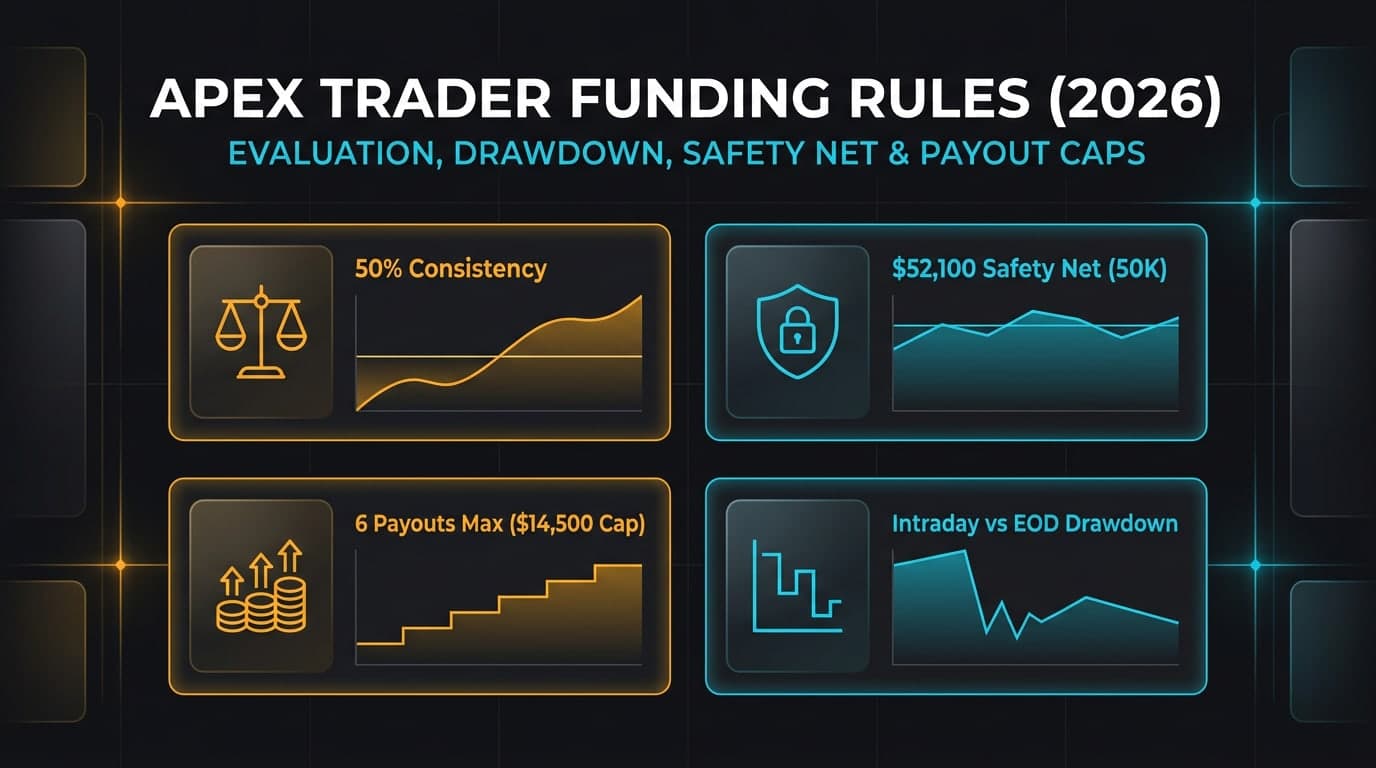
- Funded accounts pay 100% and close after six payouts. Every withdrawal requires five qualifying days, a 50% consistency check and a balance above the $52,100 safety net on a 50K, and the account shuts down after payout number six at $14,500 max on 50K Intraday or $13,000 on EOD.
- Legacy accounts are back on sale for a limited time. Most blogs still quote the pre-March 2026 rules with 30% consistency, monthly billing and uncapped payouts after the fifth, and Apex has temporarily re-listed those legacy plans alongside the new ones.
Almost every Apex Trader Funding guide ranking on Google is describing an account Apex stopped selling as its main line on 1 March 2026. On that date, Apex scrapped its monthly recurring subscriptions, 8-day payout cycles, 30% consistency rule and uncapped sixth-plus withdrawals. In their place, it launched one-time 30-day evaluations, a choice between intraday and end-of-day trailing drawdown, a 50% funded consistency gate and a hard ceiling of six payouts per funded account before the account permanently closes.
To make things more confusing, Apex left several old marketing pages live and later put its legacy monthly plans back on sale as a limited-time offer. Below is the complete 2026 rulebook for Apex's current 25K, 50K, 100K and 150K accounts, how they differ from the legacy line, and where Apex's own help center contradicts its sales pages.
Rules by account size
Apex's current line comes in four account sizes, and each size is sold in either an Intraday Trail or an EOD Trail version across Rithmic, Tradovate and WealthCharts at the same list price.
| 25K | 50K | 100K | 150K | |
|---|---|---|---|---|
| Profit target | $1,500 | $3,000 | $6,000 | $9,000 |
| Max drawdown | $1,000 | $2,000 | $3,000 | $4,000 |
| Daily loss limit, EOD evaluation | $500 | $1,000 | $1,500 | $2,000 |
| Contracts in the evaluation | 4 minis / 40 micros | 6 minis / 60 micros | 8 minis / 80 micros | 12 minis / 120 micros |
| Intraday Trail price | $167 | $249 | $790 | $1,190 |
| EOD Trail price | $490 | $590 | $1,190 | $2,190 |
| Activation, Intraday / EOD | $89 / $109 | $99 / $129 | $129 / $129 | $149 / $159 |
| Contracts once funded, start to max | 1 to 2 | 2 to 4 | 3 to 6 | 4 to 10 |
| Qualifying day, Intraday / EOD | $100 / $100 | $200 / $250 | $250 / $300 | $300 / $350 |
| Safety net | $26,100 | $52,100 | $103,100 | $154,100 |
| Balance needed to request a payout | $26,600 | $52,600 | $103,600 | $154,600 |
Notice how the 50K sits in the sweet spot of Apex's pricing table. Stepping up from a 50K to a 100K doubles your profit target from $3,000 to $6,000 and more than triples the Intraday list price from $249 to $790, yet only gives you $1,000 of extra drawdown room. Also pay attention to the last two rows: because you can only withdraw profit above the safety net and the minimum withdrawal is $500, a funded 50K needs $2,600 in profit before you can take your first dollar out.
Apex trades futures only: CME, CBOT, NYMEX and COMEX equity, currency, agricultural, energy, metal, micro and micro crypto contracts such as MBT and MET, plus Eurex contracts such as FDAX, FESX and Bund on Tradovate (about Apex). You can check a week of your own trades against these drawdowns in the prop firm drawdown calculator.
What changed on 1 March 2026
Apex stopped selling its old line as its standard offering on that date: "As of March 1st, 2026, these prior versions are no longer available for purchase" (legacy overview). If a blog post or YouTube video mentions a 30% consistency rule or 100% of the first $25,000, it is describing a legacy account.
| Rule | Legacy accounts | Accounts sold since 1 March 2026 |
|---|---|---|
| Billing | Monthly subscription | One-time fee, 30 days of access |
| Resets | Sold | None. You rebuy after a fail or expiry |
| Drawdown | Intraday trailing | Intraday trailing or end-of-day trailing |
| Drawdown on a 50K | $2,500 | $2,000 |
| Contracts on a 50K evaluation | 10 minis | 6 minis |
| Daily loss limit | None | On the EOD evaluation and on every funded account |
| Consistency | 30% | 50% |
| Profit split | 100% of the first $25,000, then 90% | 100% |
| Days per payout | 8 trading days, 5 of them at $50 or more | 5 qualifying days at $100 to $350 by size |
| Payout caps | Capped for the first 5 payouts, none from the 6th | 6 payouts, then the account closes |
The March 2026 overhaul made the first five payouts easier to reach by loosening consistency from 30% to 50%, cutting the payout cycle from 8 trading days to 5 qualifying days, and adding an EOD drawdown option. In exchange, Apex killed the uncapped upside that used to start on payout number six and cut the 50K drawdown buffer from $2,500 to $2,000. Apex's homepage also says the new accounts drop the old 30% negative P&L Maximum Adverse Excursion (MAE) rule and the 5:1 risk-reward rule, though a notifications article still lists MAE penalties, which is why that conflict is in the contradictions section below.
Although Apex's legacy overview states that legacy evaluations are "no longer available for purchase to anyone", its legacy products page later put them back on sale as a limited-time offer starting from $177 a month. Double-check which version is in your cart before you pay.
Evaluation rules
The evaluation is a single step with zero minimum trading days and no consistency rule, which means one big trend day can pass the challenge outright. The catches are all around the clock and what happens if you fail:
- 30 calendar days. Your access ends at 6:00 p.m. ET on day 30 with no extensions (fees and access).
- No consistency rule during the evaluation. The 50% rule only kicks in once you're funded.
- No resets and no refunds. If you breach the drawdown or let the 30-day clock expire, the evaluation is dead and you have to buy a new one (refund policy).
- Seven days to activate. Once you pass, the system locks your evaluation after 6:00 p.m. ET so you can't accidentally trade it back below the target, and gives you 7 calendar days to pay the one-time activation fee with no extension (activation deadline). If that was your only active evaluation, you also lose live market data until Apex provisions your funded account.
- No hedging across evaluations. Going long in one evaluation and short in another closes the accounts.
The Intraday evaluation has no daily loss limit at all. The EOD evaluation enforces one, set at $1,000 on a 50K, and hitting it liquidates your open positions and locks you out for the rest of the session without failing the account.
Intraday and end-of-day drawdown
Both versions give you the exact same dollar drawdown, $2,000 on a 50K, and they behave very differently once a trade goes into profit.
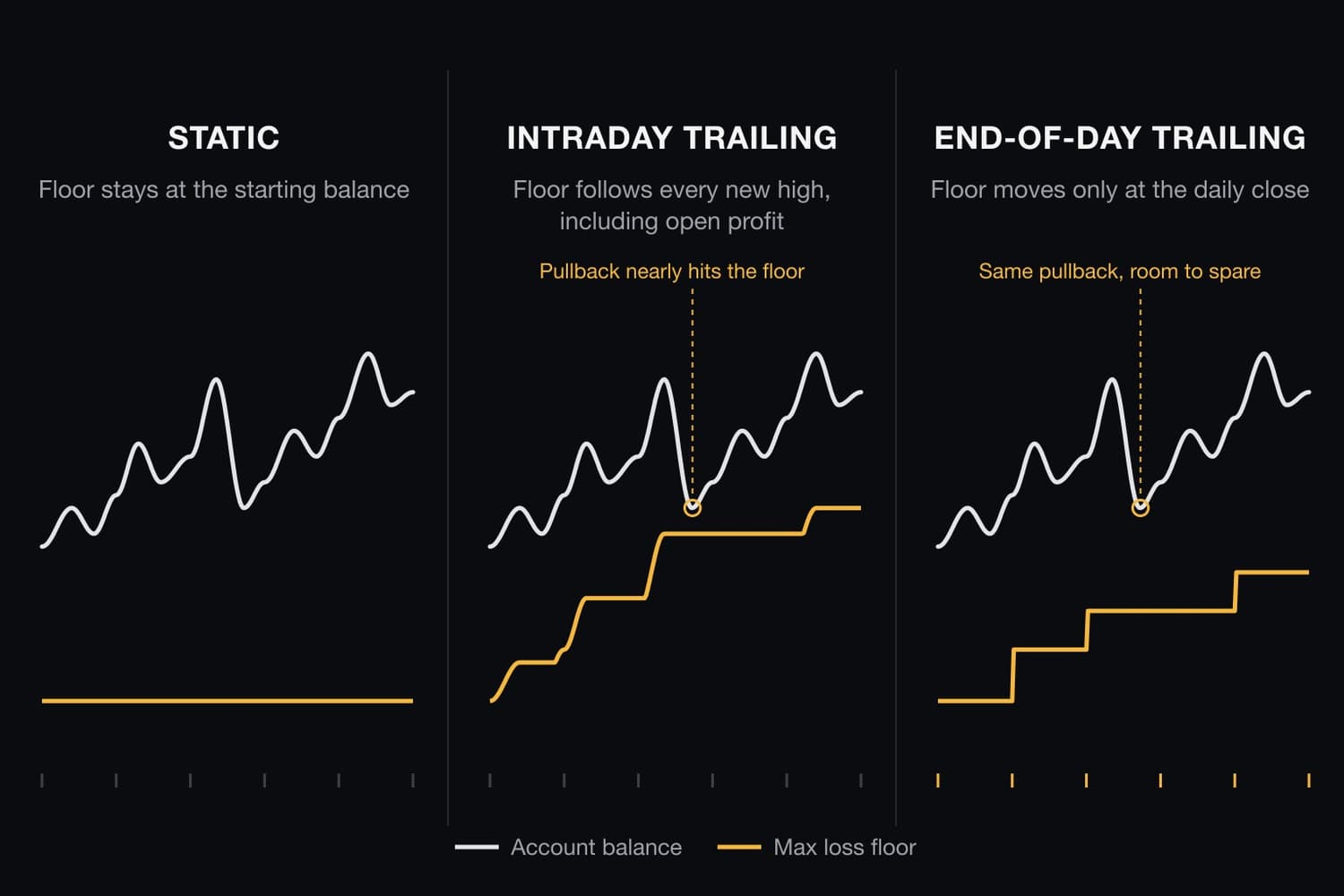
Intraday Trail follows your real-time peak equity, open profit included. In Apex's words, the threshold "adjusts upward immediately even if the position is not closed". If your trade on a fresh 50K runs up $1,300 in unrealized profit and pulls back to break-even, your drawdown floor has already moved up $1,300 to $49,300, leaving you with just $700 of room before liquidation.
EOD Trail only recalculates once a day at 4:59:59 p.m. ET based on your realized closing balance. That lets you hold through normal intraday pullbacks without shrinking your cushion, though Apex still enforces the current floor in real time during the session, open profit and loss included (EOD drawdown).
Where that trailing floor finally locks depends on both your stage and the platform you picked at checkout:
- Funded account, both types. The floor locks permanently at the starting balance plus $100. On a 50K that is $50,100, which locks as soon as your peak reaches $52,100.
- Evaluation on Rithmic or WealthCharts. It locks at the profit-target balance, $53,000 on a 50K, once your peak equity reaches $55,000. The FAQ on the same page words the rule as the target balance plus $2,000 and then gives the same $53,000 example.
- Evaluation on Tradovate. It never stops trailing during the evaluation, even on an EOD account.
Because you can't switch an account between Rithmic, Tradovate and WealthCharts after buying, your platform choice at checkout decides your evaluation drawdown lock, your charting front end and whether you can run natively on a Mac (choosing the right platform):
- Tradovate runs natively on Mac, Windows, web and mobile, connects to NinjaTrader 8, includes TradingView integration at no extra fee, and is the only Apex feed with Eurex contracts.
- Rithmic works with RTrader Pro, NinjaTrader, Sierra Chart, Quantower, ATAS, Bookmap, MotiveWave, Jigsaw, EdgePro X, Finamark, VolFix and DeepCharts (connection guides), and requires a Windows virtual machine on macOS.
Funded account rules
Apex calls its funded account a Performance Account, or PA. It is still a simulated account, and several rules tighten the day you activate it:
- Tiered daily loss limit. Even if you passed an Intraday evaluation that had no daily limit, your funded PA enforces an intraday daily loss limit that includes open losses and resets at 6:00 p.m. ET (Intraday PA rules). On a 50K it starts at $1,000 from $0 to $2,999 in profit, steps up to $2,000 from $3,000 to $5,999, and reaches $3,000 once you clear $6,000 in profit (daily loss limit).
- Contract scaling. You don't get your full evaluation size on day one. Tier levels update once a day from your 4:59:59 p.m. ET closing balance: a 50K starts at 2 contracts, moves to 3 at $1,500 in profit and unlocks its 4-contract max at $3,000. The platform automatically rejects oversized orders without failing you (scaling levels).
- Trading day. The session resets at 6:00 p.m. ET, and all positions must be flat before the 4:59 p.m. ET close.
- Inactivity. You must log at least two days with $50 or more net profit in every rolling 30-day window, or Apex closes the account with no reinstatement (inactivity policy).
- No bots. Apex bans automated trading and algorithms, requires a pending or mental stop on every trade, and forbids using your full drawdown threshold as that stop (prohibited activities).
- No opposite positions. You can't hold long and short positions on the same or a correlated instrument at the same time, across multiple accounts included. One-way copy trading across your accounts is allowed.
- News trading is allowed as part of a normal directional strategy, while straddling a release with bracket orders is banned.
You can hold up to 20 active funded accounts per household at once, counting legacy, EOD and Intraday accounts as well as personal and business profiles together. Evaluations are unlimited, but exceeding 20 funded accounts can cost you both payout eligibility and the accounts themselves (account limits).
Live graduation and the Bonus Vault. Apex reserves the right to move a trader from simulated PAs into its Live Prop Trading Program at any time (Live Prop Trading FAQ). When that happens, all of your simulated Performance Accounts close and their remaining balances move into a Bonus Vault that Apex explicitly states "is not real money, not real profits, not real gains, not live funds, and not a cash account." Your new live account starts at $0 with a $3,000 end-of-day drawdown, a 3-mini limit, a 90/10 profit split, and a cap of 5 live accounts. The Bonus Vault only unlocks as a 20% monthly bonus on live withdrawals, or 40% in the first month.
Payout rules
To unlock the withdrawal button on a funded account, you have to clear four separate gates from Apex's EOD payout page:
- Five qualifying days since your last approved payout. They don't need to be consecutive, and the daily profit threshold runs from $100 on a 25K to $350 on a 150K EOD.
- 50% consistency. Your largest profitable day must stay under 50% of your total net profit since the last approved payout. Losing days reduce the denominator because Apex measures net profit. If your best day is 50% or higher, the account stays open and the payout button stays locked until you add enough profit on other days (consistency).
- A balance above the safety net. The safety net equals your max drawdown plus $100 above the starting balance, which is $52,100 on a 50K, and stays in place for the life of the account. Because the minimum withdrawal is $500 and you cannot dip into the safety net on any request, a 50K must reach at least $52,600 before you can withdraw a cent.
- A request of $500 or more, up to the cap for that payout number.
If you trade on Tradovate, you must also meet the minimum balance in real time with zero open positions when you click submit.
Here is how those four gates work in practice. Say you trade a 50K Intraday account and book +$800, +$700, +$500, +$400 and +$300 across five sessions, giving you $2,700 in net profit and a $52,700 balance:
- Qualifying days: all five clear the $200 daily minimum.
- Consistency: your best day of $800 is about 30% of your $2,700 net profit, comfortably under the 50% cap.
- Balance: $52,700 clears the $52,600 minimum threshold.
- Requestable amount: only profit above the $52,100 safety net can be touched, so you can withdraw $600.
Now change day one to a $1,600 home run and the next four days to +$300, +$250, +$250 and +$200. Your balance is $52,600 for $2,600 in net profit and you have five qualifying days, yet your $1,600 best day is 61.5% of your net profit. The payout button stays locked until you grind total net profit past $3,200, or twice that $1,600 day. You can plug your own daily P&L into the prop firm calculator to see your exact consistency gap and withdrawable amount before requesting.
| Payout | 1 | 2 | 3 | 4 | 5 | 6 | Total |
|---|---|---|---|---|---|---|---|
| 25K, both types | $1,000 | $1,000 | $1,000 | $1,000 | $1,000 | $1,000 | $6,000 |
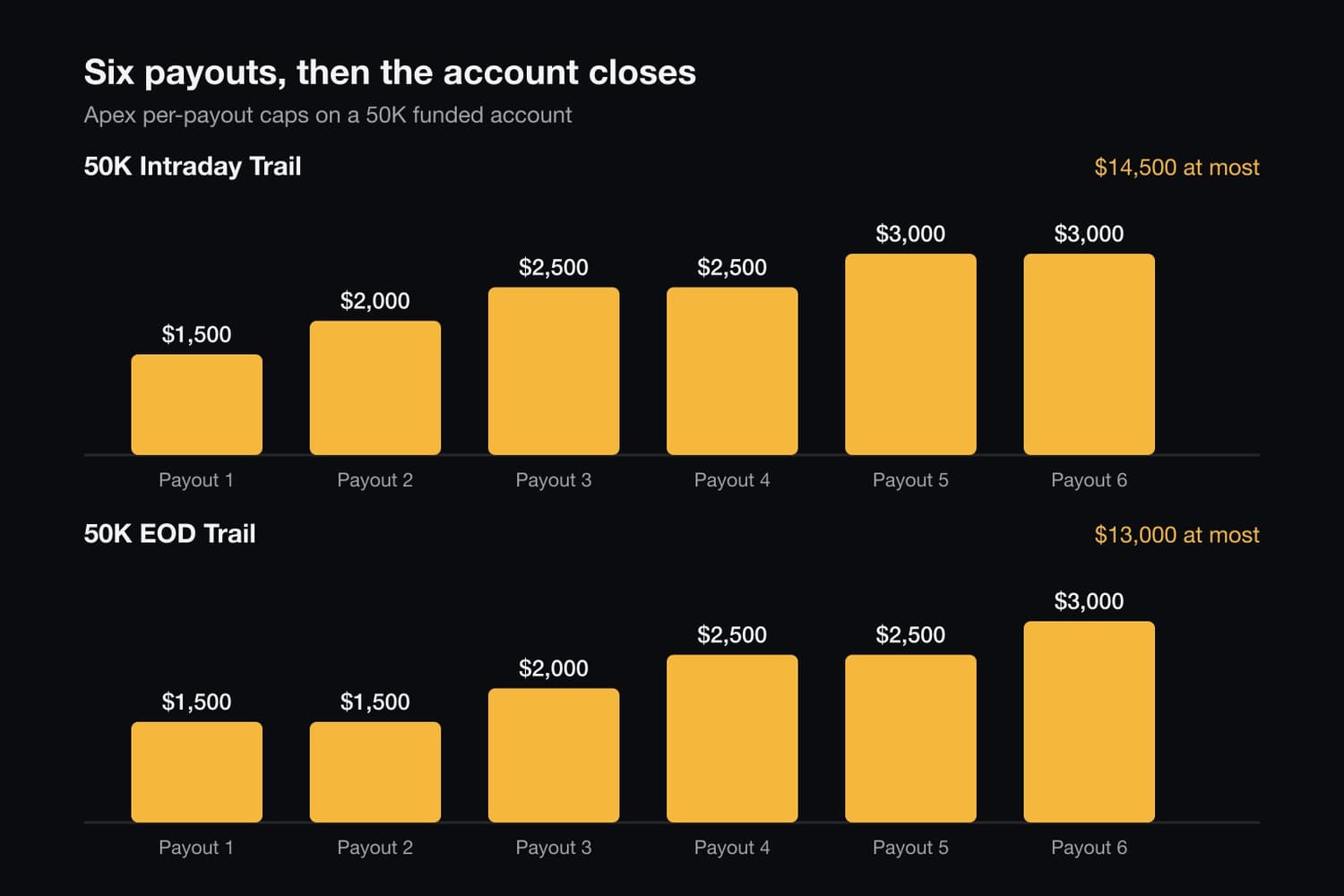
| 50K Intraday | $1,500 | $2,000 | $2,500 | $2,500 | $3,000 | $3,000 | $14,500 |
| 50K EOD | $1,500 | $1,500 | $2,000 | $2,500 | $2,500 | $3,000 | $13,000 |
| 100K Intraday | $2,000 | $2,500 | $3,000 | $3,000 | $4,000 | $4,000 | $18,500 |
| 100K EOD | $2,000 | $2,500 | $2,500 | $3,000 | $4,000 | $4,000 | $18,000 |
| 150K Intraday | $2,500 | $3,000 | $3,000 | $4,000 | $4,000 | $5,000 | $21,500 |
| 150K EOD | $2,500 | $3,000 | $3,000 | $3,000 | $4,000 | $5,000 | $20,500 |
That Total column is the hard lifetime ceiling for a single funded account. As soon as your sixth payout is approved, Apex closes the Performance Account and wipes any excess simulated balance still sitting in it, including the $2,100 safety net buffer. At list price, a 50K Intraday account costs $348 across the $249 evaluation and $99 activation for a maximum possible return of $14,500 before you have to buy and pass a brand-new evaluation. Apex doesn't disclose what share of funded accounts ever reach payout number six.
How you get paid. US traders receive ACH transfers to a US bank account in their own name and get a Form 1099 at tax time (US payouts). International traders get paid through Plane to a local bank in their declared country of residence after verifying with a physical passport or government ID, and Apex issues no tax forms to non-US users (international payouts). Keep your entity structure clean: a personal user profile can never withdraw to a business bank account, and a business profile can never withdraw to a personal bank account (registering as a person or business). Apex dropped Wise and Deel (dashboard FAQ). It quotes up to 2 business days for internal review, 3 to 4 business days to send, and 3 to 7 business days for bank processing, noting that most traders receive funds within 5 to 11 business days total with no Apex payout fee (payout methods).
Be careful trading while a withdrawal is pending: if your account balance drops below the minimum required balance after you submit a request, Apex automatically denies the payout, though your account remains open (requesting a payout).
Fees
- Evaluation. One-time purchase from $167 to $1,190 for Intraday and $490 to $2,190 for EOD at list price. Level 1 market data, listed as a $55 value, and a NinjaTrader licence, listed as a $75 value, are included on Rithmic and Tradovate (fees and access).
- Activation. One-time payment of $89 to $159 once you pass. Promo codes never apply to activation fees.
- No Activation Fee version. A higher up-front evaluation with a $0 activation fee: $690, $799, $999 and $1,890 for Intraday from 25K to 150K, and $1,090, $1,190, $1,590 and $2,490 for EOD (no activation fee).
- 5-packs. Five evaluations of the same size and type bought in one order that trade independently and share one 30-day clock from the purchase date (5-pack). The help-center article prints no dollar prices and tells buyers to check the homepage product selector. On 8 October 2026 the selector listed 50K Standard 5-packs at $950 for Intraday and $2,450 for EOD, plus $749.50 / $2,250 on a 25K, $3,450 / $4,950 on a 100K, and $4,950 / $9,950 on a 150K. By 14 October the 50K Standard 5-pack list prices had dropped by half to $475 for Intraday and $1,225 for EOD, with 50K No Activation Fee 5-packs at $3,450 for Intraday and $5,450 for EOD.
- Coupons. Apex runs promo codes almost year-round (coupon page). They discount the evaluation fee only, never the activation fee, and all prices in this guide are pre-coupon list prices.
- Data add-ons. Depth of market costs extra through the platform. Rithmic DOM expires at month-end and does not auto-renew, whereas Tradovate and WealthCharts data add-ons must be cancelled directly with the vendor. Traders classed as professional pay at least $115 a month for CME data.
- Commissions come straight out of your simulated balance on every fill. ES or NQ costs $1.99 per side on Rithmic and $1.55 on Tradovate or WealthCharts, while micro MNQ costs $0.51 per side on Rithmic and $0.52 on Tradovate or WealthCharts (Rithmic commissions, Tradovate commissions, WealthCharts commissions).
- Payment. Visa, Mastercard or Discover in your own name. Apex rejects Amex, crypto and prepaid gift cards (payment methods).
Because an active coupon can slash the evaluation price by 50% to 80%, always check the live coupon on Apex's homepage before comparing total costs across firms.
Where Apex's own pages disagree
When Apex rewrote its help center for the March 2026 overhaul, it left several older marketing and support pages live. Today those pages directly contradict the current rulebook:
- Profit split. The How it works page still says "Receive 100% of the first $25,000 per Account and 90% Beyond That". The current funded-account help pages say 100% with no tier.
- Payout caps. That same How it works page advertises "No Total Cap on Maximum Payouts", while the payout help pages cap each funded account at six payouts and permanently close it.
- Daily drawdown. It also claims "No Daily Drawdowns", even though the EOD evaluation and every new funded account enforce a daily loss limit.
- Payout cycle. The payout methods article still quotes the legacy cycle of eight trading days with five at $50+, whereas the current payout pages require five qualifying days at $100 to $350.
- 5-pack prices and hidden catalog fields. The help-center 5-pack article, last modified 5 June 2026, prints no prices and directs buyers to the homepage selector. Between 8 October and 14 October 2026, the 50K Standard 5-pack list price in that homepage catalog dropped by half, from $950 to $475 for Intraday and from $2,450 to $1,225 for EOD. The same homepage
productPickerConfigJSON also carries hidden legacy fields on new evaluations, including a 1-month renewal cycle, a $60 reset fee, 30% consistency, and a $2,000 first-payout cap on the 50K EOD. - Deel. An Apex news article states that the dashboard pushes payout trade data to Deel, while the dashboard help article states Apex no longer uses Wise or Deel.
- "No Payout Denials." The homepage banner promises it, while the help center details automatic payout denials and a notifications article outlines payout suspensions and profit removal.
- MAE rule. The homepage says the new accounts have none, yet a notifications article updated on 31 July 2026 still says its penalties apply to "all trading violations, including Scaling and Maximum Adverse Excursion (MAE)".
- Who it is for. The terms of use state that the program is "intended for United States users", even though the site markets to more than 100 countries and runs an international payout rail through Plane.
Whenever two Apex pages conflict, compliance will enforce the help-center article for your exact product tier. Screenshot the rule you rely on before you buy.
Canada and other countries
Canada isn't on Apex's restricted list. Canadians can't open a live Tradovate account, but evaluations and funded accounts are simulated, so that doesn't block them (restricted countries). Payouts go through Plane to a Canadian bank in your name.
Apex lists 87 restricted countries. Paying with a card from one of them is grounds for immediate termination, even if the card is declined. You also can't buy, trade or request a payout while you are physically in one, or use a VPN, proxy server or cloud server to mask your identity or location. For ID verification, Apex accepts only a physical passport, driver's licence, state ID or residency permit, and rejects copies, digital IDs and photos of a screen.
Is Apex worth it
Apex is cheap to try with a coupon, pays 100%, and lets you run 20 accounts. Against that, each account closes after six payouts, payouts take 5 to 11 business days, and there are no resets or refunds.
I rated Apex 3.5 out of 5, the lowest of four firms, in best prop trading firms. Topstep's end-of-day drawdown and published pass data scored higher, and the two are compared rule by rule in Apex vs Topstep. Apex doesn't publish a current pass rate; see prop firm pass rates for the numbers other firms disclose.
Disclosure: that link goes through an il.ly/go/ redirect to Apex's own site. It carries no referral code today. If I join Apex's affiliate program, it will, and I may earn a commission.
Apex rules FAQ
What is the Apex consistency rule?
On accounts sold since 1 March 2026 it is 50%. Your largest profitable day must be under half of your net profit since the last approved payout. It applies to the funded account only, and it blocks a payout instead of failing the account. Legacy accounts use 30%.
How many days do I need for an Apex payout?
Five qualifying days per payout. A day qualifies at $200 or more on a 50K Intraday account and $250 on a 50K EOD account. Legacy accounts need eight trading days with five at $50 or more.
Does Apex still pay 100% of the first $25,000?
Only on legacy accounts. New funded accounts pay 100% of every approved payout, with a cap per payout and six payouts per account.
Can you reset an Apex evaluation?
Not on the accounts sold since 1 March 2026. You have to buy a new evaluation if yours fails or expires.
Can you pass an Apex evaluation in one day?
Yes. The current evaluations have no minimum trading days and no consistency rule, so one day at the profit target passes.
Does the Apex trailing drawdown ever stop?
On a funded account it stops at the starting balance plus $100. In an evaluation it fixes at the target balance on Rithmic and WealthCharts, and never stops on Tradovate.
Is the Apex activation fee monthly?
No. It is one payment per funded account, $99 on a 50K Intraday and $129 on a 50K EOD.
Why was my Apex payout blocked?
The usual gates are fewer than five qualifying days, a best day at 50% or more of net profit, a balance under the safety net plus $500, or a balance that fell below the minimum after you submitted the request.
Does Apex still sell 250K and 300K accounts?
Not in the current line, which stops at 150K. They exist as legacy accounts, which Apex re-listed for a limited time at $697 and $797 a month.
How long does an Apex payout take?
Apex states 5 to 11 business days in total: up to 2 business days for review, 3 to 4 to send, and 3 to 7 for bank processing.